
Table of contents
- How AI sales coaching works: Insights for sales leaders
- Conversation intelligence: Enhancing rep-customer interactions
- Real-time transcription, coaching, and scoring
- CRM integration: fueling data-driven coaching
- Role-play simulations and personalized practice sessions
- Final thoughts: Why sales leaders are prioritizing AI coaching
How AI sales coaching works: Insights for sales leaders
In an era of digital selling and data-driven decisions, AI-powered sales coaching has emerged as a game changer. For SDR managers, sales ops leaders, and directors of sales, the stakes are high. Sales cycles are growing more complex, buyer expectations are soaring, and productivity gaps can significantly impact revenue. To keep up, organizations are turning to AI to equip reps with real-time feedback, drive consistent coaching, and maximize performance.
A 2024 report found that revenue organizations using AI recorded 29% higher sales growth than their peers not using AI [1]. Here’s a breakdown of how AI sales coaching works and the ways it drives results across sales organizations.
Conversation intelligence: Enhancing rep-customer interactions
Conversation intelligence uses AI to analyze sales calls and identify performance patterns. This enables sales leaders to drive consistent improvements across the team. Here’s how it works:
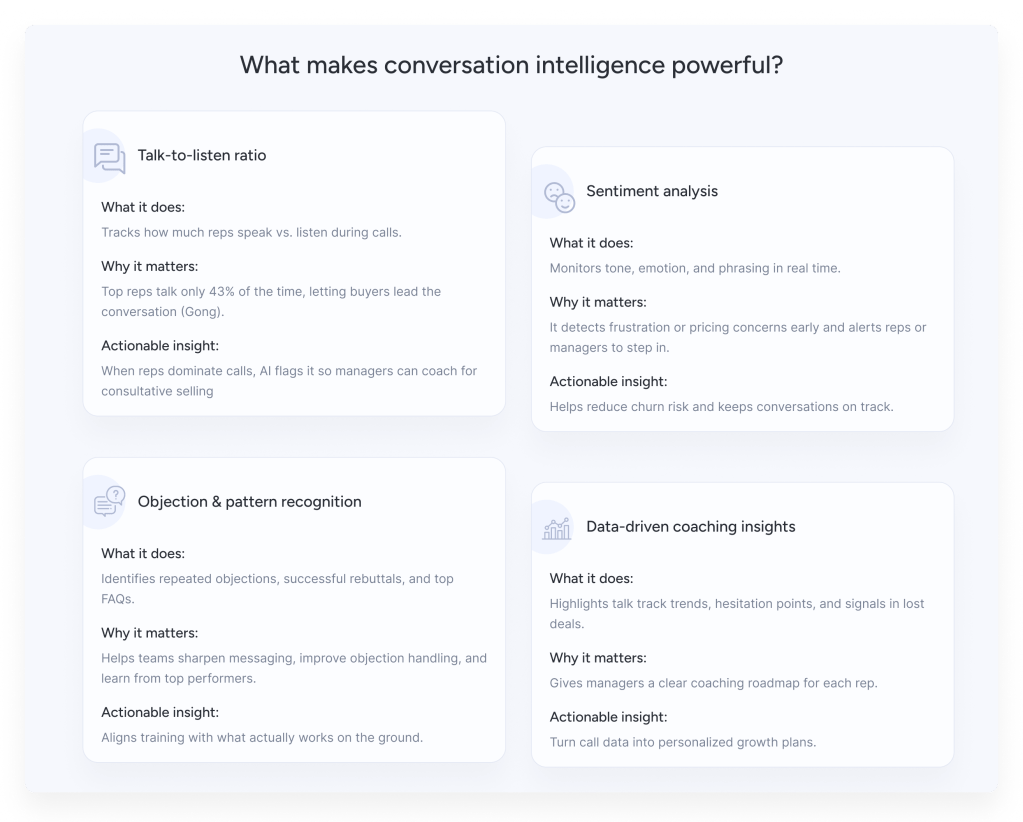
- Talk to listen ratio tracking: AI tracks how much time reps spend talking versus listening. Gong’s analysis shows that reps who win deals speak only 43% of the time, compared to 57% for buyers [2]. When reps dominate the conversation, AI flags these moments and helps managers coach toward more consultative conversations.
- Sentiment analysis: AI assesses tone, emotion, and phrasing in real time. If a customer’s sentiment turns negative due to frustration or pricing concerns, the system alerts the rep or manager to take corrective steps [3]. This helps reduce churn risk and keeps conversations productive.
- Objection and pattern recognition: AI uncovers recurring objections, successful rebuttals, and frequently asked questions. This allows sales teams to refine messaging, improve objection handling, and keep discovery conversations aligned with what top performers do best.
- Data-driven coaching insights: By identifying trends in talk tracks, hesitation points, or dropped deals, AI provides managers with a clearer roadmap to coach individual reps more effectively.
These capabilities collectively lead to significant gains. Companies using conversation intelligence report a 50% increase in win rates and a 19% reduction in sales cycle length [4].
Real-time transcription, coaching, and scoring
AI enables managers to scale call reviews and deliver faster, more effective feedback through a combination of transcription, analysis, and scoring technologies:
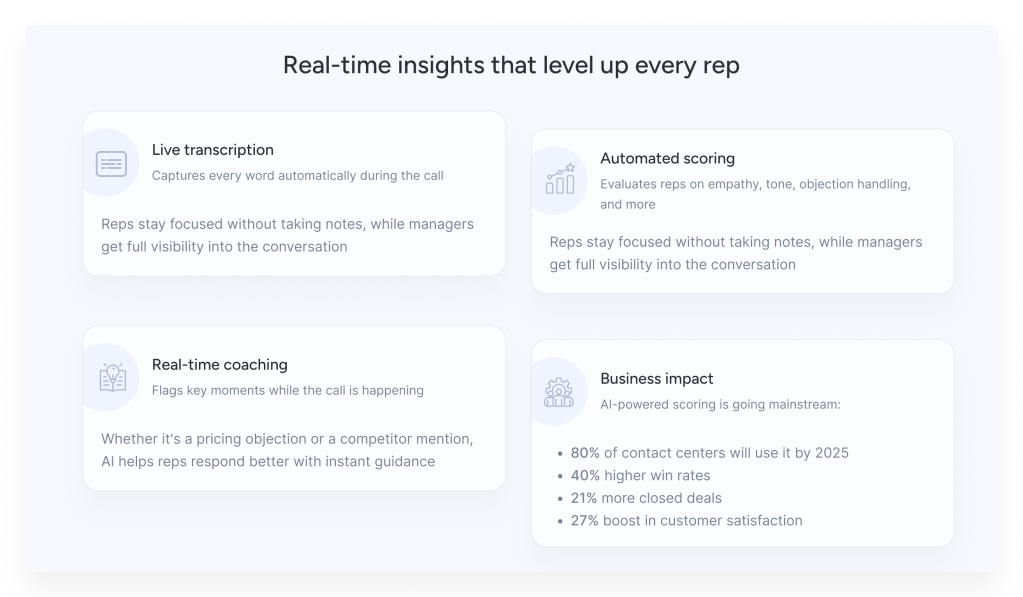
- Live transcription: Automatically captures every word spoken during a sales call, eliminating the need for reps to take manual notes. This allows reps to stay focused on the conversation and ensures that managers have complete visibility into call content.
- Automated scoring: AI evaluates reps across key performance dimensions such as empathy, product knowledge, objection handling, and tone. While traditional QA teams typically review only 2% of calls, AI allows for analysis of up to 100%, making coaching more consistent and data-driven [5].
- Real-time coaching: During live calls, AI can instantly flag key moments such as when a rep encounters a pricing objection or a competitor is mentioned. This enables managers or the platform to deliver coaching guidance while the call is still in progress and helps reps adjust and respond more effectively.
- Business impact: The adoption of AI in call scoring is growing rapidly. By 2025, 80% of contact centers are expected to leverage AI scoring systems [5]. Organizations already using these tools report a 40% increase in win rates [6], a 21% rise in closed deals, and a 27% boost in customer satisfaction [7].
CRM integration: fueling data-driven coaching
Integrating AI coaching with CRM platforms enables a more intelligent, contextual, and efficient sales coaching workflow. When sales activities and conversation intelligence are embedded directly into the CRM, managers and reps can take timely action based on accurate, real-world insights.
- Contextual coaching: AI pulls from CRM data such as deal stage, contact history, and buyer personas to deliver tailored coaching prompts. For instance, if a high-value deal stagnates in the pipeline, AI may suggest personalized outreach or a specific case study to re-engage the buyer.
- Actionable insights: When a prospect raises concerns such as pricing, competition, or internal delays, AI can automatically assign follow-up tasks or trigger relevant email templates. This ensures that reps take the right next steps without delay, increasing the odds of moving deals forward [8].
- Advanced reporting and analytics: CRM-integrated AI dashboards show trends in rep behavior, coaching effectiveness, and pipeline progression. Managers can track rep improvement over time and identify patterns that separate top performers from the rest.
The results are hard to ignore. AI-enhanced CRMs have contributed to a 15% increase in sales revenue and a 10% improvement in customer retention [9]. Administrative work has been cut by 70%, and some teams have achieved a 75% improvement in coaching efficiency and a 22% drop in rep attrition [10][11].
Role-play simulations and personalized practice sessions
Sales success depends on practice, but traditional role-plays can be inconsistent and hard to scale. AI-powered simulations provide a smarter, more reliable way for reps to sharpen their skills.
- Realistic scenarios: Reps engage in lifelike conversations that simulate real buyer situations, ranging from discovery questions to pricing pushback. These sessions let reps test strategies and build confidence in a no-risk environment.
- Instant feedback: After each simulation, the system evaluates delivery, tone, pacing, and content. Reps receive specific suggestions they can act on immediately to improve their performance.
- Personalized improvement paths: AI tracks rep progress over time and pinpoints weak areas. Based on this, it recommends targeted exercises, relevant playbooks, or short training modules, saving managers time while keeping coaching relevant.
The results speak for themselves. Teams using AI simulations have seen onboarding times drop by 70%, realized a 7 to 15x return in just one year [12], helped 17% more reps hit quota, and lowered new hire attrition by 40% [13]. Reps are actively engaging too, with 74% participating every two weeks and 82% achieving high reliability scores in skill assessments [14].
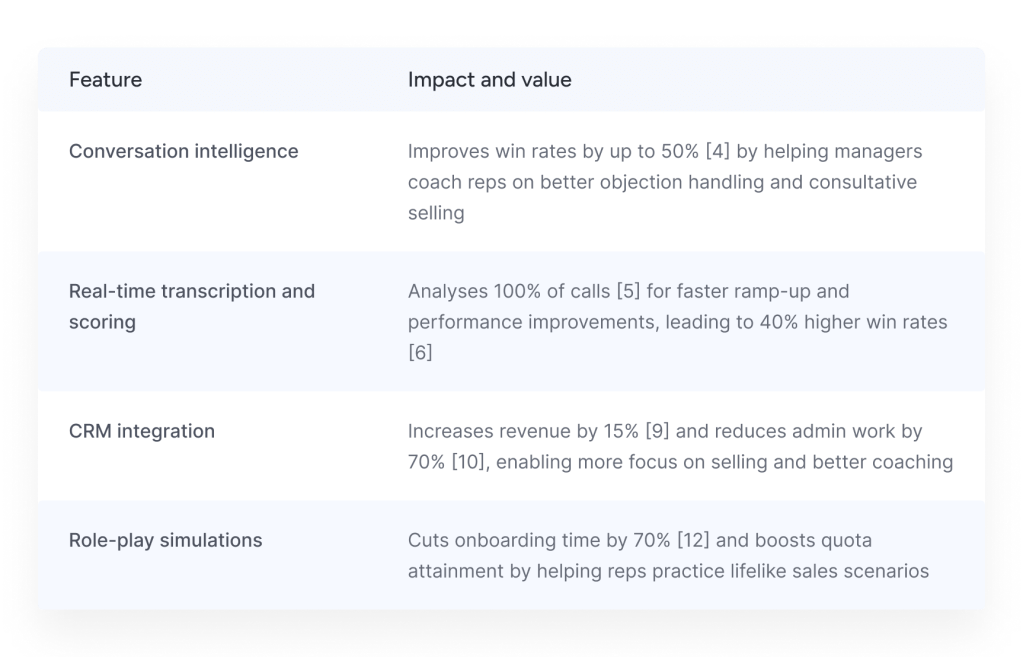
AI sales coaching significantly improves sales performance by enhancing key areas. It boosts win rates by up to 50% through better coaching, improves ramp-up and performance with real-time call analysis, and increases revenue by 15% while cutting admin work by 70% via CRM integration. Role-play simulations further accelerate onboarding and quota attainment by providing lifelike practice scenarios.
Final thoughts: Why sales leaders are prioritizing AI coaching
AI sales coaching is more than a trend. It’s a strategic necessity. By embedding real-time guidance, personalized development, and data-driven coaching into daily workflows, sales leaders can accelerate performance and improve team consistency.
Organizations that embrace AI coaching are gaining:
Organizations that embrace AI coaching are gaining:
- A consistent pipeline of skilled reps coached with data-backed precision
- Shorter ramp times, higher rep engagement, and stronger retention
- More predictable revenue outcomes with less dependency on manual oversight
- Actionable insights from real conversations, scaled across entire teams
As technology continues to evolve, now is the time to invest in systems that build better reps, close more deals, and create winning teams at scale.
Sources:
[1] https://www.prnewswire.com/news-releases/revenue-organizations-using-ai-in-2024-reported-29-percent-higher-sales-growth-than-their-peers-according-to-new-report-from-gong-302312896.html

[2] https://www.gong.io/resources/labs/talk-to-listen-conversion-ratio/

[3] https://www.kixie.com/sales-blog/how-to-leverage-sentiment-analysis-in-sales-calls-with-ai/

[4] https://www.outreach.io/resources/blog/conversation-intelligence

[5] https://callcriteria.com/ai-powered-call-scoring/

[6] https://www.avoma.com/

[7] https://convin.ai/blog/ai-sales-call-coaching

[8] https://www.salesforce.com/sales/conversation-intelligence/

[9] https://www.repordermanagement.com/blog/ai-boosts-sales-efficiency/

[10] https://persana.ai/blogs/crm-integration-for-ai-sales-agents

[11] https://www.dialpad.com/ai/

[12] https://www.retorio.com/blog/what-is-ai-sales-training-software

[13] https://www.retorio.com/blog/what-is-ai-sales-training-software

[14] https://www.eubrics.com/success-stories/
 Outscale.ai