
Sales coaching metrics that actually matter: Going beyond call scores and win rates
In B2B SaaS sales, effective coaching is one of the highest-leverage activities a leader can invest in. Yet many teams still rely on outdated indicators like call scores and win rates, metrics that often miss the deeper story behind rep performance.
According to research, while 82% of teams track win rates, only 23% truly understand what drives their sales success [1]. And with only about 1% of calls reviewed by managers [2], it’s clear the coaching signal is getting lost in the noise.
This article explores the new wave of coaching metrics that offer clarity, actionability, and predictive power—metrics that help SDR Managers, RevOps leaders, and VPs of Sales actually move the needle on revenue and rep development.
The limits of call scores and win rates
Traditional metrics are easy to track, but rarely tell the whole story:
- Win rates are misleading: Win rate only reflects whether a deal was won or lost. It does not account for deal value, extended sales cycles, or external market forces. Teams may celebrate wins while missing the fact that average deal size is shrinking or that the cost of acquisition is increasing [3].
- Human-evaluated call scores lack scale and nuance: Call evaluations are often based on subjective judgment and are prone to inconsistency across reviewers. Managers typically listen to fewer than 1% of recorded calls [2], making these evaluations unscalable. Furthermore, manual reviews often focus on checklists or script compliance rather than real buyer engagement. For instance, a rep may receive a high score for sticking to the script, even if the buyer shows little interest or pushes back without being addressed effectively [4]. These methods overlook subtle, yet crucial cues such as buyer hesitation, tone, and objections.
“Traditional call quality scores are too broad and disconnected from real buyer outcomes.” — Voiso, Sales Metrics Analysis [3]
Key takeaway: Metrics like win rate and call score are lagging, surface-level indicators. They don’t uncover skill gaps, learning curves, or deal risks early enough to drive proactive coaching.
Core metrics that matter: Rep progression, behaviour change, and learning velocity
Modern sales coaching focuses on measuring growth and adaptability, not just outcomes. These three metrics form the foundation of a more effective coaching strategy:
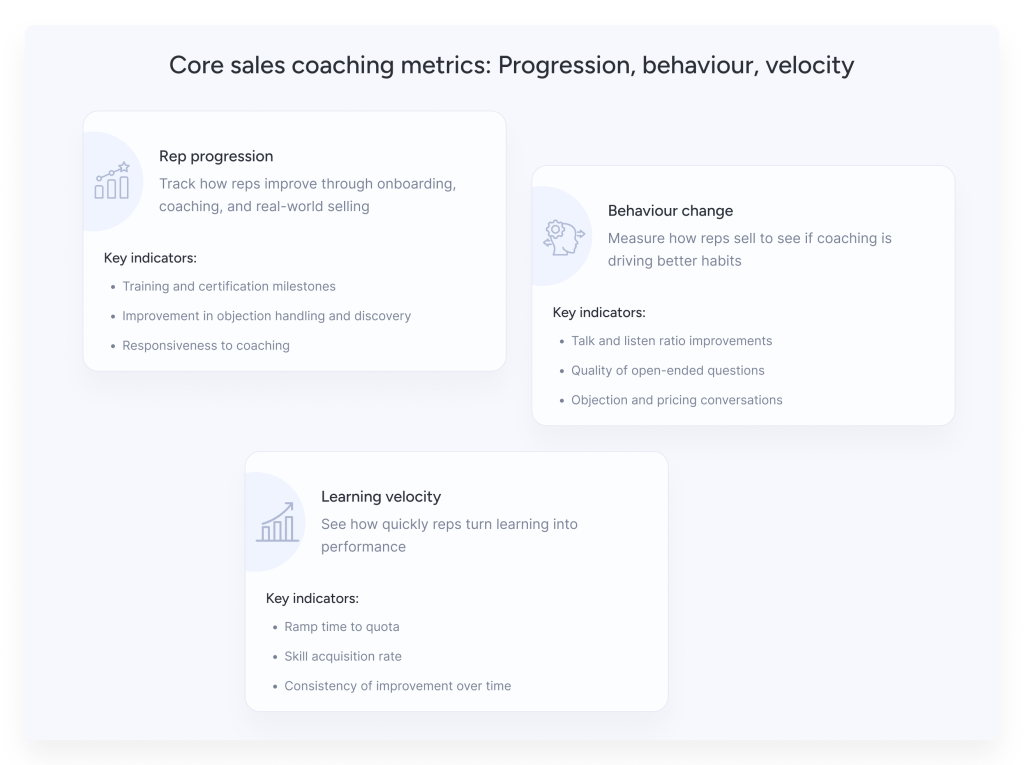
1. Rep progression
Rep progression tracks how a salesperson evolves over time through onboarding, coaching interventions, and live performance. It shows whether coaching is translating into real developmental milestones.
- Training completion and certification milestones: This involves tracking the completion of onboarding modules, certifications, or enablement checklists. A rep’s ability to complete structured learning paths on time reflects their engagement level and foundational knowledge.
- Improvement in objection handling or discovery questioning: Compare early calls with those later in the quarter to assess whether reps are improving in areas like handling objections, asking consultative questions, or qualifying leads better. This behavioral shift is a critical marker of development.
- Responsiveness to feedback sessions: Measure how often and how quickly reps implement coaching feedback in their next interactions. Look for tangible improvements in talk tracks, objection handling, tone, and confidence in real-world selling environments [5].
Why it matters: 91% of companies lack formal sales training programs, and 57% lack structured onboarding [10]. Tracking rep progression enables managers to design coaching paths personalized to each rep’s gaps—maximizing enablement ROI.
“Rep coachability is reflected in how quickly they apply feedback and improve post-coaching.” — Salesforce, Coaching Success Study [6]
2. Behaviour change
Behaviour change focuses on shifts in how reps sell, not just how often. It shows whether reps are internalizing best practices and adjusting based on coaching, instead of relying on outdated or ineffective habits.
- Talk/listen ratio adjustments: Reps who dominate calls with monologues are less effective than those who listen and guide discovery. Coaching should encourage a shift to optimal talk/listen ratios (usually around 45/55), indicating a more buyer-focused conversation style
- Quality of open-ended questions: Track how reps transition from using closed-ended yes/no questions to more strategic, open-ended ones that uncover buyer intent and pain points. Better questioning leads to richer sales conversations
- Handling of objections and pricing conversations: Analyse whether reps improve in addressing common objections over time, using techniques taught during coaching. AI tools can highlight whether reps are actively applying objection-handling frameworks in real calls [7]
Why it matters: Activities alone don’t drive sales. It’s the way reps conduct calls that shapes the buyer experience and sales outcomes. Behaviour-based metrics reveal whether coaching is changing selling dynamics.
“You can’t coach what you can’t measure—conversation intelligence helps quantify selling behaviors like curiosity and empathy.” — Allego, Sales Enablement Blog [7]
3. Learning velocity
Learning velocity measures how quickly a rep moves from knowledge acquisition to on-the-job application. It’s the sales equivalent of time-to-productivity and is a powerful way to track coaching ROI.
- Average ramp time: Track how long it takes a new rep to reach full quota or make their first few deals. The industry average in B2B SaaS is 3.2 months [5]. Coaching should aim to compress this timeline by reinforcing key concepts more rapidly
- Skill acquisition rate: Use performance analytics and role-play data to see how fast reps adopt new behaviors like objection handling, value articulation, or stakeholder mapping. High learning velocity indicates a culture of coaching responsiveness
Why it matters: Fast learners not only deliver results quicker but are more likely to stay engaged and grow into top performers. Managers can accelerate team impact by focusing on consistent coaching cadence and adaptive learning.
“Companies that prioritize sales coaching grow revenue 28% faster than those that don’t.” — The Sales Coach Network [8]
Linking coaching to pipeline movement and quota predictability
Top-performing sales orgs aren’t just training reps, they’re using coaching to influence pipeline flow and forecast accuracy.
How to make the link:
- Monitor changes in deal velocity: Track if reps coached on specific deal tactics move their opportunities through the pipeline faster than those who aren’t.
- Tie rep improvements to forecast quality: Use deal stage advancement and close-rate data to correlate individual coaching interventions with improved forecast confidence and quota attainment [6].
- Look at quota consistency: Evaluate whether coached reps hit quota more consistently over time. Since only 47% of reps hit annual quota [9], small improvements can create major gains.
“Effective coaching improves sales performance by 8%, proving that targeted intervention pays off.” — Salesforce [6]
Real-world insights:
- 65% of high-performing reps credit strong coaching and real-time feedback for their success [10].
- AI-powered dashboards help leaders spot where deals stall, identify undercoached reps, and course-correct with precision [11].
Using AI to surface high-signal coaching data
AI-powered coaching tools are transforming how managers gather insights and prioritize coaching.
Key advantages:
- Objective behavior tracking: AI systems can analyze thousands of conversations and quantify behaviors like empathy, hesitation handling, or confidence. These granular insights are difficult to capture manually [12].
- Efficiency gains: Teams using AI-driven coaching save up to 6 hours per week per rep. Time that would have gone into call reviews can now be invested in high-impact coaching sessions [13].
- Outcome boosts: AI-recommended actions result in 50% higher win rates, while guided coaching programs driven by conversation intelligence yield 35% better close rates [14].
What to track with AI:
- Rep responsiveness to feedback: AI can show whether coached reps are applying techniques, such as objection handling or storytelling, in their follow-up calls.
- Repeated deal risk patterns: By analyzing thousands of deals, AI surfaces patterns like pricing objections that consistently lead to drop-offs. This allows for tailored rep training.
- Adherence to talk tracks: Evaluate whether reps are sticking to the messaging framework that aligns with your ICP and sales methodology.
“AI frameworks now allow automated skill scoring, so managers can track learning in real time without relying on subjective scoring.” — Pipedrive [12]
Building a coaching metrics dashboard that drives action
A good dashboard doesn’t just display data, it creates accountability, highlights patterns, and directs manager attention to where it matters.
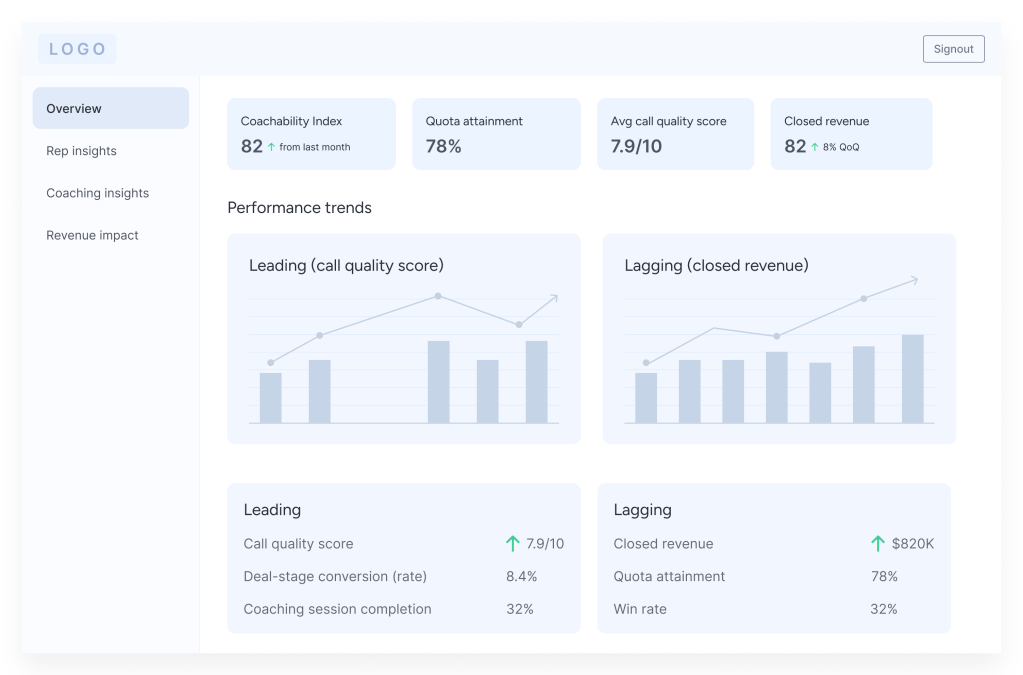
Must-have features:
- Blend of leading and lagging indicators:
- Leading: Monitor call quality scores, deal-stage conversion rates, and coaching session completion to detect early signs of rep improvement.
- Lagging: Track closed revenue, win rates, and quota attainment to validate the long-term impact of coaching efforts [15].
- Annotations and trend lines: Dashboards should include historical comparisons, comments from managers, and trend arrows to make skill progression visually clear [16].
- Real-time sync with CRM and enablement tools: Automation reduces manual reporting and ensures that data is always fresh and actionable [17].
- Coachability index: Use composite metrics that combine training completion, coaching engagement, and performance shifts to evaluate individual rep potential [17].
Real-world insights:
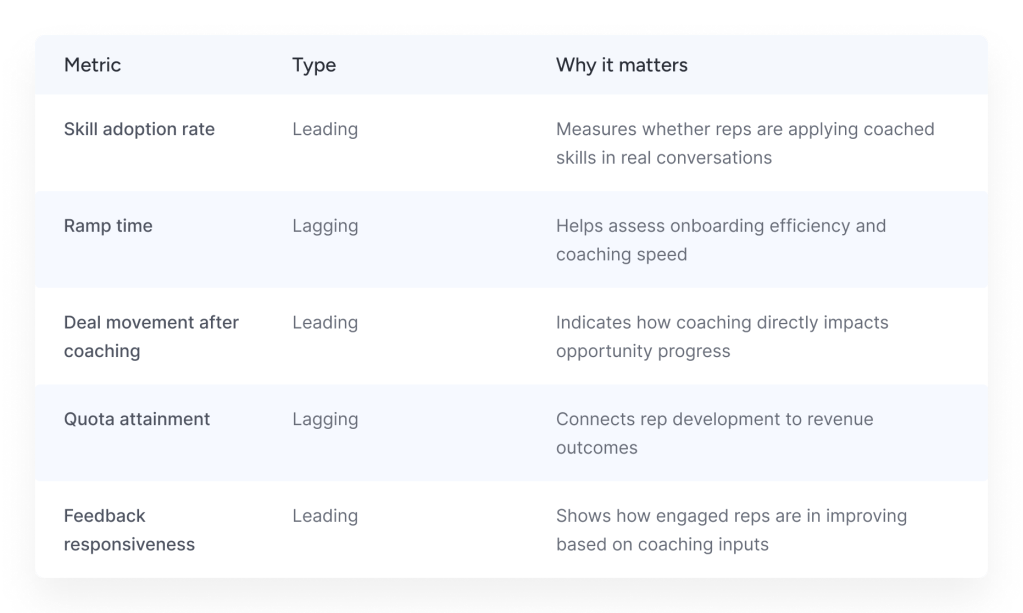
This table highlights important sales coaching metrics, grouped into leading and lagging types. Leading metrics like skill adoption rate, deal movement after coaching, and feedback responsiveness help spot early signs of rep improvement and engagement. Lagging metrics such as ramp time and quota attainment show how coaching impacts onboarding speed and long-term performance. Together, these metrics offer a clear picture of how coaching drives rep development and business results.
Conclusion: Coaching metrics as a growth engine
As sales cycles become longer and buyer expectations more complex, coaching must evolve from a soft skill to a revenue-critical function. By going beyond superficial metrics like win rates and call scores, and instead focusing on rep progression, behaviour change, and coaching responsiveness, sales leaders can unlock both rep potential and predictable revenue outcomes.
When backed by AI-powered data capture and real-time dashboards, coaching becomes less of a gut-feel activity and more of a structured, strategic growth lever.
What to measure:
- Are your reps improving post-feedback through measurable skill growth?
- Are they closing skill gaps faster and consistently applying feedback in live calls?
- Is your pipeline moving more smoothly after coaching interventions?
- Can you forecast revenue based on improved rep behavior and pipeline performance?
If you can say yes to these, your coaching strategy isn’t just effective, it’s future-ready.
Sources:
[1] https://forecastio.ai/blog/mastering-the-opportunity-to-won-rate-in-b2b-sales
[2] https://www.avoma.com/blog/sales-call-reviews
[3] https://voiso.com/articles/call-quality-score-metrics
[4] https://meetrecord.com/blog/call-scoring
[5] https://ryanestis.com/2025/04/18/coaching-and-learning-agility/
[6] https://www.salesforce.com/sales/coach/
[7] https://www.allego.com/blog/improve-sales-performance-metrics/
[8] https://www.thesalescoachnetwork.com/post/sales-coaching-impact-key-metrics-for-success
[9] https://www.eubrics.com/blog/consistent-quota-achievement-across-teams
[10] https://thesalescollective.com/team-quotas-statistics/
[11] https://www.orum.com/blog/sales-quota
[12] https://www.pipedrive.com/en/blog/ai-in-sales-management
[13] https://www.gong.io/labs/generative-ai-in-sales/
[14] https://www.gong.io/resources/labs/we-measured-the-roi-of-ai-in-sales-heres-how-it-really-impacts-your-deals/
[15] https://saleshood.com/blog/sales-productivity-leading-vs-lagging-indicators/
[16] https://www.insia.io/post/sales-dashboard-best-practices
[17] https://www.allego.com/blog/sales-metrics-that-matter
 Outscale.ai