
Table of contents
- AI sales call assistants: real-time help or real-time distraction?
- What are AI sales call assistants and how do they work?
- Example tools
- Key benefits: live guidance, objection handling, and rep confidence
- Where it goes wrong: distractions, overload, and tech fatigue
- How reps really feel: perception, adoption, and resistance
- Making it work: best practices for integrating AI assistants into call workflows
- Final takeaway: real-time coaching, when done right, drives real results
AI sales call assistants: real-time help or real-time distraction?
As sales teams embrace AI, a hot debate continues to simmer in virtual sales floors: Are AI-powered call assistants a game-changer or just another voice in the room? These assistants are designed to guide sales reps live during calls, offering real-time prompts, reminders, and relevant talk tracks. But do they elevate conversations, or do they interrupt the natural flow of dialogue?
In this blog, we dive deep into the benefits, challenges, and best practices of using AI sales call assistants, equipping sales leaders with practical insights to decide if this technology fits into their modern sales motion.
What are AI sales call assistants and how do they work?
AI sales call assistants are intelligent tools that utilize natural language processing (NLP) and machine learning to analyse live sales conversations and provide helpful prompts to representatives during the call. These assistants are built to respond in real-time, identifying key moments and providing timely information that can shift the outcome of a conversation.
Key functionalities:
- Real-time transcription and analysis: AI assistants continuously monitor calls to transcribe speech, identify keywords and intent, and evaluate sentiment. Based on this input, they suggest next steps or offer reminders to keep the conversation on track [1].
- Workflow integration: These tools integrate deeply with CRM systems and sales communication platforms. They help reps by highlighting long monologues, detecting objections or competitor mentions, and surfacing talk tracks or documents without manual searching [2].
- Contextual coaching: Rather than being static scripts, AI assistants tailor guidance based on live conversation dynamics. For instance, when a buyer raises a pricing concern, the assistant can instantly pull up tailored positioning or ROI benefits [2].
Example tools
- Outscale.ai’s real-time cue cards and rep intelligence: Outscale provides contextual, real-time guidance during calls by surfacing dynamic cue cards that adapt to the conversation. It also delivers rep-specific insights based on historical performance, helping managers deliver targeted coaching faster [3].
- Dialpad’s live coach cards: This tool activates on trigger words and provides cards with relevant information such as pricing details or competitor insights during the call [4].
- Gong’s real-time call insights: Gong uses AI to analyse live and recorded sales calls, offering real-time notifications and guidance to improve rep performance. Its platform surfaces talk ratios, objection handling, and competitive mentions during and after calls [17].
- Other tools in this space include Gong, Chorus, Clari Copilot, Mindtickle Call AI, ZoomInfo Copilot, and Salesforce Einstein.
These assistants can also streamline post-call activities, such as summarizing meetings, assigning follow-ups, or updating CRM records, making them indispensable across the sales workflow [1].
Key benefits: live guidance, objection handling, and rep confidence
When configured thoughtfully, AI sales call assistants empower reps to navigate complex sales scenarios with confidence, precision, and speed. They are designed to support the rep in the moment, acting like a virtual coach sitting beside them.
Top benefits:
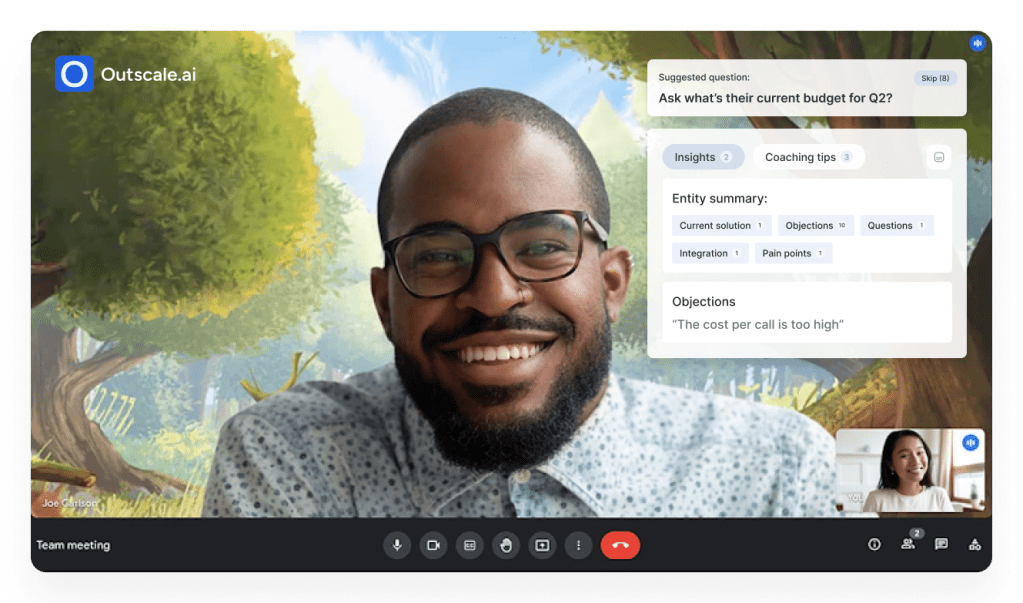
Source: https://outscale.ai/
- Live objection handling: Real-time prompts help reps stay composed when objections arise. Assistants offer scripts, relevant product features, or case studies to guide the rep’s response. This not only helps close more deals but also builds consistency in messaging across the team [5].
- Improved confidence: Junior reps often feel overwhelmed during live conversations. AI support levels the playing field by helping them sound more experienced, reducing the need for constant manager intervention [5].
- Cycle time reduction: According to a Vonage report, 69% of sellers said AI tools helped them shorten the sales cycle by at least a week. This can mean faster pipeline movement and more closed deals in less time [6].
- Faster ramp-up: Data from Persana AI shows that reps supported by AI assistants can reduce ramp-up from 6 to 9 months down to just 3 weeks, significantly speeding up team productivity [7].
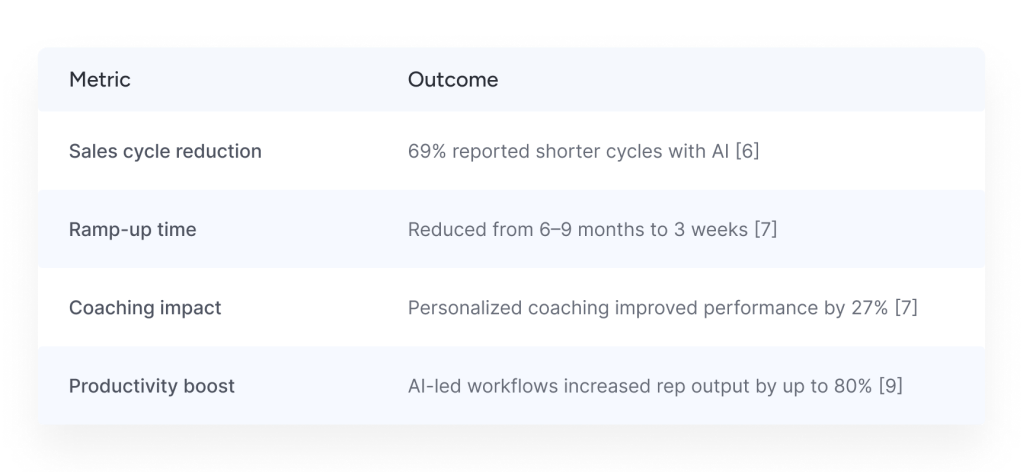
AI-driven sales tools have shown strong outcomes: 69% reported shorter sales cycles, ramp-up times dropped from months to weeks, personalized coaching boosted performance by 27%, and productivity surged by up to 80%.
Where it goes wrong: distractions, overload, and tech fatigue
While the benefits are enticing, AI sales assistants can backfire if implemented poorly or without a clear strategy. Reps may experience cognitive fatigue or even grow resistant if the system feels more burdensome than helpful.
Key pitfalls:
- Cognitive overload: When AI prompts flood the rep mid-call, it can become difficult to maintain a natural flow of conversation. Experienced reps, in particular, may find these prompts intrusive or disruptive to their rhythm [9].
- Inaccurate insights: If the AI misinterprets the conversation or pulls up irrelevant information, it creates friction rather than ease. Inaccurate transcriptions and flawed sentiment analysis add to the rep’s frustration, forcing them to override or ignore prompts [10].
- Repetition and redundancy: Without proper configuration, the assistant may surface the same suggestions repeatedly. Over time, reps begin to ignore these prompts, reducing trust in the tool’s effectiveness [10].
According to a study cited by CX Today, poorly configured AI assistants have been found to introduce inefficiencies like unnecessary edits, off-target recommendations, and workflow disruptions [10].
How reps really feel: perception, adoption, and resistance
Understanding rep sentiment is crucial to successfully rolling out AI in sales organizations. Some reps welcome AI as an enhancement, while others are wary of surveillance, data use, or a perceived loss of autonomy.
Adoption trends:
- Enhanced decision-making: A report by Vena Solutions found that 73% of sales professionals believe AI provides insights they wouldn’t have uncovered otherwise [8].
- Widespread adoption: HubSpot’s data shows 43% of reps are already using AI in some form, and 76% anticipate AI becoming a standard in sales workflows by 2030 [11].
Resistance points:
- Trust and privacy concerns: According to a McKinsey report, 41% of employees remain apprehensive about AI. Top concerns include cybersecurity (51%), data accuracy (50%), and privacy (43%) [12].
- Training and readiness: AI adoption also faces hurdles due to budget limitations and a lack of structured onboarding programs. Without proper enablement, even the best tools can fail to gain traction.
Experts at Nooks suggest that the most sustainable approach is “human-first, AI-accelerated,” where AI amplifies but doesn’t replace seller judgment [13].
Making it work: best practices for integrating AI assistants into call workflows
To ensure AI assistants deliver value, leaders must approach implementation with structure, strategy, and empathy. Success lies in balancing technical configuration with user buy-in and ongoing support.
Implementation playbook:
- Start with use-case pilots: Begin by introducing AI in a low-complexity area, such as objection handling or call logging. Evaluate performance and gather feedback before scaling to more advanced use cases [2].
- Customize for workflow fit: Avoid a one-size-fits-all setup. AI suggestions should reflect your team’s sales methodology, CRM setup, and customer journey stages to ensure relevance [1].
- Set clear KPIs: Define what success looks like early on. Metrics like response time, call quality, and lead conversion can help track performance and steer continuous improvements [1].
Boosting adoption:
- Hands-on training: Organize regular sessions with live demos, Q&A, and role-plays. Reinforce learning with simple user guides and encourage peer learning to normalize adoption [14].
- Transparent rollout: Clearly communicate how the AI tool works, what data it uses, and how it benefits reps. Building this trust is crucial to successful onboarding [15].
- Security-first approach: Address concerns upfront by ensuring secure data handling, user consent protocols, and clear usage boundaries [15].
Tactical enhancements:
- Call summaries and alerts: Use AI to auto-generate post-call summaries, follow-up tasks, and deal alerts so reps can focus on selling, not admin [16].
- Contextual timing: Deliver suggestions only at key conversation moments, not continuously, to reduce interruptions.
- Prompt pacing: Set a cap on the number of prompts per minute and allow reps to snooze or dismiss them when necessary.
Final takeaway: real-time coaching, when done right, drives real results
AI sales call assistants can supercharge sales teams, but their success depends entirely on thoughtful deployment. The right setup brings improved productivity, shorter cycles, and greater rep confidence. The wrong setup leads to fatigue, resistance, and missed opportunities.
For revenue leaders, the message is clear: make AI assistive, not invasive. Start small, involve your reps early, and align your tools with clear, measurable goals. By putting people at the center of AI strategy, sales organizations can turn live call coaching into a true competitive edge.
Sources:
[1] https://www.iovox.com/blog/ai-sales-assistant
[2] https://www.mindtickle.com/blog/the-complete-guide-to-ai-sales-assistants/
[3] https://outscale.ai/
[4] https://www.dialpad.com/features/real-time-assist/
[5] https://response-whisperer.com
[6] https://www.vonage.com/resources/articles/ai-sales-agent/
[7] https://persana.ai/blogs/ai-sales-coaching-agent
[8] https://www.venasolutions.com/blog/ai-statistics
[9] https://www.springlabs.com/blog/the-future-of-real-time-agent-assist
[10] https://www.cxtoday.com/contact-center/contact-center-ai-assistants-are-introducing-new-inefficiencies-burdens-finds-study/
[11] https://blog.hubspot.com/sales/state-of-ai-sales
[12] https://www.mckinsey.com/capabilities/mckinsey-digital/our-insights/superagency-in-the-workplace-empowering-people-to-unlock-ais-full-potential-at-work
[13] https://www.nooks.ai/blog/ai-sales-assistant
[14] https://www.callrail.com/blog/ai-tools-for-sales-teams/
[15] https://salesdrive.info/ai-in-sales-strategy-and-implementation-framework/
[16] https://scratchpad.com/blog/ai-in-sales/
[17] https://www.gong.io/
 Outscale.ai