
Table of contents
Beyond gut feel: the data-driven approach to sales coaching
For decades, sales coaching leaned on intuition. Managers relied on experience and “gut feeling” to guide reps. But in today’s competitive environment, instinct alone is no longer enough. The difference between winning and losing often comes down to precision, scalability, and measurable impact. Modern leaders are moving away from ad hoc coaching toward a repeatable, data-driven science.
By combining insights from call performance, historical trends, and CRM data, leaders are building coaching systems that are more personalized, trackable, and effective. With the addition of artificial intelligence (AI) and large language models (LLMs), coaching platforms can now analyse calls in real time, surface contextual insights, and even recommend personalized coaching actions at scale. This guide explores how to implement data-driven coaching that drives team performance and revenue.
Why intuition falls short in coaching
Sales coaching has a direct impact on quota attainment and revenue growth. Teams with structured coaching are 91.2% more likely to hit quota compared to 84.7% without it [1]. Yet most managers spend under 5% of their time on coaching [2]. Relying on ride-along or casual advice creates inconsistent, biased, and unscalable feedback.
Intuition-based advice is also prone to bias. Managers may overestimate or underestimate a rep’s ability, leading to vague feedback such as “ask more questions.” As a result, deeper issues remain unaddressed. In contrast, data-driven organizations supported by AI are far more likely to win and retain customers [3].
Conversation intelligence: identifying skill gaps
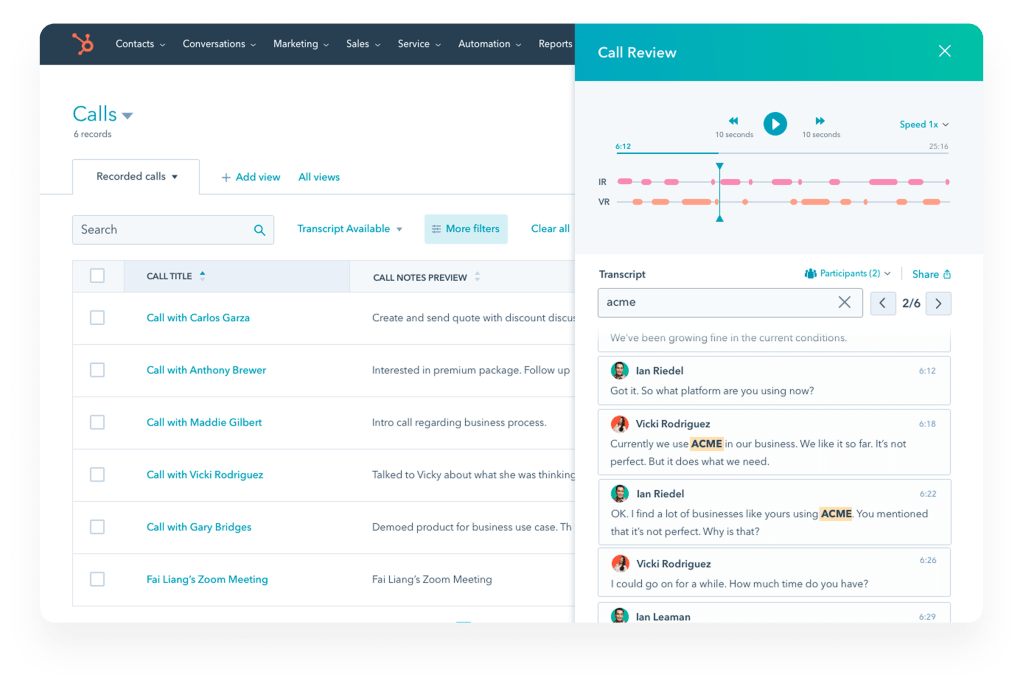
To move beyond guesswork, sales leaders use conversation intelligence (CI) tools. These platforms analyze recorded calls to uncover patterns that intuition often misses. Modern CI systems increasingly embed AI and LLMs to detect sentiment, intent, and contextual nuance that traditional keyword spotting cannot. They highlight:
- Discovery questions: CI and AI models assess whether reps ask open-ended questions that uncover pain points, budget, and timelines, or if they rush to pitch. Strong discovery ensures reps tailor solutions, while weak discovery leads to missed opportunities.
- Talk-to-listen ratio: Exact measurements expose poor discovery or weak listening skills. With AI assistance, managers can track patterns across thousands of calls and coach reps to pause, ask deeper follow-ups, and engage prospects more effectively.
- Keyword and intent tracking: Beyond simple keyword usage, LLMs can identify whether reps bring up key features, competitors, or value propositions at the right moments, and whether their language matches buyer intent. Misuse or omission suggests rushed or incomplete conversations.
This level of precision drives results. Using real call data enhanced by AI has been shown to raise win rates by 62% [4], boost close rates by 30%, and shorten sales cycles by nearly 20% [5]. Top-quartile cold callers, identified through CI insights, book three times more meetings than average reps [6].
Tracking performance trends over time
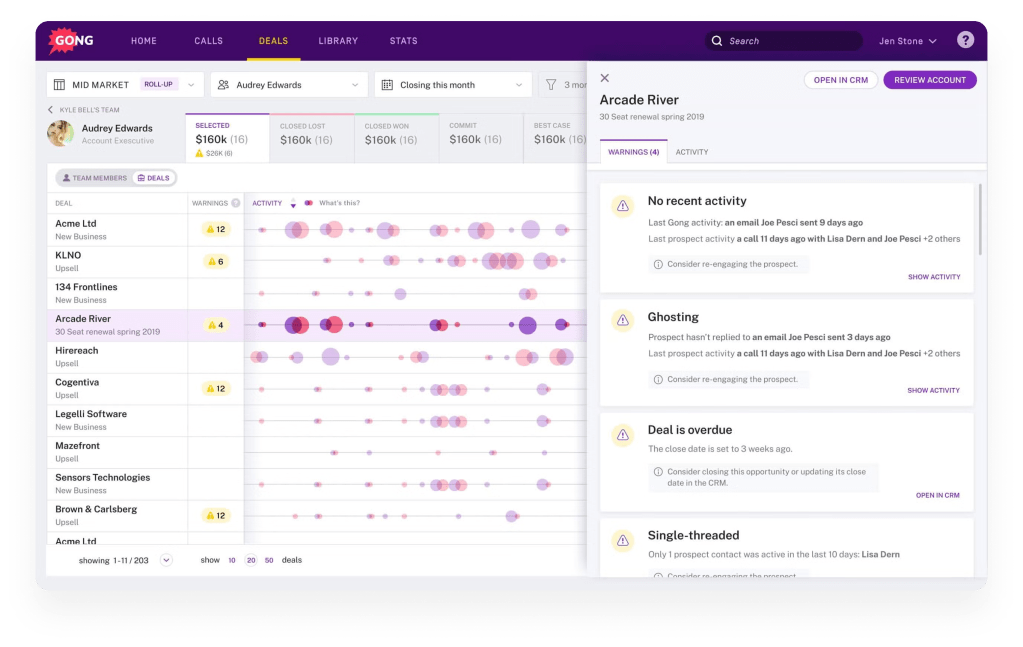
One-off call reviews help, but patterns over time provide far more insight. AI-powered trend analysis can detect subtle performance declines weeks before they affect pipeline numbers. Tracking these trends allows managers to step in earlier with targeted coaching.
The “middle 60%” of reps benefit the most from structured coaching, with performance gains of up to 19% [7]. AI-driven scorecards, which leverage LLMs to analyze thousands of calls, have delivered 20% win-rate lifts by exposing recurring performance gaps [8].
Organizations that adopt trend-based coaching approaches see win rates 28% higher than those without structured programs [8].
Leveraging CRM insights for context
Source: https://outscale.ai/
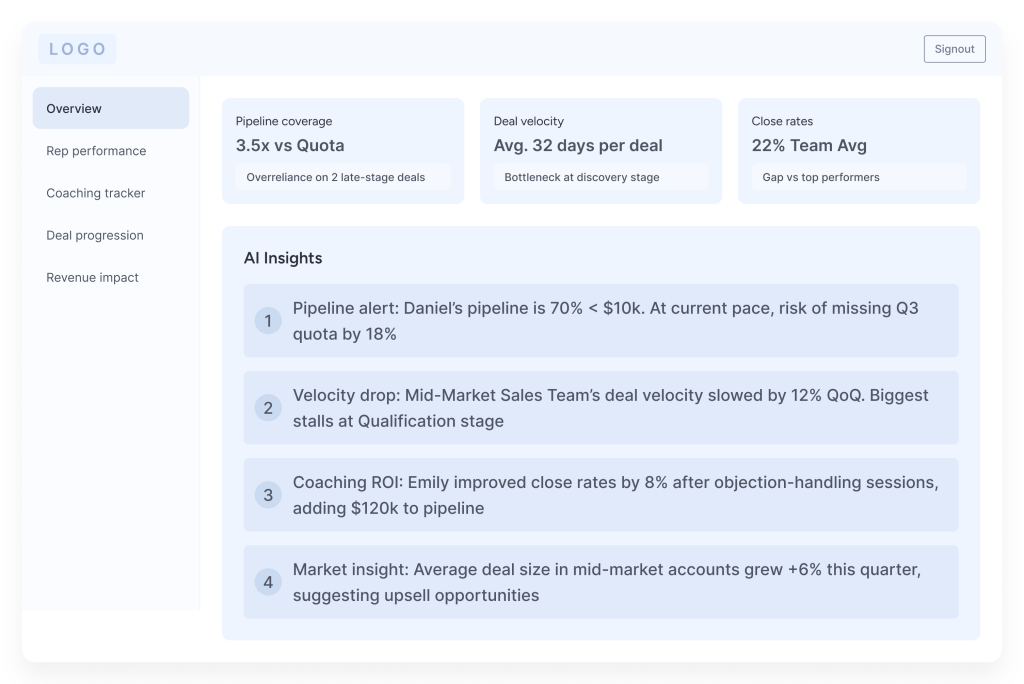
Call analysis shows how reps perform, while CRM data explains why it matters. A rep’s calls may look solid, but without pipeline context, managers can miss underlying risks. When combined, CI, AI, and CRM create a 360-degree performance view.
Key CRM metrics to integrate include:
- Pipeline size: This helps assess whether pipeline volume and quality can sustain targets. AI can flag risks hidden in the data, such as too many small deals or overreliance on a few late-stage opportunities. A healthy benchmark is often 3–4x coverage against quota [16].
- Deal velocity: This measures how quickly deals move. AI models can surface systemic bottlenecks, such as consistent stalls at qualification due to weak discovery or delays at negotiation linked to pricing challenges.
- Close rates: These highlight conversion efficiency. By comparing team averages, AI can differentiate between individual underperformance and systemic messaging gaps.
CRM use has been shown to boost sales by 29% and productivity by 34% [9]. Mobile CRM adoption is particularly powerful, with 65% of users hitting quota compared to only 22% without [7]. When paired with CI and AI, CRM data shows whether struggles stem from weak qualification, shallow discovery, or inconsistent follow-up [6].
Building a closed-loop coaching system
The strongest coaching systems create a closed loop, turning insights into measurable improvements. AI and LLMs are central to this cycle, automating insight generation and recommending next-best coaching actions. Instead of being one-off events, coaching becomes an ongoing cycle:
- Identify skill gaps: Use CI and AI to flag weaknesses such as difficulty with pricing objections, shallow discovery, or poor listening habits. These evidence-based insights replace guesswork and keep coaching focused.
- Prescribe solutions: Translate gaps into targeted actions such as assigning AI-recommended training modules, practicing with role-plays, or reviewing curated calls that model best practices. LLMs can even generate custom coaching scripts tailored to each rep’s patterns.
- Track progress: Apply CRM metrics and AI-powered dashboards to measure improvement. For example, check whether close rates on deals with pricing objections improve within 30 days, or whether pipeline velocity accelerates after targeted coaching. This makes coaching accountable and directly tied to business results.
This system solves a common challenge: 42% of companies cannot measure coaching impact [7]. With a closed-loop approach enhanced by AI, coaching outcomes link directly to revenue growth.
Organizations with strong coaching cultures see 29% more sales wins [7]. Digital platforms are accelerating adoption, with 77% of sales orgs now using them and 66% employing AI for personalization [10]. Personalized feedback is especially critical, since 81% of reps report not receiving it today [7].
Experts recommend full-cycle coaching platforms that integrate with CRM, combining CI, AI, LLMs, and real-time feedback [10]. This ensures coaching remains continuous, scalable, and measurable.
Conclusion: data as the future of coaching
Sales is evolving, and coaching must evolve too. Gut feel and unstructured advice are no longer sufficient. By using data from calls, trends, CRM, and AI-enhanced analysis, leaders can coach with greater precision, scalability, and measurable impact.
Importantly, data and AI do not replace the human side of coaching. Instead, they enhance it by providing clarity and context, freeing managers to focus on supporting rep growth. The outcome is a more predictable, profitable, and high-performing sales organization.
Sources:
[1] https://happysales.ai/blog/sales-coaching-statistics
[2] https://qwilr.com/blog/sales-coaching-statistics/
[3] https://www.newhorizons.com/blog/gut-instincts-vs-data-driven-sales-coaching-which-is-better
[4] https://www.gong.io/resources/sales-coaching-guide
[5] https://www.outreach.io/resources/blog/conversation-intelligence
[6] https://llcbuddy.com/blog/sales-coaching-statistics/
[7] https://qwilr.com/blog/sales-coaching-statistics/
[8] https://crm.org/crmland/crm-statistics
[9] https://www.sbigrowth.com/blog/4-elements-of-a-healthy-sales-pipeline
[10] https://www.momentum.io/blog/top-tools-that-integrate-sales-coaching-with-crm-systems-2025-buyers-guide
 Outscale.ai