
Table of contents
- The 6 coaching models every sales manager should master (and when to use each)
- Why sales managers need multiple coaching models
- The GROW model for structured goal setting
- The OSKAR model for solution-focused coaching
- The CLEAR model for clarity and motivation
- The FUEL model for high performers
- The performance-based model for accountability
- The situational leadership model for adaptive management
- Choosing the right model for the right moment
The 6 coaching models every sales manager should master (and when to use each)
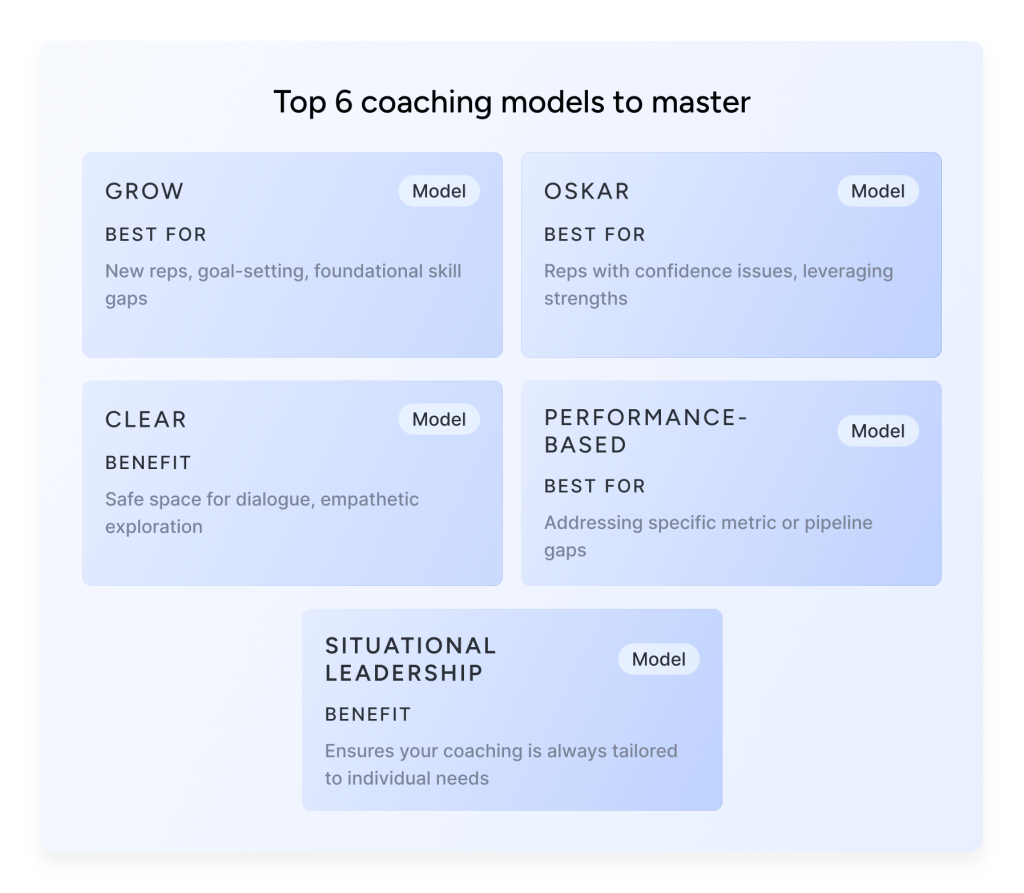
Source: https://outscale.ai/
In today’s fast-paced B2B SaaS environment, sales managers face a complex challenge: how do you get the best performance out of a diverse team? The answer isn’t a single, rigid playbook. It’s about becoming a master coach, equipped with a toolkit of frameworks to address every unique situation, from a struggling SDR to a top-performing VP of Sales.
Gone are the days of one-size-fits-all coaching. The most effective sales leaders understand that the key to unlocking potential lies in flexibility. This guide will walk you through six powerful coaching models, explaining what they are, how they work, and most importantly, when to use each one to drive sustainable growth and quota attainment across your team.
Why sales managers need multiple coaching models
Think of your sales team like a sports team. You wouldn’t coach every player the same way, right? A rookie wide receiver needs a different approach than a seasoned quarterback. The same principle applies in sales. Your team is a mix of personalities, experience levels, and skill sets, and their challenges are just as varied.
Effective coaching is arguably the most significant lever you have for improving rep performance. Research shows that coaching can lead to an 88% boost in productivity, a dramatic increase compared to the 23% from training alone [3]. But a rigid approach will only get you so far. As experts point out, there is no single best framework; the most effective approach is to use multiple models and adapt to each rep’s needs [7].
High-performing sales organizations understand this. Data shows that companies with a structured coaching process achieve a 28% higher win rate on forecasted deals and a 91% quota attainment rate [2]. This is why so many high-growth companies, 60% of them to be exact, include structured coaching in their training programs [4]. Reps themselves are hungry for it, with 79% saying that coaching and training would help them advance their careers [5].
A diverse set of coaching models, namely GROW, OSKAR, CLEAR, FUEL, performance-based, situational leadership, gives you the agility to handle various scenarios, from building fundamental skills with a junior BDR to helping a senior account executive overcome a mental block.
The GROW model for structured goal setting
The GROW model is a classic, foundational coaching framework for a reason. It is simple, effective, and promotes active problem-solving by the coach, rather than prescriptive advice from the manager. It’s an ideal choice for addressing skill gaps and helping reps build a clear, actionable plan.
The acronym stands for four key steps:
- Goal: What does the rep want to achieve? This step is about defining a specific, measurable, and realistic objective. It could be closing a specific deal, improving their cold call-to-connect ratio, or mastering a new product feature.
- Reality: What is the current situation? This is a crucial, non-judgmental exploration of the present state. You and the rep discuss their current performance, the obstacles they’re facing, and what they’ve already tried.
- Options: What could you do? This is a brainstorming session where the rep generates possible solutions. Your role is to guide, not provide answers. Encourage them to think creatively about all the possibilities.
- Will: What will you do? This final step solidifies the commitment. The rep chooses a specific action from their options and commits to it. This personal ownership significantly increases their motivation and follow-through [9].
Example in action:
For a rep struggling with cold calls, a GROW session could look like this:
- Goal: “I want to book five discovery calls this week from my cold outreach.”
- Reality: “I’m only getting one booking per week. I’ve been using the same opening line, and people are hanging up quickly.”
- Options: “I could try a new opening line, research their company more thoroughly before I call, or use a different channel like LinkedIn to warm up the lead first.”
- Will: “I will research a new opening line and try it on my next 10 calls. I’ll also send a quick, personalized message on LinkedIn to the next five prospects before I call them.”
This structured approach has been shown to improve productivity, decision-making skills, and confidence among employees [10]. It’s the perfect model for a sales manager to use when a rep needs a clear path from problem to solution.
The OSKAR model for solution-focused coaching
While GROW is great for goal-setting, the OSKAR model offers a unique, solution-focused approach that is especially powerful for boosting confidence and leveraging existing strengths. Instead of dwelling on what’s going wrong, OSKAR focuses on what is working well to build momentum. This is a fantastic model for a rep who feels stuck or is struggling with motivation.
OSKAR stands for:
- Outcome: What is the desired end result? This is a forward-looking step where the rep describes their ideal future state in detail.
- Scaling: On a scale of 1 to 10, how close are you to achieving your outcome? This step helps the rep quantify their progress and acknowledge the small successes they’ve already made.
- Know-how: What have you already done well? This is the heart of the model. You explore the moments when they were at a higher number on the scale. What was different? What did they do that worked? This builds on their existing strengths [13].
- Affirm & action: What will you do next? You affirm the positive actions they’ve identified and help them choose a small, measurable action to take immediately.
- Review: What’s the plan to review progress? You set up a clear follow-up to check in on their progress and continue the coaching process.
Example in action:
For a rep who feels stuck after several weeks of missed quotas, an OSKAR session could look like this:
- Outcome: “I want to consistently hit 80% of my quota this month and feel more confident during my outreach.”
- Scaling: “Right now, I’d say I’m at a 4 out of 10. Last month I was closer to a 6 when I was booking more demos.”
- Know-how: “When I was at a 6, I had a stronger morning routine and was blocking time for prospecting without distractions. My email response rates were higher then too.”
- Affirm & action: “I will bring back my morning prospecting block and set a daily goal of sending 15 personalized emails. I’ll also keep track of responses to see what messaging works best.”
- Review: “We’ll check in during our 1:1 next week to see if your consistency has improved and whether response rates are trending upward.”
The OSKAR model is a valuable tool for sales managers because it shifts the conversation from deficit-based to strength-based, which can be a huge morale booster for a rep who feels like they’re in a slump. Research shows that solution-focused methods like this improve goal attainment and satisfaction with the coaching process [14].
The CLEAR model for clarity and motivation
The CLEAR model is particularly useful when a rep is feeling overwhelmed, unmotivated, or lacks a clear direction. It is a more empathetic and exploratory framework that prioritizes active listening and creating a safe space for open dialogue.
The CLEAR framework consists of:
- Contracting: You and the rep agree on the purpose and scope of the coaching conversation. This sets clear expectations.
- Listening: You actively listen, without judgment, to the rep’s perspective. This step is about truly hearing their concerns and feelings.
- Exploring: You ask open-ended questions to help the rep uncover the root cause of their challenge. You guide them in exploring different possibilities without prescribing a solution.
- Action: You work with the rep to define a clear, specific action plan to move forward.
- Review: You agree on a plan to review the outcomes and determine next steps.
Example in action:
For a rep who feels overwhelmed by managing multiple deals at once, a CLEAR session could look like this:
- Contracting: “Let’s focus today on what’s causing the most stress in managing your pipeline and see if we can find a way forward.”
- Listening: “I’m feeling buried under follow-ups. I don’t know which opportunities to prioritize, and I keep missing small details that cost me momentum.”
- Exploring: “What happens when you try to prioritize your deals? Which ones feel most critical to move forward right now? What tools or methods have helped you stay organized in the past?”
- Action: “I’ll create a daily checklist of my top three deals to focus on and block two hours each morning for follow-ups before any other tasks.”
- Review: “We’ll revisit this next week in our 1:1 to see if the checklist and time-blocking help reduce your stress and improve deal progress.”
The CLEAR model is powerful because it gives reps the space to be vulnerable and explore their challenges without pressure. When reps feel heard, they are more likely to commit to a solution they help create. It is a great model for a sales manager to use when a rep needs a conversation more than a quick fix [20].
The FUEL model for high performers
Sometimes, the best coaching isn’t about fixing a problem, but about pushing a great performer to an even higher level. The FUEL model is designed to do just that. It challenges assumptions and helps a rep move beyond their comfort zone to unlock new levels of success.
The steps are:
- Frame: You set the context for the conversation, defining the topic and its importance.
- Understand: You seek to understand the rep’s perspective, their current thinking, and their assumptions about the situation
- Explore: This is a crucial, challenging step. You ask provocative questions to help them look at the situation from a new angle and explore new strategies they haven’t considered before.
- Layout: You work together to lay out a clear plan of action, with specific commitments and next steps.
Example in action:
For a high-performing rep who consistently hits quota but wants to break into enterprise accounts, a FUEL session could look like this:
- Frame: “Let’s talk about how you can start winning larger, enterprise-level deals. You’ve mastered mid-market accounts, and now it’s time to expand your impact.”
- Understand: “I feel confident in my current sales process, but I hesitate with enterprise accounts because the sales cycles are longer, and I’m not sure how to navigate multiple stakeholders.”
- Explore: “What would change if you mapped the buying committee early on? How might building an executive sponsor relationship change the deal trajectory? What strategies from your mid-market success could you adapt for enterprise?”
- Layout: “I’ll identify two enterprise accounts this week, research their key decision-makers, and schedule an intro meeting with one of their senior leaders. We’ll review my progress in two weeks.”
The FUEL model is a more advanced coaching technique. While GROW is great for building fundamentals, FUEL is for the sales manager who needs to stretch a high-performing account executive or director who has plateaued or is looking for a new challenge [21]. It is the difference between getting a rep to hit quota and helping them shatter it.
The performance-based model for accountability
While the previous models are about building skills and confidence, the performance-based model is all about accountability and results. This is a critical tool for sales managers, especially when pipeline health, deal velocity, or quota attainment are at risk.
This approach is centered around objective data and measurable metrics. As a sales manager, you use your CRM and sales engagement platforms to identify specific behavioral and performance gaps.
- Key performance indicators (KPIs): This model relies on metrics such as calls-to-connect ratios, demo-to-SQL conversion rates, and average deal size. Research shows that metrics-driven coaching is most effective when tied to these measurable behaviours [19].
- Pipeline health: Companies with effective sales pipeline management grow revenue 28% faster and achieve 9.3% higher quota attainment [15]. A performance-based coaching session might focus on improving the qualification of deals in the pipeline to prevent stagnation.
- Quota attainment: With the average B2B SaaS quota attainment hovering around 70-80% [18], this model helps close that gap. A manager might identify that a rep is struggling to get deals to the proposal stage and use data to guide them on where to focus their efforts.
Example in action:
For a rep whose activity levels are strong but who struggles to move deals past the demo stage, a performance-based session could look like this:
- KPIs: “Your demo-to-SQL conversion rate is currently 15%, while the team average is 30%.”
- Pipeline health: “Looking at your pipeline, several opportunities have been stuck at the demo stage for over three weeks, which suggests qualification or follow-up might be the issue.”
- Quota attainment: “Because of these stalled deals, you’re tracking at 65% of quota for the quarter. If we improve your conversion rate, you’ll be back on pace.”
- Action plan: “This week, you’ll send tailored recap emails after each demo highlighting next steps, and I’ll review your last two demo recordings to provide feedback on your discovery questions.”
- Review: “We’ll check your conversion rate again in two weeks to see if these adjustments are moving deals forward faster.”
Effective performance-based coaching can increase deal sizes, win rates, and sales activities by 25–40% [16]. It is about using data, not gut feelings, to identify coaching opportunities and hold reps accountable for their results.
The situational leadership model for adaptive management
The situational leadership model is less of a framework for a single conversation and more of an overarching philosophy for a sales manager. It asserts that the best leadership style depends on the rep’s readiness, which is defined by their skill level and their motivation or confidence.
The model suggests that a sales manager should adapt their approach through four stages:
- Directing (high skill, low motivation): For a brand new SDR, you are a director. You provide clear instructions, detailed guidance, and close supervision.
- Coaching (low skill, high motivation): For a rep who is learning and enthusiastic, you use a coaching style, providing both guidance and support. You explain your decisions and encourage their input.
- Supporting (high skill, low motivation): For an experienced rep who is struggling with confidence or a mental block, you provide support. You encourage them, listen to their concerns, and help them find their own solutions.
- Delegating (high skill, high motivation): For your top performers, you can delegate. You give them a goal and trust them to execute, stepping back to let them take full ownership of the process.
Example in action:
For a sales team with a mix of experience levels, situational leadership could look like this:
- Directing: “For our new SDR, I’ll provide a daily call script, sit in on their first five calls, and give real-time feedback so they feel confident with the basics.”
- Coaching: “For our motivated but still-learning AE, I’ll walk through their demo structure with them, explain why certain questions uncover stronger pain points, and then let them try it with their next few prospects.”
- Supporting: “For our experienced AE who’s been missing quota recently, I’ll schedule a 1:1 to listen to what’s blocking them, encourage them to trust their past wins, and help them identify a strategy they feel confident committing to.”
- Delegating: “For our top enterprise rep, I’ll simply align with them on their annual target and trust them to execute their account strategy, checking in only at key milestones.”
This model is critical for sales managers, as it helps them avoid the trap of managing everyone the same way. It provides a strategic lens for deciding which of the other frameworks to apply in any given situation [22].
Choosing the right model for the right moment
With so many powerful frameworks at your disposal, how do you decide which one to use? The key is to match the model to the rep’s maturity and the specific challenge they are facing. Here is a simple guide to help you choose the right approach.
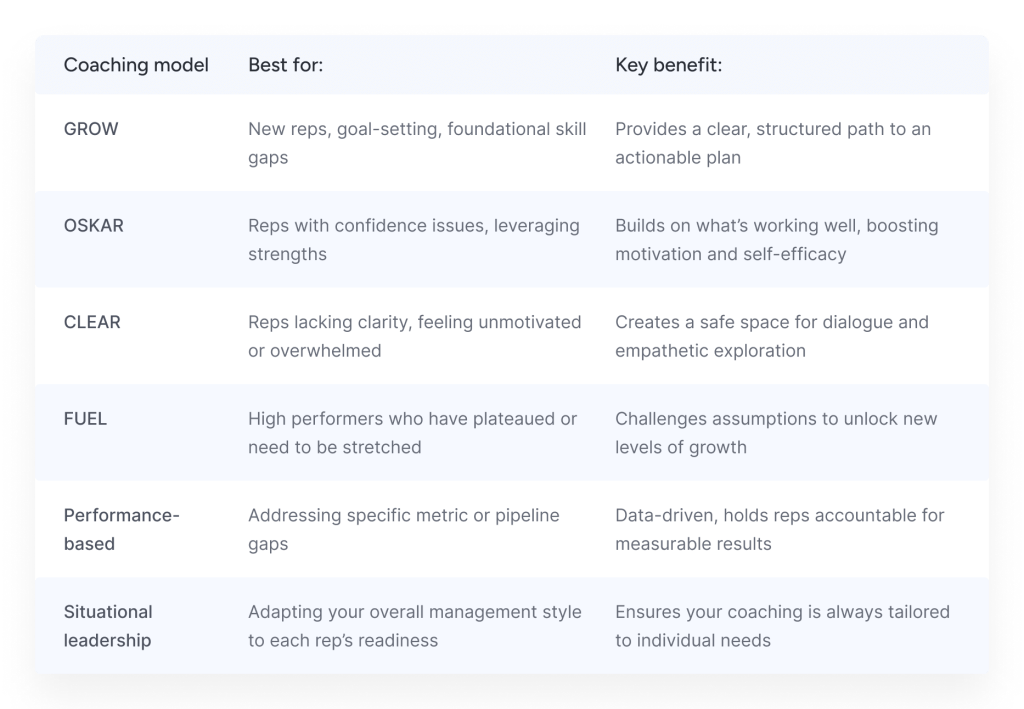
This table outlines coaching models suited for different sales rep needs. GROW guides new reps with goal-setting and skills through a clear plan, while OSKAR builds confidence by leveraging strengths. CLEAR supports reps lacking clarity or motivation with empathetic dialogue, and FUEL stretches high performers to unlock new growth. Performance-based coaching addresses specific metric gaps with data, and Situational leadership adapts coaching to each rep’s readiness
Your role as a sales manager is not just to hit your team’s number, it’s to develop the people on your team. Having a deep understanding of these coaching models turns you from a manager into a true coach, capable of unlocking potential, inspiring confidence, and driving your team to new heights.
Ultimately, the best sales managers don’t just have a single framework, they have a library of them. They know when to use a structured approach for goal-setting and when to use an exploratory approach for a mental block. This flexibility and adaptability is what separates good sales leaders from great ones.
Sources:
[1] https://www.globenewswire.com/news-release/2024/11/19/2983613/0/en/Using-AI-in-Sales-Coaching-Achieves-3-3x-Growth-in-Quota-Attainment-According-to-New-Research.html
[2] https://qwilr.com/blog/sales-coaching-statistics/
[3] https://qwilr.com/blog/sales-coaching-statistics/
[4] https://whatfix.com/blog/sales-coaching
[5] https://federicopresicci.com/blog/sales-coaching/sales-coaching-statistics
[6] https://blog.hubspot.com/sales/sales-coaching-guide
[7] https://aslantraining.com/blog/coaching-frameworks-and-models-for-sales-leaders
[8] https://www.coach4growth.com/coaching-skills/coaching-models/grow-model/
[9] https://atomus.com/blog/working-with-the-grow-coaching-model
[10] https://www.alore.io/blog/framework-for-coaching
[11] https://www.coach4growth.com/coaching-skills/coaching-models/grow-model/
[12] https://www.growthspace.com/glossary/oskar-coaching-model
[13] https://www.socoselling.com/sales-coaching-models/
[14] https://www.alore.io/blog/framework-for-coaching
[15] https://blog.zoominfo.com/sales-pipeline-statistics/
[16] https://luisazhou.com/blog/coaching-statistics
[17] https://luisazhou.com/blog/coaching-statistics
[18] https://www.venasolutions.com/blog/sales-statistics
[19] https://federicopresicci.com/blog/sales-coaching/sales-coaching-metrics/
[20] https://www.paperbell.com/blog/clear-coaching-model/
[21] https://www.clemmergroup.com/blog/the-fuel-coaching-model-is-more-effective-than-the-grow-model/
[22] https://aslantraining.com/blog/coaching-frameworks-and-models-for-sales-leaders
[23] https://predictablerevenue.com/blog/top-5-sales-coaching-models-used-by-top-performing-sales-leaders/
 Outscale.ai