
Table of contents
- Beyond the bootcamp: A guide to sales coaching and training that sticks
- Why most sales training fails after onboarding
- Embedding coaching into daily workflows
- Creating a feedback loop between training and performance
- Balancing structured training with adaptive coaching
- Measuring long-term program effectiveness
- Conclusion
Beyond the bootcamp: A guide to sales coaching and training that sticks
You’ve invested time and money into a stellar sales training program. New reps graduate from onboarding with a head full of knowledge and the confidence to crush their quotas. But a few months later, you see it, the creeping decline: key skills aren’t being applied, best practices are forgotten, and performance starts to plateau. The truth is, sales training isn’t failing because it’s bad; it’s failing because it’s being treated as a one-time event, not an ongoing process.
For sales leaders, managers, and revenue operations professionals, this is a familiar and frustrating cycle. The “onboarding bootcamp” model, while essential for foundational knowledge, often falls victim to the forgetting curve, a psychological phenomenon where newly acquired information is rapidly lost without reinforcement. This blog post isn’t about the latest training buzzwords, it’s about building a sustainable, long-term sales coaching and training program that integrates seamlessly into your sales organization’s DNA, extending well beyond a rep’s first 90 days. We’ll explore why traditional methods fail and how to build a continuous learning engine that drives sustained revenue growth and rep success.
Why most sales training fails after onboarding
The statistics are sobering, but they tell a clear story:
- Gartner found that 70% of B2B sales reps forget the training they received within one week, and 87% within one month [2].
- Other research points to an even more dramatic drop, with 84% of sales training forgotten by reps within three months without proper reinforcement [3].
- In fact, 85-90% of sales training has no lasting impact after 120 days, with most knowledge lost quickly [1].
These numbers aren’t a reflection on the quality of the content, but rather the flawed assumption that a one-off session is enough. As experts have noted, a major pitfall is treating training as a one-time event rather than an ongoing process [6]. Training programs fail when they are disconnected from the broader sales strategy and when managers don’t actively reinforce the learning. This is compounded by the fact that a staggering 46% of companies provide no training beyond onboarding, 40% offer no upskilling, and 45% provide no ongoing coaching [4].
A one-size-fits-all approach also contributes to the problem. Nearly three-quarters of sales leaders, 72%, say that training fails when it doesn’t account for individual needs [5]. Without a personalized approach, reps may disengage from content that doesn’t feel relevant to their specific challenges or skill gaps.
Embedding coaching into daily workflows
The solution to knowledge decay is not more training sessions, but continuous coaching. Coaching must become a built-in process, not an afterthought [10]. To make it stick, it needs to be embedded into the daily, weekly, and monthly rhythms of your sales team.
This is a shift from reactive, ad-hoc feedback to proactive, structured support. The goal is to make coaching a natural part of a rep’s routine through consistent touchpoints, so it feels less like an add-on and more like a tool for success.
Actionable strategies to embed coaching:
- Integrate into pipeline reviews: Instead of simply reviewing deal stages, use pipeline reviews to coach on specific deal strategy, next steps, and potential hurdles. This is a perfect opportunity to apply and reinforce concepts learned in training.
- Structured call feedback: Real-time coaching during or immediately after sales calls is highly effective [9]. With platforms like Outscale.ai, managers don’t have to wait for post-call reviews. Reps get live guidance on asking the right questions, handling objections, and moving deals forward while it matters most.
- Implement a coaching framework: Providing managers with a simple, repeatable framework can make coaching more consistent and effective. The GROW model (Goal, Reality, Options, Will) is an excellent example. It structures conversations to empower reps to find their own solutions, fostering critical thinking and ownership rather than being told what to do [7].
- Encourage peer learning: Create opportunities for reps to learn from each other. This can be as simple as a channel where reps can share successful call recordings or a weekly “best practices” session led by a top performer.
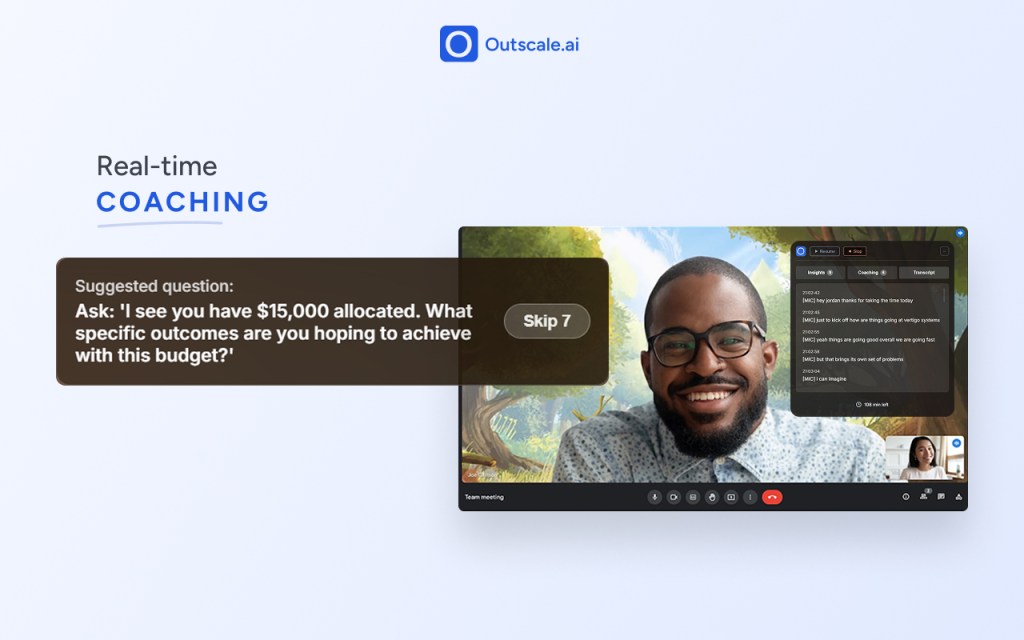
Outscale.ai provides the real-time coaching on your sales call.
Organizations that prioritize coaching see roughly 16.7% higher win rates than those that don’t [11]. The data shows that making coaching a daily habit directly impacts the bottom line.
Creating a feedback loop between training and performance
To prove the value of your sales training program, you need to connect the learning to real-world outcomes. This requires a robust feedback loop powered by data. Rather than relying on gut feelings, you can use objective metrics to identify skill gaps, measure progress, and adjust your training content in real-time.
A great way to do this is by connecting specific rep behaviors (actions) to business outcomes and quota attainment. The AOR model (Actions, Outcomes, Results) is a powerful framework for this, as it links training actions to tangible results [12].
How to create a data-driven feedback loop:
- Leverage CRM and call data: Use data from your CRM, call recordings, and email interactions to measure key performance indicators (KPIs) like talk-to-listen ratio, question-to-statement ratio, and adherence to sales process. This data provides actionable, objective insights for coaching conversations [14].
- Track leading and lagging indicators: Don’t just look at the final numbers. Track leading indicators of success, such as activity metrics (e.g., number of calls, discovery calls completed), and then connect those to lagging indicators like closed-won rates and quota attainment [26].
- Implement a cadence for review: Schedule regular, data-driven check-ins. For example, a weekly session to review a handful of call recordings, a monthly meeting to analyse CRM data, and quarterly business reviews to assess progress against strategic goals.
This data-driven approach is a key component of effective sales enablement. Companies with formal sales enablement strategies achieve 49% higher win rates on deals [17]. Furthermore, organizations that use AI in sales training are 2.6 times more likely to see a positive ROI because they can generate more effective, data-driven feedback loops [15]. This is how you move from guessing to knowing what’s working, and what’s not.
Balancing structured training with adaptive coaching
The “one-size-fits-all” approach to sales training is a primary reason reps fail to hit their targets. In fact, 67% of sellers expected to miss quota in 2024, due in part to training programs that don’t adapt to individual needs [18]. A truly effective program combines the scalability of structured training with the personalization of adaptive coaching.
Structured training provides the foundation. It’s where you teach your methodology, product knowledge, and core messaging. It ensures every rep has the same baseline understanding of your value proposition. However, this is just the beginning.
The power of adaptive coaching lies in its ability to address individual skill gaps and learning styles. Sales expert Robin Treasure warns that standardized methodologies rarely account for individual skill gaps, recommending competency-based coaching instead [22].
- Competency-based coaching: Identify the specific skills each rep needs to develop. For a junior SDR, this might be building rapport and handling objections. For a seasoned rep, it could be multi-threading complex enterprise deals.
- Personalized learning paths: Use data from your feedback loop to create individualized learning paths. If a rep’s talk-to-listen ratio is off, their personalized plan might include a series of modules on active listening and mock calls focused on discovery questions.
- On-the-job coaching: As one of the most effective learning methods for reps, manager-led, on-the-job coaching is vital [20]. This is where the manager acts as a mentor, guiding a rep through a real-world scenario. The data supports this, with 29% of reps who receive weekly one-on-one coaching being classified as top performers [19].
Adaptive coaching combines data insights with manager discretion to create personalized learning paths while maintaining scalability, ensuring every rep gets the support they need to succeed [21].
Measuring long-term program effectiveness
Demonstrating the value of a sales training and coaching program is crucial for securing continued buy-in and investment from leadership. The ROI isn’t just about a one-time lift in performance, but about sustained impact.
As a reminder, effective training and coaching programs yield an average ROI of 353%, with every $1 invested generating $4.53 in return [16].
To measure this, you need a balanced scorecard of metrics, including both leading and lagging indicators:
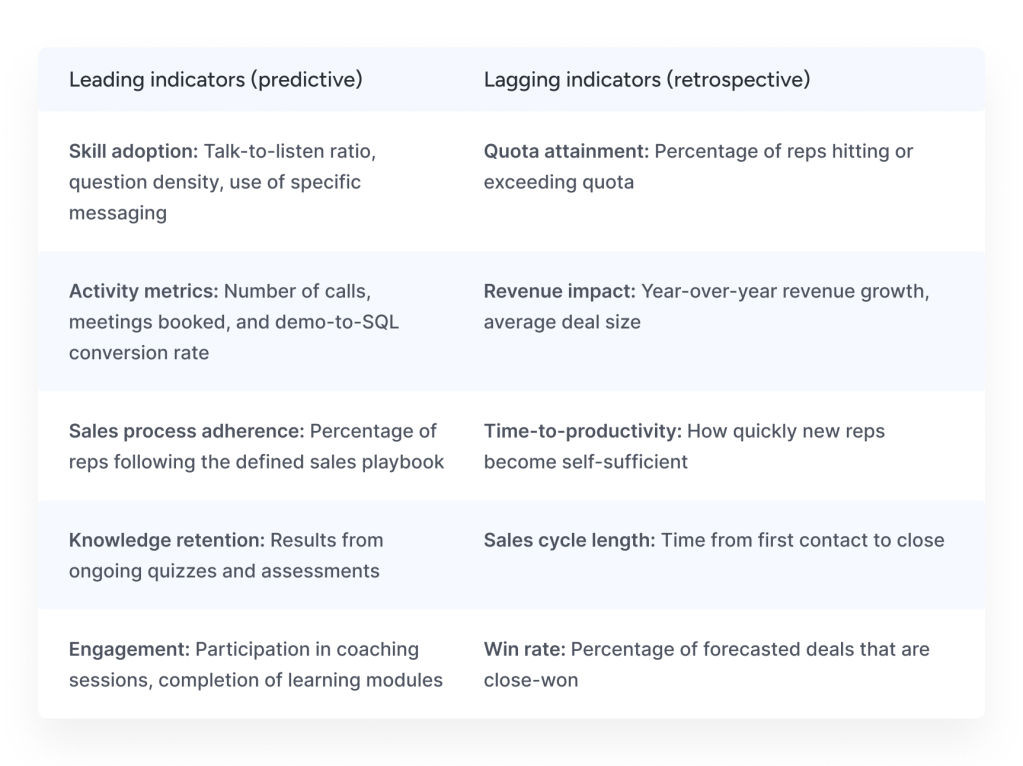
This table distinguishes between leading and lagging indicators of sales effectiveness. Leading indicators are predictive and focus on behaviours and activities that drive future results, such as skill adoption (e.g., talk-to-listen ratio, messaging use), activity metrics (calls, meetings, demo-to-SQL conversions), adherence to sales processes, knowledge retention through quizzes, and engagement in coaching or learning modules. Lagging indicators are retrospective, reflecting outcomes such as quota attainment, revenue impact, time-to-productivity for new reps, sales cycle length, and win rate. Together, these measures provide a balance between monitoring present actions and evaluating long-term performance outcomes
Effective sales enablement, which includes a robust coaching program, has been shown to decrease a new rep’s time-to-productivity by 40-50% [24]. This is a hidden ROI metric that is often overlooked. Moreover, organizations with strong sales enablement strategies achieve 49% higher win rates on forecasted deals [25].
By tracking a combination of these metrics, sales managers, revenue operations, and sales leaders can make mid-course corrections, proving the ongoing value of their program and ensuring that their investment is paying off long after the initial training is complete.
Conclusion
Designing a sales coaching and training program that doesn’t fall apart after onboarding isn’t just a best practice, it’s a competitive necessity. The transition from a static, one-and-done event to a dynamic, continuous process is the single most important step you can take.
By embedding coaching into daily workflows, creating a data-driven feedback loop, and balancing structured learning with adaptive, personalized guidance, you can build a system that not only equips your reps with the skills they need, but also reinforces those skills over the long term. This approach transforms sales reps from trained individuals into a resilient, high-performing team capable of consistently exceeding goals. The result is a more engaged, effective sales force and a predictable, scalable impact on your company’s bottom line.
Sources:
[1] https://www.rainsalestraining.com/blog/7-reasons-sales-training-fails
[2] https://federicopresicci.com/blog/sales-training/sales-training-statistics/
[3] https://llcbuddy.com/data/sales-training-providers-statistics/
[4] https://federicopresicci.com/blog/sales-training/sales-training-statistics/
[5] https://thesalescollective.com/sales-training-statistics-usa/
[6] https://blog.thebrevetgroup.com/why-sales-training-fails
[7] https://www.mindtickle.com/blog/11-sales-coaching-tips-and-techniques-to-improve-sales-mindtickle/
[8] https://www.workwithpod.com/post/best-practices-for-sales-coaching-in-b2b-companies-what-works-and-why
[9] https://www.mindtickle.com/blog/11-sales-coaching-tips-and-techniques-to-improve-sales-mindtickle/
[10] https://federicopresicci.com/blog/sales-coaching/sales-coaching-statistics/
[11] https://www.workwithpod.com/post/best-practices-for-sales-coaching-in-b2b-companies-what-works-and-why
[12] https://www.clari.com/blog/4-tips-for-successful-sales-coaching/
[13] https://www.hyperbound.ai/blog/sales-training-market
[14] https://www.clari.com/blog/4-tips-for-successful-sales-coaching/
[15] https://www.allego.com/blog/sales-training-programs-2025/
[16] https://thesalescollective.com/sales-training-statistics-usa/
[17] https://learn.g2.com/sales-enablement-statistics
[18] https://www.highspot.com/blog/hit-sales-quota-with-ai-coaching/
[19] https://learn.g2.com/sales-enablement-statistics
[20] https://federicopresicci.com/blog/sales-coaching/sales-coaching-statistics/
[21] https://www.infoprolearning.com/blog/sales-training-strategies-to-look-out-for-in-2025/
[22] https://thesalescollective.com/sales-training-statistics-usa/
[23] https://www.rainsalestraining.com/blog/measuring-the-effectiveness-of-sales-training
[24] https://www.g2.com/articles/sales-enablement-roi
[25] https://www.g2.com/articles/sales-enablement-roi
[26] https://www.rainsalestraining.com/blog/measuring-the-effectiveness-of-sales-training
 Outscale.ai