
Table of contents
- Best tools for AI sales coaching for B2B/SaaS in 2025: a deep dive
- What sets B2B/SaaS sales coaching apart
- Core features that matter for SaaS sales teams
- Top AI sales coaching tools in 2025
- Leading named platforms and their focus
- How high-performing SaaS teams use these tools
- Selecting the right platform for your go-to-market model
- Evaluate technical fit and integration
- Final takeaway for revenue leaders
Best tools for AI sales coaching for B2B/SaaS in 2025: a deep dive
In the high-stakes world of B2B and SaaS sales, the gap between a high-performing sales organization and a struggling one often comes down to the quality, consistency, and scalability of its sales coaching. For years, sales leaders, including SDR managers, BDR managers, and directors of sales, have faced the bottleneck of manually reviewing calls and relying on gut instinct. This traditional model simply cannot keep pace with the modern buyer. However, 2025 marks a definitive pivot. Revenue operations and sales enablement professionals are now embracing artificial intelligence not just as an optimization layer, but as the foundation of their coaching strategy.
AI sales coaching tools have evolved from simple transcription services to comprehensive revenue intelligence platforms that actively prescribe actions, shorten sales cycles, and deliver unprecedented forecasting accuracy. This deep dive is designed for sales leaders and RevOps professionals navigating the complex landscape of AI-driven enablement. We will explore the specific needs of the SaaS sales environment, break down the core features that drive impact, compare the leading platforms, and provide a framework for selecting the right technology to significantly boost rep productivity and deal velocity.
What sets B2B/SaaS sales coaching apart
The B2B sales motion, particularly within the SaaS industry, is defined by complexity. Unlike transactional sales, SaaS deals involve high contract values, intricate product configurations, and a significant commitment to adoption, demanding a coaching approach that is persistent, data-driven, and focused on strategic communication.
Navigating complexity and consensus
The modern B2B buying journey is rarely linear or singular. Supporting research indicates that by 2025, B2B deals involve an average of six to ten stakeholders and take 25% longer to close than they did five years ago [1]. This growing complexity means sales reps must be expertly coached on multi-stakeholder navigation, consensus building, and consistent value messaging.
The challenge is compounded by the prevalence of multi-decision buying groups. Roughly 80% of B2B technology purchases now include four or more individuals in the final decision, requiring reps to tailor their approach and content to diverse roles, from end-users to financial approvers [2]. Furthermore, with 63% of B2B buying decisions extending three months or longer, the need for persistent, data-driven coaching to maintain deal momentum and prevent stagnation is paramount [2].
The talent retention and ramp-up challenge
For sales leaders, managing talent churn is a constant battle. The average sales turnover stands at a staggering 35%, nearly three times the rate of any other function [3]. This underscores a critical need for AI platforms that can provide scalable, consistent coaching to support retention and drastically accelerate the ramp-up time for new hires. Manual coaching simply cannot provide the necessary speed and uniformity.
Product-led growth (PLG) coaching requirements
The shift toward product-led growth (PLG) introduces another layer of complexity. For PLG sales teams, success is heavily dependent on integrating coaching tools with product analytics to feed reps insights from product usage and marketing data [4]. Coaching must transition from general product pushing to sophisticated solution-selling. This requires an emphasis on soft skills like empathy, active listening, and emotional intelligence, which AI is increasingly becoming the linchpin for developing [5].
Core features that matter for SaaS sales teams
For sales and RevOps professionals looking to measure and maximize ROI, selecting the right AI coaching platform means focusing on core functionalities proven to drive performance uplift. Gartner reports that companies leveraging AI coaching platforms improve overall quota achievement by 30%, proving the measurable return on data-driven enablement investments [6].
Here are the critical features that define a best-in-class AI sales coaching tools in 2025:
1. Real-time conversation intelligence and feedback
Conversation intelligence (CI) forms the foundation of modern coaching. It moves beyond simple recording and transcription to analyse 100% of customer interactions—tracking talk ratios, objection handling, sentiment, and the use of key messaging. The key differentiator is real-time analysis.
- In-the-moment guidance: Advanced systems deliver immediate, actionable coaching cues directly to the rep during a live call. This contextual coaching can flag when a rep is dominating the conversation, or prompt them with a pre-approved talking point when a specific competitor is mentioned [7].
- Timely feedback loop: Data shows that reps coached within 24 hours of a call improve 2.5 times faster than those receiving delayed feedback [8]. AI automates the identification and delivery of these critical moments, ensuring the feedback loop is always timely and relevant.
2. Behavioral insights and skill reinforcement
AI reveals the subtle behavioural patterns of top performers, providing quantitative proof of what works. For instance, behavioural intelligence often shows that successful reps let prospects speak for at least 33% of a call, demonstrating the importance of communication balance [6].
- Customized learning paths: Platforms generate personalized coaching plans based on individual performance data (e.g., struggling with discovery questions or consistent discounting).
- Gamified training: AI-driven training uses gamification to maintain engagement. Statistics show that 83% of employees in gamified training feel motivated, compared to 61% in traditional formats [9]. This ensures skill reinforcement is scalable and sticky.
3. Pipeline coaching and predictive forecasting
Revenue intelligence tools integrate conversation data with CRM data to coach managers on deal management, not just call technique.
- Forecasting accuracy: AI-enabled revenue intelligence platforms can achieve up to 98% forecasting accuracy, a dramatic improvement over the 66% accuracy often seen when relying solely on manual manager judgment [10]. This is achieved by analyzing relationship strength, customer sentiment, and deal activity velocity.
- Content recommendation: AI-powered content recommendations suggest the most relevant sales collateral—case studies, decks, pricing guides—based on the current deal stage and buyer persona, ensuring reps always have the right materials [11].
4. Administrative automation
Salespeople often spend only 30% of their time actually selling, dedicating the other 70% to administrative tasks [7]. Conversation intelligence and AI tools reclaim this time by automating CRM updates, call summaries, and next-step actions, directly boosting rep productivity.
Top AI sales coaching tools in 2025
The AI coaching market is highly competitive, dominated by platforms specializing in either conversation intelligence, revenue forecasting, or pure readiness and enablement. Matching your needs to a platform’s strengths is key for a successful implementation.

The table compares leading AI sales coaching platforms by functionality, target users, and data sources. Allego and Mindtickle focus on structured enablement through practice videos and content coaching, ideal for large or training-intensive teams. Chorus and Gong specialize in conversation intelligence and call analysis for insights into messaging, deals, and performance. Clari and Outreach offer advanced revenue orchestration, forecasting, and real-time sales execution for leadership and fast-paced teams. Cluely and Outscale.ai deliver real-time AI-driven coaching and live guidance during calls, while Salesloft integrates engagement workflows and automation for multi-channel outreach teams. Together, these tools leverage CRM, call recordings, and user data to optimize sales productivity and readiness
Leading named platforms and their focus
- Chorus: Excels in Conversation Intelligence, offering deep analysis of what is being said on sales calls to improve messaging and training strategy. It is highly valued for its ability to flag coachable moments, track competitor mentions, and identify conversation trends across the team.
- Clari: Focuses on Revenue Orchestration and Predictive Intelligence. Using its RevAI engine, Clari delivers accurate deal forecasting, deal scoring, and critical pipeline visibility, making it the platform of choice for Revenue Leaders prioritizing operational excellence and financial predictability.
- Cluely: Functions as a Real-Time AI Sales Copilot. Its unique selling point is providing immediate, non-intrusive guidance, dynamic talk tracks, and live objection handling directly on the rep’s desktop during a call, acting as a personal assistant for in-the-moment performance.
- Gong: Continues to be the benchmark for Conversation Intelligence and Revenue Intelligence. It provides comprehensive visibility into deals, pipeline health, and rep performance, featuring robust Deal Risk Scoring and automated coaching workflows that inform RevOps and sales leadership.
- Allego: Specializes in Sales Enablement and Readiness, providing digital coaching, practice, and AI Role-Playing capabilities. It excels at delivering structured, on-demand training and personalized content recommendations, making it ideal for large teams with complex products that require continuous, formalized skill practice.
- Mindtickle: Specializes in Readiness and Enablement. Its core AI feature is AI Role-Plays with realistic AI buyers, combined with data-driven skill coaching and content automation. This platform is ideal for Sales Enablement teams that need to scale structured, personalized training and skill mastery across a large organization.
- Outscale.ai: Provides Real-time Call Analysis with a focus on 100% monitoring and an Intelligent Coaching Engine. It leverages custom AI models and RAG-powered knowledge support to provide personalized, instantaneous guidance, making it effective for high-growth organizations aiming for rapid rep ramp-up and consistent performance.
How high-performing SaaS teams use these tools
The measurable impact of AI coaching is staggering. Organizations that have adopted AI in their sales processes reported 29% higher sales growth than their peers without AI [12], with 83% of AI-enabled sales teams achieving growth [13]. High-performing sales teams are 36% more likely to achieve higher win rates using AI-powered coaching than those relying on manual methods [14].
High-performing SaaS teams don’t just use these tools; they integrate them strategically into their enablement workflows:
1. Scaling coaching and boosting manager productivity
AI automates call review and quality assurance across 100% of interactions, a monumental task that frees managers from manual listening to proactive, strategic coaching [15]. Instead of spending 80% of their time passively reviewing calls, managers now use AI to flag the 20% of calls that need immediate, specific intervention.
- Targeted improvement: AI-driven analytics allows managers to identify specific skill gaps (e.g., talking too much during discovery) and assign targeted, automated coaching modules. This hyper-personalization drives faster results.
- Quantified success: Case studies repeatedly demonstrate this uplift. Kelly Services, for example, achieved a 36% lift in placement rates and a 50% faster rep ramp-up time using AI-driven coaching analytics [12]. Pushpay’s integration of conversational intelligence similarly led to a significant 62% increase in win rates [6].
2. Maintaining messaging consistency for high-volume teams
For large, high-volume SDR and BDR teams, messaging drift is a constant risk. Outbound teams leverage AI assistants like Outscale.ai, Cluely, and Salesken.ai that provide live call prompts and next-step guidance during conversations to ensure every rep, regardless of experience, maintains perfect adherence to the approved value proposition and objection handling scripts [16]. This ensures every call contributes positively to pipeline hygiene.
3. Enterprise-scale enablement and readiness
In enterprise organizations, global team readiness and certification are essential for product launches and new messaging rollouts. Leaders leverage AI tools for realistic role-play simulations and use readiness platforms for scalable, global rep certification. This ensures every geographically dispersed rep is trained, tested, and certified on the latest product and compliance messaging before engaging customers [16].
Selecting the right platform for your go-to-market model
Choosing the correct AI sales coaching platform is a strategic decision that must align with your organization’s go-to-market (GTM) model and sales maturity. A high-volume SDR team has drastically different needs than an enterprise account executive team.
Match features to your sales motion
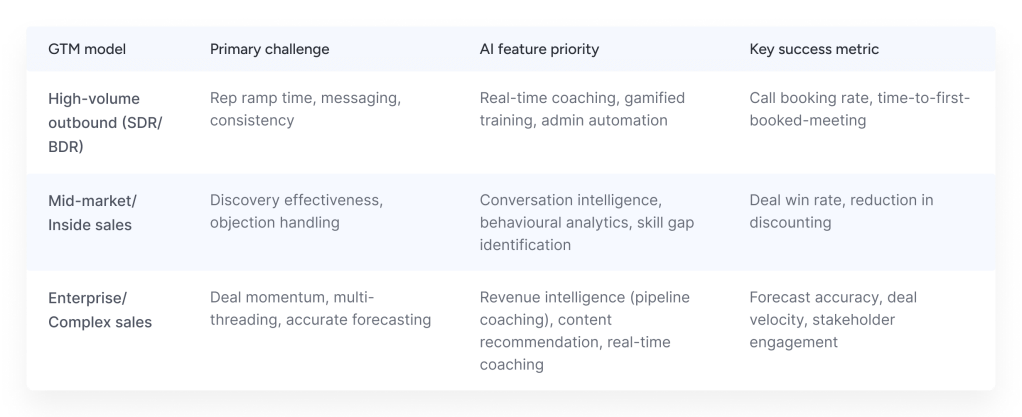
The table shows AI coaching focus across sales models. High-volume outbound teams use real-time coaching and automation to cut ramp time and boost booking rates. Mid-market sales prioritize conversation intelligence and analytics to improve discovery and raise win rates. Enterprise teams rely on revenue intelligence and real-time coaching to strengthen forecasting, deal velocity, and engagement.
Evaluate technical fit and integration
The value of an AI platform is only as strong as its integration with your existing tech stack, primarily your CRM (Salesforce, HubSpot, etc.) and your sales engagement platform (Outreach, Salesloft, etc.)
- Deep CRM integration: Ensure the AI platform writes back to the CRM automatically, creating call summaries, next steps, and opportunity updates. This is critical for achieving the time-saving benefits of AI.
- Scalability: Choose a platform that can handle your volume of calls and manage diverse coaching needs across multiple regions and languages.
- Data governance: Confirm the tool adheres to necessary data privacy and security standards, especially when dealing with sensitive customer conversations.
Final takeaway for revenue leaders
AI sales coaching is no longer a luxury, but the baseline requirement for maintaining competitive edge and driving sustainable sales growth. Teams utilizing these platforms see higher quota attainment and win rates [16]. By strategically adopting these tools, sales managers and RevOps leaders can transition from being reactive call listeners to proactive revenue accelerators, ensuring every rep performs at their peak potential. The future of B2B sales enablement is prescriptive, personalized, and powered by intelligence.
Sources:
[1] https://martal.ca/sales-cycle-lb
[2] https://sopro.io/resources/blog/b2b-buyer-statistics-and-insights
[3] https://www.mckinsey.com/~/media/mckinsey/business%20functions/marketing%20and%20sales/our%20insights/future%20of%20b2b%20sales%20the%20big%20reframe/future-of-b2b-sales-the-big-reframe.pdf
[4] https://userguiding.com/blog/product-led-growth-experts
[5] https://www.sap.com/blogs/sales-ai-makes-soft-skills-valuable
[6] https://persana.ai/blogs/ai-sales-case-studies
[7] https://www.claap.io/blog/what-is-conversation-intelligence
[8] https://kixie.com/sales-coaching-statistics-live-coaching-impact
[9] https://www.amplifai.com/blog/gamification-statistics
[10] https://www.clari.com/products/forecast
[11] https://spotio.io/blog/ai-sales-tools
[12] https://www.gong.io/press/revenue-organizations-using-ai-in-2024-reported-29-percent-higher-sales-growth-than-their-peers-according-to-new-report-from-gong
[13] https://www.salesforce.com/news/stories/sales-ai-statistics-2024
[14] https://www.outdoo.ai/blog/ai-sales-coaching-guide
[15] https://www.momentum.io/blog/top-ai-driven-sales-coaching-platforms-2025-buyers-guide-for-gtm-teams
[16] https://outscale.ai/2025/10/07/best-tools-for-ai-sales-coaching-in-2025
 Outscale.ai