
Table of contents
- 5 myths around AI sales coaching tools: The sales leader’s guide to debunking misconceptions
- Myth 1. AI sales coaching replaces human managers
- Myth 2: AI tools can’t understand sales context
- Myth 3: AI coaching is only for enterprise teams
- Myth 4: AI insights aren’t accurate or trustworthy
- Myth 5: Implementing AI coaching is too complex
- Myth 6: AI coaching is only post-call analysis
- Myth 6: AI coaching is only post-call analysis
- Conclusion: Embrace AI as the engine for sales manager effectiveness
5 myths around AI sales coaching tools: The sales leader’s guide to debunking misconceptions
In the demanding world of B2B sales, achieving consistent sales performance and boosting sales productivity are non-negotiable mandates for managers, directors, and VPs of Sales. Yet, the traditional model of sales coaching is crumbling under the weight of increased managerial responsibilities and the sheer volume of buyer interactions.
AI sales coaching tools are the answer to this gap. These platforms promise a future of hyper-personalized, scalable development for every rep, but their rise has been shadowed by skepticism. For Sales Managers, BDR/SDR Managers, and RevOps leaders responsible for implementing effective sales enablement strategies, navigating the noise requires separating fact from fiction. Concerns often center on job security for managers, the true intelligence of the technology, and whether these solutions are even viable outside of massive enterprise budgets.
These platforms promise a future of hyper-personalized, scalable development for every rep, but their rise has been shadowed by skepticism. For Sales Managers, BDR/SDR Managers, and RevOps leaders responsible for implementing effective sales enablement strategies, navigating the noise requires separating fact from fiction. Concerns often center on job security for managers, the true intelligence of the technology, and whether these solutions are even viable outside of massive enterprise budgets.
The reality is that modern, purpose-built AI is not a threat, but a critical engine for scaling coaching impact and driving revenue efficiency. This article will debunk the five most common myths about AI sales coaching tools, providing sales leaders with the clarity and data they need to embrace the next generation of sales enablement.
Myth 1. AI sales coaching replaces human managers
This is arguably the most persistent fear in the sales organization, suggesting that AI sales coaching tools are designed to render the human sales manager obsolete. This myth fundamentally misunderstands the role of AI, which is to augment, not automate away, the human element in coaching.
The truth is, AI is the necessary lifeline for the overburdened sales manager. Sales managers are facing immense pressure, with 70% overseeing more representatives than they did in the previous year [1]. This managerial strain means managers admit they lack the time to coach their teams regularly, with 44% reporting they don’t have enough time [2].
The resulting coaching gap is significant: while top-performing sales teams are 51% more likely to maintain a regular coaching cadence, managers spend less than 8% of their time actually coaching [3].
AI fills this time-and-bandwidth void by taking on the heavy lifting of repetitive, time-consuming tasks:
- 100% interaction analysis: AI analyses every single sales call and interaction, providing a complete, unbiased view of rep performance, which is impossible for a human manager to achieve.
- Rapid feedback loops: Platforms using Generative AI for simulation and role-play grading dramatically reduce turnaround time. An AI coach can review a role-play submission in roughly 60 seconds, compared to 17 minutes for a human manager [4]. This efficiency saves immense managerial time, with estimates showing that reviewing just 7,000 annual role-play submissions consumes the equivalent of 50 full work weeks of human effort [4].
- Enabling personalized coaching: When managers do coach, 39% of reps report sessions feel too generic, despite 91% of managers believing coaching improves performance [1]. AI closes this personalization gap by identifying specific, repeatable behaviors that correlate with positive outcomes for each individual rep.
As experts summarize, “AI doesn’t replace human coaches, it elevates them” [3]. It provides the necessary data and frees up managers to focus on the high-value activities: motivation, career development, complex deal strategy, and personalized, one-on-one leadership.
Myth 2: AI tools can’t understand sales context
A common skepticism, particularly among seasoned VP of Sales and Director of Sales leaders, is that technology cannot grasp the subtle, complex, and human-driven context of a sales conversation. They believe AI simply counts keywords and cannot distinguish between a successful objection handling and an awkward failure.
Modern AI for sales coaching, powered by advanced Natural Language Processing (NLP) and Generative AI, has moved far beyond simple keyword matching. These systems are now sophisticated conversation intelligence engines capable of interpreting not just what was said, but how it was received within the context of the deal stage.
- Interpreting intent and emotion: AI platforms now interpret nuance in tone, emotion, and intent. They can detect confusion, satisfaction, hesitation, and verbal indications of next steps in customer conversations [5]. Specialized tools even provide automated feedback on elements like a rep’s tone, duration of speaking, and specific phrasing within conversation simulations [6].
- High accuracy in call analysis: Under standard audio conditions, modern AI call analysis systems achieve approximately 95% accuracy [5]. This accuracy is critical for ensuring the insights delivered back to the manager are reliable.
- Surface true buyer intent: Traditional CRM systems only capture a small fraction of customer interactions. Revenue AI platforms, however, analyse the 99% of customer interactions missed by CRMs to surface genuine buyer intent and relationship health [7]. This comprehensive analysis leads to significantly better sales outcomes; the use of AI for meeting preparation and content recommendations, based on conversational context, has been shown to improve win rates by 9% [8].
AI provides the objective, data-rich layer of context that a manager might miss when only reviewing summary notes. This capability is essential for modern Revenue Operations (RevOps) teams focused on improving forecast accuracy and deal progression.
Myth 3: AI coaching is only for enterprise teams
For mid-market and SMB sales organizations, the belief that AI sales coaching tools are prohibitively expensive, complex, or only beneficial for sales teams with thousands of reps is a significant barrier to adoption. This myth of exclusivity is quickly becoming outdated.
AI is rapidly leveling the playing field between SMBs and larger enterprises, providing smaller sales teams with resources previously available only to the largest organizations [9]. The scalability and reduced cost of cloud-based, AI-native solutions have made them accessible to sales orgs of all sizes, from startups to the mid-market.
- SMBs are embracing AI: Small and mid-sized businesses are not just considering AI, they are aggressively adopting it. 75% of SMBs are already experimenting with AI tools, and a striking 91% of AI-using SMBs report revenue growth [9].
- Proven mid-market ROI: The impact is measurable. One mid-market B2B firm implemented AI for lead prioritization and coaching and achieved a notable 66% increase in win rates within three months [10].
- Consistent, low-cost training: For smaller teams, AI is the key to delivering consistent training without the need to hire additional full-time sales trainers or overburden existing managers. This makes advanced, personalized coaching economically viable for lean sales organizations [11].
- Efficiency gains: Beyond revenue growth, AI provides massive time savings for smaller teams. SMBs using AI report saving an average of 18 hours weekly through automation and AI-driven coaching efficiencies [10].
AI coaching is now an essential utility for growth, allowing small and mid-sized sales organizations to compete on the basis of training quality and performance consistency, regardless of headcount.
Myth 4: AI insights aren’t accurate or trustworthy
Trust is paramount when implementing technology that dictates how a sales team develops and performs. Concerns often arise regarding the accuracy of AI-generated insights and the potential for embedded bias in its recommendations. Sales Ops and RevOps leaders, who manage the integrity of the data ecosystem, often scrutinize this point closely.
The reliability of modern AI is secured by two key advancements: comprehensive data review and bias mitigation frameworks.
- Elimination of sample bias: The biggest threat to accuracy in coaching has historically been human bias and limited sample size. Manual coaching reviews typically cover only 1–3% of total sales interactions [5]. The problem is that managers naturally gravitate toward reviewing calls from their best or worst performers, creating a sample bias. AI monitoring reviews 100% of sales interactions, eliminating this bias and providing a statistically sound foundation for all insights [5].
- Data quality is the core: Bias in AI does not stem from human-like thought patterns, but from the quality of the underlying data. As expert commentary highlights, AI biases arise mainly from flawed labeling, missing entries, or imbalanced datasets used to train the models [12]. Leading AI platforms are engineered to address this by focusing on robust, balanced data inputs.
- Validated intelligence: Advanced conversation intelligence tools automatically extract accurate, reliable insights from the “messy” data of sales calls, significantly improving the reliability of the sales data flowing into the CRM and coaching programs [13]. Furthermore, modern RevOps teams validate AI’s effectiveness not just through sales metrics, but by combining them with broader buyer sentiment and Net Promoter Score (NPS) data to ensure AI is improving overall coaching outcomes and customer experience [1].
When implemented on a high-quality data set, AI offers an objective, high-fidelity lens into sales performance that is far more trustworthy than relying on limited manual observations.
Myth 5: Implementing AI coaching is too complex
The final hurdle for many sales leaders is the fear of long, cumbersome, and expensive implementation projects. Visions of lengthy IT engagements and complex integrations with existing sales technologies deter many from taking the leap.
Today’s AI sales coaching tools are built on cloud-native architectures designed for speed and ease of integration, completely changing the implementation timeline.
- Rapid deployment for fast ROI: The setup time for AI coaching platforms has shrunk dramatically. Traditional, pre-AI platforms often required up to eight weeks for setup, whereas AI-native tools are designed to deploy in as little as two weeks [14].
- Plug-and-play integration: Leading vendors provide rapid onboarding, often achieving deployment in one to two weeks with pre-built, seamless integrations for essential tools like Slack, Salesforce, and other communication platforms [15]. This allows sales teams to bypass complex, custom development work.
- Immediate value confirmation: Analysts specifically recommend that organizations aim for quick wins within the first 30 days of implementation to quickly prove the return on investment (ROI) of the AI solution [16]. This focus on rapid time-to-value ensures the technology starts driving results almost immediately, satisfying the demands of the RevOps team.
- Tangible efficiency benefits: The deployment of automation and contextual coaching quickly translates into operational gains for the team. SMBs using AI report saving approximately 2.25 hours per rep daily, resulting in monthly cost savings of around 4.7K, and, crucially, achieving 30% shorter sales cycles [17].
The complexity myth is now firmly in the past. Modern AI coaching is a fast, highly integrated solution designed to deliver immediate improvements to sales cycle efficiency and managerial capacity.
Myth 6: AI coaching is only post-call analysis
The final misconception that Sales and RevOps leaders often hold is that AI’s role is purely retrospective, limited to reviewing recorded calls and identifying trends after the interaction has ended. While post-call analysis is powerful, this view ignores the evolution of the technology into providing real-time, in-the-moment coaching.
Modern conversational intelligence platforms have developed the capability to listen to, process, and analyze live dialogues instantly. This advancement shifts coaching from being purely reactive to proactively guiding behavior when it matters most: while the representative is speaking to the prospect.
- In-moment guidance: Real-time coaching systems leverage Automated Speech Recognition (ASR) and large language models to offer contextual prompts. If a rep forgets a key compliance point, misses a critical competitor mention, or uses premature pricing language, the system can instantly suggest the correct next phrase or key piece of information in a discreet manner.
- Immediate behavioural correction: Waiting for post-call feedback means the opportunity to win that specific deal is lost. Real-time coaching ensures immediate behavioural correction, helping the rep pivot the conversation, address objections effectively, and stay on-script to maximize the chance of success in that live interaction.
- Product examples: Leading platforms, including innovative solutions like Cluely and Outscale.ai, offer this type of real-time guidance, transforming the rep’s experience by making the AI a co-pilot during difficult conversations.
By moving coaching into the live environment, AI transitions from a performance review tool to a direct driver of immediate deal outcomes.
Myth 6: AI coaching is only post-call analysis
The final misconception that Sales and RevOps leaders often hold is that AI’s role is purely retrospective, limited to reviewing recorded calls and identifying trends after the interaction has ended. While post-call analysis is powerful, this view ignores the evolution of the technology into providing real-time, in-the-moment coaching.
Modern conversational intelligence platforms have developed the capability to listen to, process, and analyze live dialogues instantly. This advancement shifts coaching from being purely reactive to proactively guiding behavior when it matters most: while the representative is speaking to the prospect.
- In-moment guidance: Real-time coaching systems leverage Automated Speech Recognition (ASR) and large language models to offer contextual prompts. If a rep forgets a key compliance point, misses a critical competitor mention, or uses premature pricing language, the system can instantly suggest the correct next phrase or key piece of information in a discreet manner.
- Immediate behavioural correction: Waiting for post-call feedback means the opportunity to win that specific deal is lost. Real-time coaching ensures immediate behavioural correction, helping the rep pivot the conversation, address objections effectively, and stay on-script to maximize the chance of success in that live interaction.
- Product examples: Leading platforms, including innovative solutions like Cluely and Outscale.ai, offer this type of real-time guidance, transforming the rep’s experience by making the AI a co-pilot during difficult conversations.
By moving coaching into the live environment, AI transitions from a performance review tool to a direct driver of immediate deal outcomes.
Summary of AI coaching myths vs. reality
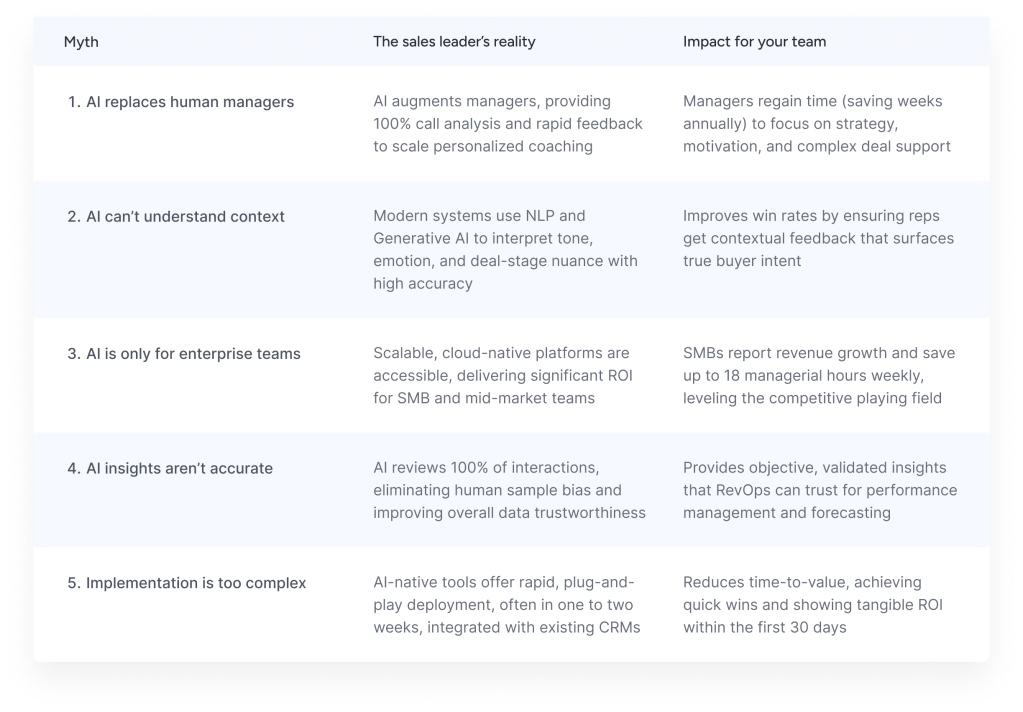
AI coaching doesn’t replace managers but augments them with rapid, 100% accurate call analysis and contextual feedback, freeing up time for strategy. These scalable, cloud-native tools are now accessible to all team sizes, providing objective, validated insights by reviewing all interactions. Implementation is fast, often plug-and-play, leading to quick ROI by delivering significant managerial time savings and improving win rates
Conclusion: Embrace AI as the engine for sales manager effectiveness
For Sales Managers, BDR/SDR Managers, and RevOps leaders, the five most common myths about AI sales coaching tools should no longer be sources of hesitation. The data overwhelmingly supports the position that AI is mature, accessible to all business sizes, and fundamentally designed to enhance human capability.
These platforms provide the foundation for true coaching scalability, allowing every member of the sales leadership team to deliver personalized, data-driven development based on objective performance data. By shifting from time-consuming manual review to high-leverage strategic coaching, your organization can significantly boost sales performance, ensure consistency across the board, and finally bridge the coaching gap that frustrates both reps and management.
It’s time for sales leaders to move past the myths and begin leveraging contextual coaching to drive measurable revenue efficiency across the entire sales pipeline.
Sources:
[1] https://www.mindtickle.com/blog/roi-of-ai-sales-training-and-coaching/
[2] https://www.outreach.io/resources/blog/ai-sales-coaching-software-boost-win-rates
[3] https://www.rainsalestraining.com/blog/ai-coaching-and-roleplay
[4] https://www.mindtickle.com/blog/ai-coach/
[5] https://www.solidmatics.com/blogs/beyond-listening-how-ai-powered-call-analysis-is-redefining-business-communication-and-intelligence
[6] https://brooksgroup.com/sales-training-company/news-and-press/selling-power-2024-top-ai-sales-coaching/
[7] https://www.gong.io/blog/ai-sales-task-prioritization
[8] https://www.highspot.com/blog/ai-sales-coaching/
[9] https://www.salesforce.com/news/stories/smbs-ai-trends-2025/
[10] https://skywork.ai/blog/smb-revenue-growth-ai-tools-best-practices-2025/
[11] https://www.pipedrive.com/en/blog/ai-sales-coaching
[12] https://www.tandfonline.com/doi/full/10.1080/09585192.2025.2480617
[13] https://www.salesforce.com/sales/conversation-intelligence/software
[14] https://www.oliv.ai/blog/gong-vs-clari
[15] https://www.momentum.io/blog/best-tools-that-analyze-sales-interactions-for-coaching-2025-buyers-guide
[16] https://www.11x.ai/blog/top-sales-automations-software-compared
[17] https://superprompt.com/blog/ai-sales-automation-small-business-11-tools-worth-paying-for-revenue-growth
 Outscale.ai