
Table of contents
- Budget-friendly tools for AI sales coaching: Maximize quota attainment without the enterprise price tag
- Balancing cost and capability: what “budget-friendly” really means
- Top low-cost AI coaching platforms for 2025
- Freemium and modular pricing: scaling as your team grows
- Hidden costs to watch out for
- How to choose the right tool for your team size and sales motion
- Summary and key takeaways for sales leadership
Budget-friendly tools for AI sales coaching: Maximize quota attainment without the enterprise price tag
The demand for hyper-efficient, data-driven sales coaching has never been higher. For sales managers, BDR managers, and directors of sales, ensuring consistent rep performance is the ultimate challenge. However, legacy conversation intelligence and sales enablement platforms often come with minimum contract values and per-seat costs that put them squarely out of reach for startups, small to mid-sized businesses (SMBs), and growing teams.
The good news for today’s RevOps and sales leadership is that the artificial intelligence landscape has leveled the playing field. New AI-native alternatives are offering the same, or even superior, contextual coaching capabilities, real-time feedback, and performance tracking at a fraction of the traditional cost. This shift means that achieving significant return on investment (ROI) through intelligent coaching is now a budget-friendly reality, not an enterprise luxury. This guide provides a curated look at the affordable AI sales coaching tools for 2025, offering a framework to help you choose a platform that delivers strong value without the burdensome enterprise pricing.
Balancing cost and capability: what “budget-friendly” really means
For a director of sales or a sales operations leader, “budget-friendly” is not synonymous with “cheap” or “low-feature,” it means achieving disproportionately high ROI for every dollar invested. AI coaching tools, even at accessible price points, are designed to generate significant, measurable gains. In fact, generative AI delivers an impressive average of a 3.7x return on investment for every dollar spent [1]. This explains why 91% of SMBs utilizing AI report revenue growth, with 86% noting improvements in profit margins [1].
In the context of sales coaching, true affordability is defined by a comparison between the expense of new AI-native platforms and the total cost of ownership (TCO) associated with legacy systems. Consider the stark contrast: older, established revenue intelligence tools can cost upwards of $500 per user per month, locking out smaller organizations with high minimums. Newer AI-native alternatives, however, are architected for efficiency, resulting in a TCO that is roughly 80% lower than their legacy counterparts [2].
For startups with fewer than 50 sales representatives, experts recommend adopting sales enablement tools with transparent pricing that stays within the $0 to $99 per user range, specifically to avoid platforms that impose mandatory minimum contract values of $5,000 or more [2].
The value proposition of AI is further underscored by the hidden costs of manual coaching. Organizations that rely solely on outdated manual coaching methods experience 20% higher turnover among their sales representatives, suggesting that the lack of data-driven, consistent feedback directly impacts retention and hiring costs [3]. By contrast, companies that embrace AI-driven sales coaching achieve an average of 30% improvement in overall quota attainment, proving that even budget-friendly tools provide measurable performance gains [4].
A truly budget-friendly AI coaching solution must include a non-negotiable set of core features [5]. These capabilities ensure that the platform is fundamentally valuable to both the sales manager and the frontline representative:
- Reliable transcription: Accurate capture of sales conversations.
- Talk-track analysis: Identifying successful and unsuccessful phrasing, objections, and handling techniques.
- Keyword and topic tracking: Monitoring adherence to approved messaging and competitor mentions.
- Basic sentiment analysis: Gauging the emotional temperature of the conversation to flag deals at risk.
Top low-cost AI coaching platforms for 2025
The market for conversation intelligence has rapidly matured, moving beyond a handful of expensive incumbents to embrace specialized, cost-effective solutions. These modern platforms focus on core AI coaching functionality, making them accessible to growing B2B SaaS organizations seeking maximum impact on a lean budget.
One powerful example of this market shift is Spiky.ai, which directly addresses the budget constraints of smaller teams by offering a free plan that covers up to 10 meetings per user [6]. Its paid plans are highly accessible, starting at just $15 to $29 per user per month, and include essential features like personalized coaching recommendations and seamless integration with major CRM systems like Salesforce and HubSpot [6]. This level of focused, low-cost capability has delivered tangible results, with one customer reporting a 75% reduction in deal review time and a 25% boost in team productivity after integrating the platform [7].
Another leader in accessible meeting transcription and collaboration is Otter.ai Business, which offers robust transcription capabilities at approximately $20 per user per month [8]. While primarily focused on accurate recording and sharing, its collaboration tools are foundational for small and mid-sized teams that need a searchable, reliable record of their calls.
For those needing more advanced conversation intelligence features closer to real-time, platforms like Cluely provide a strong mid-market entry point. Starting at about $20 per user per month for the Pro plan, this tool offers deep conversation intelligence and in-call, real-time feedback designed to guide sales representatives during live conversations [9]. The ability to receive automated, real-time guidance based on proven talk tracks is an immediate boost to sales efficiency. Furthermore, specialized real-time copilots, such as HeyNomi, are demonstrating high effectiveness, helping reps to close, on average, 12% more deals by providing immediate, in-the-moment support [10].
As the market continues to evolve, mid-market AI coaching tools are increasingly integrating advanced deal intelligence and pipeline risk alerts—features once exclusive to expensive enterprise platforms. This trend is creating viable, affordable alternatives for SMBs [11]. One such platform that excels in this segment is Outscale.ai. It focuses heavily on in-call, real-time guidance—a feature that provides immediate, contextual support to reps during live conversations. It is positioned perfectly for budget-conscious RevOps and sales leaders at high-growth B2B SaaS companies who need maximum impact on a lean budget. Outscale.ai’s platform is designed to guide reps in real time so they ask the right questions and handle objections flawlessly. A core capability is its Instant Knowledge Support: a RAG-powered agentic bot that provides reps with immediate, on-demand answers regarding product details, competitive intelligence, or support queries right during the call. By integrating this real-time coaching and knowledge support, Outscale.ai ensures 100% call coverage and helps managers cut down on manual coaching time significantly.
Freemium and modular pricing: scaling as your team grows
When selecting a budget-friendly AI tool, sales managers and RevOps professionals must look beyond the initial sticker price and evaluate how the platform’s pricing structure accommodates scaling. Freemium and modular pricing models have become essential strategies for managing tech expenditure effectively, ensuring that the cost of the platform aligns precisely with the value and functionality consumed.
Usage-based pricing, for instance, is highly preferred by customers, with 80% favoring models that align payment with the value actually received [12]. This is a massive advantage for organizations with fluctuating sales team sizes or seasonal sales cycles, as it allows them to tightly control spend.
Freemium models serve as a critical entry point. These often provide basic tiers that are completely free of charge, including core capabilities like meeting transcription and basic call summaries [13]. However, key features that unlock managerial and RevOps value—such as advanced analytics, custom talk-track analysis, and deep coaching features—are typically locked behind the paid subscription tiers [13]. This is an ideal way for a BDR Manager to onboard a small team and prove out the ROI before submitting a full platform request to finance.
The inherent drawback of freemium models must be acknowledged by sales leaders: many free AI coaching tools deliberately exclude essential CRM integration from their starter tiers [14]. This exclusion forces a manual data-entry workaround that becomes unsustainable as the team scales, inevitably making the “freemium” model an expensive bottleneck in the long run once a team outgrows the basic functionality.
Modular pricing is a sophisticated alternative that offers sales leaders granular control over budget allocation. This model charges based on distinct variables: per user, per feature, or per usage metric (such as call minutes analyzed) [15]. Modular pricing allows a director of sales to allocate budget precisely: dedicating a lower-cost, usage-based plan to the SDR function, for example, while ensuring the AE team has access to higher-tier deal intelligence features required for complex enterprise sales cycles. This level of precision is critical for revenue operations leaders managing tight budgets across fragmented sales functions [14].
A comparison of scaling models
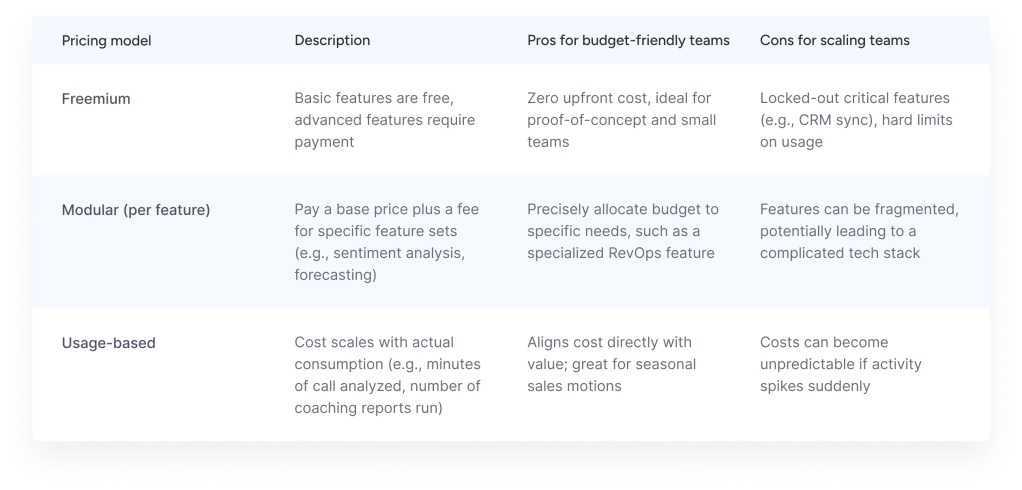
These pricing models each present trade-offs for growing businesses. Freemium is ideal for low-cost testing but restricts scaling teams with locked-out critical features. The Modular approach allows precise budget allocation to specific needs, though it risks complicating the tech stack with fragmented features. Finally, Usage-based pricing aligns cost directly with value consumed but can lead to unpredictable spikes in expense if activity suddenly increases
Hidden costs to watch out for
The biggest pitfall for sales managers adopting a new “budget-friendly” AI coaching tool is underestimating the true total cost of ownership (TCO). While a starter tier might be advertised at a remarkably low price, the transition to a fully functional suite can be jarring. In some cases, scaling from an initial low-cost tier (e.g., $25 per month) to a comprehensive AI suite can result in a staggering 22x cost increase per seat [16]. A thorough assessment of the sales tech stack’s long-term viability is paramount.
Sales leaders and RevOps professionals must scrutinize subscription agreements for several common hidden expenses [13]:
1. Onboarding and training fees
Many vendors charge non-recurring fees to cover the initial setup, platform customization, and comprehensive training for the sales management team and sales representatives. For growing teams, these costs, sometimes referred to as professional service fees, can be significant.
2. Integration costs
Seamless integration with your CRM (e.g., Salesforce, HubSpot) and existing sales engagement platform is non-negotiable. However, if your sales motion requires a custom or complex integration, AI integration projects can unexpectedly add $10,000 to $20,000 in professional service fees, which dramatically inflates the total cost of ownership and disrupts budget planning [17].
3. Premium analytics and reporting
Basic plans often provide conversation transcription and simple summaries. The real value for a VP of sales or a RevOps director lies in sophisticated features like customized performance dashboards, detailed trend analysis, and predictive pipeline risk modeling, which are frequently locked behind the most expensive tiers [13].
4. Usage and storage limits
Beware of caps on recorded call minutes, data storage, or the number of coaching reports generated per month. For a BDR team with high outbound call volume, hitting a usage limit can instantly trigger an expensive overage fee or necessitate an immediate, unplanned upgrade to a higher-priced plan. It is crucial to model your expected call volume against the stated limits of the plan before commitment.
How to choose the right tool for your team size and sales motion
Selecting the correct AI sales coaching tool requires a structured approach that aligns the platform’s capabilities with your organizational stage, the complexity of your sales cycle, and your overarching revenue operations goals.
Step 1: Prioritize seamless CRM integration
For every sales organization, regardless of size, the data foundation must be unified. RevOps leaders emphatically stress that seamless CRM integration is non-negotiable [18]. If the AI coaching platform cannot immediately and accurately push conversation data and insights back into Salesforce or HubSpot, it creates data silos. These silos destroy the purpose of unified revenue operations, leading to inaccurate forecasting and fragmented coaching efforts. Choose a tool that guarantees bidirectional data sync from day one.
Step 2: Match capabilities to your organizational stage
The ideal platform varies dramatically based on your team’s size and maturity [2].
- Startups (fewer than 50 reps): Focus on simplicity and speed. These teams should select simple, low-cost tools in the $0 to $99 per user range that require minimal setup effort. The primary goal is achieving basic conversation intelligence and talk-track consistency.
- Mid-market teams (50–200 reps): At this stage, fragmented costs become a problem. These teams benefit significantly from unified AI platforms that combine conversation intelligence, forecasting, and coaching within a single tool. This consolidation prevents the financial and operational friction caused by managing multiple, siloed vendors [2].
- Enterprise teams (200+ reps): Requirements shift to include governance and scalability. Enterprises often mandate SOC2/GDPR compliance and require robust APIs for integration, and demand rapid deployment. Newer AI-native solutions are disrupting this space by promising complete system rollout within one to two weeks, a dramatic improvement over legacy systems that can require hundreds of hours for setup [2].
Step 3: Align features with sales cycle complexity
The sales motion itself dictates the necessary feature depth.
- Simple BDR/SDR outbound motion: The focus should be on quantity, call clarity, and adherence to talk tracks. Tools featuring accurate transcription, basic sentiment scoring, and automated call summaries are sufficient.
- Complex AE sales cycles (high ACV/long cycle): For account executives managing high-value, complex deals, the AI tool must offer advanced analytics. You must prioritize features such as deal intelligence, deep sentiment analysis, and churn detection powered by conversation data [19]. These capabilities provide the sales manager with foresight into deal health, allowing for proactive intervention before a key opportunity collapses.
Summary and key takeaways for sales leadership
The era of expensive, inaccessible AI sales coaching is over. The current generation of AI-native tools provides high-impact capabilities—from real-time guidance to sophisticated deal intelligence—at a cost structured for growth. For SDR managers, RevOps, and VPs of Sales, the path to maximizing quota attainment with a budget-friendly platform involves strategic evaluation.
The key takeaway is to focus on Total Cost of Ownership, not just the introductory price. Embrace platforms with transparent, modular, or usage-based pricing models that allow you to scale functionality precisely as your sales team and revenue goals mature. By prioritizing seamless CRM integration and choosing a platform whose core features align with your team’s size and sales cycle complexity, you can leverage the power of AI to drive measurable performance gains and significantly reduce the hidden costs associated with manual, ineffective coaching.
Sources:
[1] https://bigsur.ai/blog/ai-adoption-statistics-smb-vs-enterprise
[2] https://www.oliv.ai/blog/best-revenue-intelligence-software-platforms
[3] https://insight7.io/guide-to-choosing-the-right-ai-sales-coaching-tool/
[4] https://outscale.ai/2025/10/15/best-tools-for-ai-sales-coaching-for-b2b-saas-in-2025/
[5] https://sales.hatrio.com/blog/9-best-ai-sales-coaching-tools-2025/
[6] https://spiky.ai/en/pricing
[7] https://spiky.ai/case-studies/what-a-story
[8] https://www.outdoo.ai/blog/12-sales-coaching-tools-you-should-consider
[9] https://cluely.com/pricing
[10] https://www.heynomi.com/
[11] https://www.eesel.ai/blog/gong-competitor
[12] https://www.zuora.com/guides/ultimate-guide-to-usage-based-pricing/
[13] https://medium.com/@KMSSolutions/saas-costs-a-detailed-breakdown-of-pricing-models-hidden-fees-and-long-term-roi-83465c1a4dd1
[14] https://www.allego.com/blog/how-to-choose-the-right-ai-sales-tool/
[15] https://www.researchgate.net/publication/394873614_Dynamic_Pricing_Models_in_SaaS_A_Comparative_Analysis_of_AI-_Powered_Monetization_Strategies
[16] https://www.hyperbound.ai/blog/the-complete-cost-breakdown-what-sales-ai-tools-really-cost-after-beta
[17] https://ddi-dev.com/blog/programming/how-much-does-ai-cost/
[18] https://www.konnectify.co/blogs/the-ultimate-guide-to-revops-software-and-tools-in-2025
[19] https://www.cxtoday.com/conversational-ai/top-conversational-intelligence-vendors-ai-driven-insights-for-smarter-enterprises/

 Outscale.ai