
Table of contents
- How to evaluate AI sales coaching software in 2025: A practical guide for sales leaders
- 1. Defining your coaching goals before choosing a tool
- 2. Key evaluation criteria for modern AI tools
- 3. Integration and workflow compatibility
- 4. Security, compliance, and ethical AI considerations
- 5. Measuring ROI after implementation
- Conclusion
How to evaluate AI sales coaching software in 2025: A practical guide for sales leaders
In 2025, the strategic shift from manual, anecdotal sales coaching to AI-driven enablement is no longer optional, it is fundamental to revenue predictability. For sales managers, BDR/SDR managers, and RevOps leaders, the challenge isn’t whether to adopt artificial intelligence, but how to select the right platform from a rapidly expanding market. Choosing the wrong tool can lead to stalled adoption, integration nightmares, and a costly failure to impact the bottom line.
This guide provides a practical, five-step framework for assessing AI-driven coaching software based on core factors like accuracy, integration, and long-term business impact. Selecting a tool in this category is a revenue decision, and a structured evaluation process is the key to mitigating risk and accelerating performance across your entire sales organization.
The cost of inaction, or choosing poorly, is severe. With the average cost of replacing a single sales representative estimated at approximately 195,000, investing in effective, scalable coaching is the primary strategy for cost mitigation and talent retention [1]. Your evaluation must move beyond superficial feature lists and drill down into the platform’s core analytical engine and its compatibility with your existing sales ecosystem.
1. Defining your coaching goals before choosing a tool
Before even requesting a vendor demonstration, sales leaders must align software selection with specific, measurable performance objectives. The AI tool is merely a mechanism to achieve predefined organizational goals, not a goal in itself. This upfront clarity is the foundation of a successful deployment.
A major challenge in sales enablement is misalignment, with surveys indicating that about 94% of businesses fail to align individual sales goals with corporate objectives [2]. This lack of connection between enablement activities and key business outcomes means coaching efforts often miss the mark. A data-driven approach is essential, as sales teams utilizing this methodology are 2.3 times more likely to achieve their goals than those relying solely on intuition [3].
Here are the critical features that define a best-in-class AI sales coaching tools in 2025:
- Outcome-based: Focus on tangible results that AI can analyse and influence. This could involve improving close rates in a specific vertical, enhancing product knowledge retention, or significantly reducing the ramp time for new hires [4].
- Skill-specific: Sales leaders recommend explicitly setting coaching objectives linked to performance targets, such as better discovery call execution, improved qualification efficiency, or a higher demo conversion rate [5]. This ensures the AI tool is evaluated against its ability to measure and correct specific, measurable skills.
The demand for scalable coaching has never been higher, with 70% of sales managers reporting overseeing a higher volume of sales representatives compared to the previous year [6]. AI provides the urgency and scalability needed to meet this demand. Moreover, the investment directly translates to results, as sellers who receive high-performing coaching achieve win rates that are 53% higher than their peers [1]. Therefore, your goals should directly target the skills needed to move your lagging indicators, like pipeline velocity and revenue growth.
2. Key evaluation criteria for modern AI tools
Once your goals are defined, the technical assessment begins. The core value of AI coaching lies in its ability to accurately and instantly extract insights from sales conversations and present them to managers and reps in a usable format.
Data accuracy and conversation intelligence quality
The performance of any AI coaching tool hinges on the quality of its underlying conversation intelligence engine. As experts note, the core of these tools is transcription accuracy, operating under the tenet: “If the words are wrong, the outcomes are too” [7].
When evaluating transcription and analysis capabilities, prioritize the following:
- Transcription precision Look for providers that boast modern AI transcription accuracy rivaling human levels, typically operating in the 90–97% range under ideal conditions [8]. Errors in transcription lead to flawed analytics and poor coaching recommendations.
- Real-time contextual coaching: Teams using real-time AI guidance have seen up to a 20% improvement in key sales skills, such as open-ended questioning and active listening [9]. The platform should be able to deliver in-the-moment suggestions or alerts based on conversation flow, tone, and stated customer objections.
- Custom model training: Evaluators must ensure the AI is trained using secure, clean, company-specific data [10]. Generic large language models (LLMs) often lack the contextual understanding required for effective sales coaching, especially when dealing with proprietary product terms, unique industry jargon, or specific competitor names.
User experience and reporting depth
A sophisticated AI engine is useless if managers and representatives cannot easily access and act on the data. Reps on AI-powered teams report 80% easier access to customer insights compared to only 54% on non-AI teams [11], which speaks directly to the quality of the user interface.
Modern AI platforms must automatically record, transcribe, and analyze calls, producing rep scorecards and highlighting skill gaps in real time to improve essential skills like discovery and objection handling [10]. Furthermore, data quality directly supports business operations: teams using AI-informed coaching were 30% more likely to submit accurate sales forecasts, demonstrating superior pipeline visibility [9].
3. Integration and workflow compatibility
AI coaching software must seamlessly integrate with your existing sales technology stack. Integration challenges remain a significant barrier, with 19% of companies citing tool and system integration as their top implementation hurdle [12]. Ignoring compatibility will lead to low user adoption, data silos, and a swift death for the project’s ROI.
CRM and data synchronization
The most critical integration is with your customer relationship management (CRM) system. Tight CRM integration ensures real-time data sharing between coaching insights and sales pipelines, preventing representatives from wasting time on manual updates and losing valuable customer context [13].
The business impact of this tight integration is undeniable:
- Businesses see an average 29% increase in sales revenue and a 34% boost in sales productivity after integrating systems like CRM [14].
- Companies that implemented integrated CRM technology saw up to a 42% improvement in sales forecasting accuracy [14].
- Organizations with CRM-connected coaching tools report roughly 15% higher win rates and 8% higher quarterly revenue growth compared to peers without integration [13].
Workflow and enablement tool compatibility
Look beyond the CRM. The coaching software should also integrate smoothly with existing workflows and tools, such as automatically capturing calls via calendar sync and pushing summarized insights directly to collaboration platforms like Slack or into your learning management system (LMS) [15]. This frictionless data flow drives sustained adoption and usage across the team.
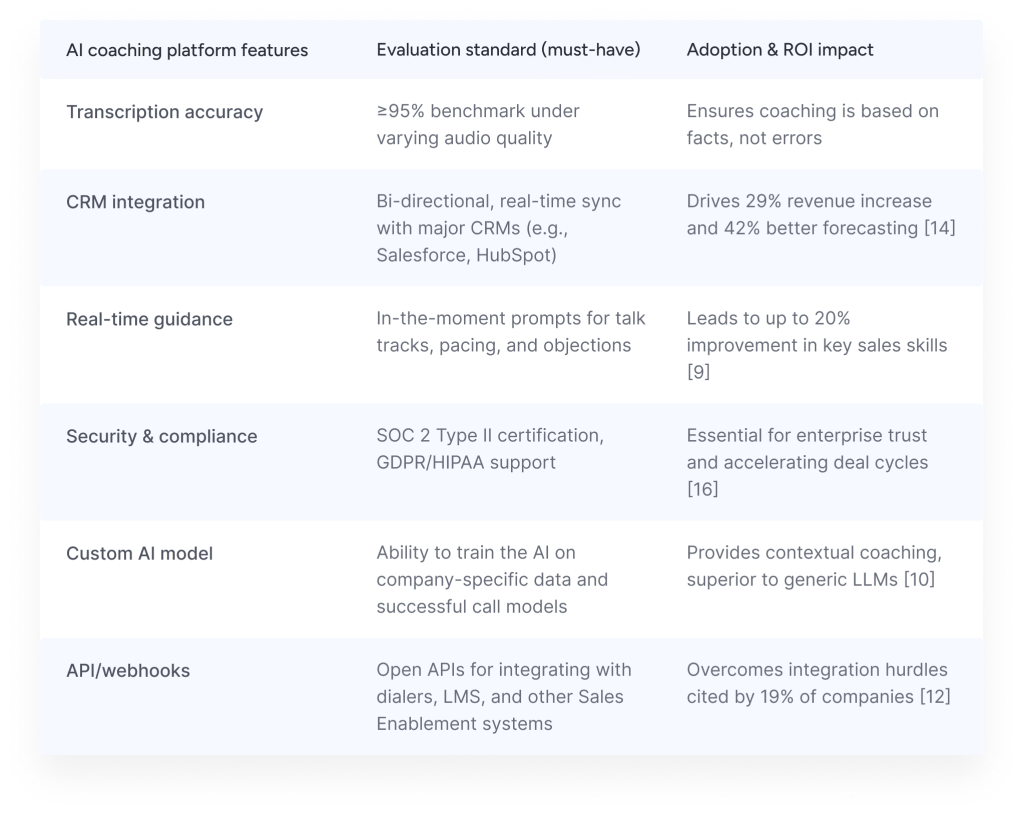
The table outlines key evaluation standards and ROI impacts of AI coaching platform features. High transcription accuracy (≥95%) ensures reliable coaching insights, while bi-directional CRM integration with tools like Salesforce and HubSpot drives up to a 29% revenue boost and 42% better forecasting. Real-time guidance enhances sales performance by up to 20%. Security and compliance with SOC 2, GDPR, and HIPAA standards are vital for enterprise trust. Custom AI models enable context-rich coaching tailored to company data, and open APIs or webhooks ease integration challenges faced by 19% of organizations
4. Security, compliance, and ethical AI considerations
For RevOps and Sales Operations, the adoption of new AI tools introduces critical considerations around data governance, compliance, and ethical usage. When handling sensitive customer and employee conversation data, robust security is not optional, it is an enterprise requirement.
Data privacy and regulatory compliance
Privacy compliance is non-negotiable, particularly when dealing with global customers. Sales leaders must inquire whether the vendor supports constraints like GDPR and HIPAA, and offers essential privacy features [15]:
- Consent prompts: Mechanisms for ensuring consent is captured for recording and analysis.
- Redaction and masking: The ability to automatically redact personally identifiable information (PII) or sensitive numbers from transcriptions and audio recordings.
- Role-based access: Granular controls to ensure only authorized managers and leaders can access specific coaching data or representative performance dashboards.
A key indicator of a reliable, enterprise-ready platform is the achievement of SOC 2 Type II certification [22]. This standard builds trust with clients, especially in highly regulated industries, and can significantly accelerate deal cycles by satisfying security questionnaires early on.
Ethical AI and bias mitigation
As AI plays a larger role in evaluating human performance, ethical considerations become paramount. Ethical AI usage requires vendors to demonstrate transparency, active bias mitigation, and a commitment to maintaining human oversight [17].
Bias mitigation is crucial to ensure fairness. If the AI is trained primarily on one demographic of high-performing sellers, it may unfairly penalize others who use different, but equally effective, sales styles. You must understand how the vendor ensures the AI’s scoring and feedback mechanisms are fair and impartial across all team members. The ICF AI Coaching Framework, established in November 2024, sets clear standards across ethics, assurance, and bias mitigation, ensuring trustworthy AI coaching outputs [18]. Sales leaders should ensure their chosen vendor actively aligns with these or similar established industry frameworks.
5. Measuring ROI after implementation
The final, and perhaps most important, step is defining how you will measure the return on investment (ROI). AI sales coaching is a strategic investment in human capital; its success must be measured through changes in representative behaviour and resulting revenue outcomes.
The quantitative evidence supporting AI-enhanced coaching is compelling. Revenue organizations using AI reported 29% higher sales growth in 2024 than their non-AI counterparts [19]. Furthermore, AI coaching has been shown to:
- Accelerate sales cycles: It can shorten sales cycles by up to 22% and boost rep productivity by 30% [9].
- Boost win rates and attainment: Organizations with AI-enhanced coaching saw win rates increase by up to 50% and quota attainment roughly 3.3 times higher year over year [9].
To measure ROI effectively, sales leaders should establish baseline metrics prior to implementation and track the following before-and-after metrics [20]:
Behavioural metrics (leading indicators)
These metrics assess the effectiveness of the coaching itself:
- Talk/listen ratio: Did the AI successfully coach reps toward the ideal benchmark?
- Use of discovery questions: Did the frequency and quality of open-ended questions improve?
- Adherence to required talk tracks: Did the team consistently follow the prescribed messaging in key deal stages?
- Ramp time for new hires: Was the time it took a new representative to hit 50% or 100% quota reduced?
A key indicator of a reliable, enterprise-ready platform is the achievement of SOC 2 Type II certification [22]. This standard builds trust with clients, especially in highly regulated industries, and can significantly accelerate deal cycles by satisfying security questionnaires early on.
Revenue outcomes (lagging indicators)
These metrics assess the business impact of the behavioural changes:
- Win rate: The percentage of opportunities closed-won versus closed-lost.
- Sales-cycle time: The average number of days from opportunity creation to close.
- Quota attainment: The percentage of representatives hitting or exceeding their quarterly quotas.
- Pipeline visibility and forecast accuracy: The improvement in the management team’s ability to accurately predict revenue.
Conclusion
Evaluating AI sales coaching software in 2025 is a rigorous, multi-faceted exercise. It requires Sales Managers, Directors, and RevOps leaders to look beyond the hype and focus on the practical realities of implementation.
The right AI platform is defined not by the number of features it offers, but by its ability to align with your specific coaching goals, deliver highly accurate and contextualized intelligence, integrate seamlessly with your core systems, and adhere to strict enterprise security and ethical standards. By following this structured approach, you ensure your investment delivers scalable, measurable improvements in sales behavior, ultimately leading to higher win rates and predictable revenue growth. The future of sales enablement is AI-powered, but only those organizations that conduct a thorough, strategic evaluation will unlock its full transformative potential.
Sources:
[1] https://challengerinc.com/blog/challenger-sales-coaching-framework/
[2] https://salesxceleration.com/sales-leadership-in-2024-key-takeaways-and-what-to-expect-next-year
[3] https://forecastio.ai/blog/strategies-for-setting-and-achieving-effective-sales-goals
[4] https://www.allego.com/resources/dont-let-ai-pass-you-by-the-new-era-of-personalized-sales-coaching-development/
[5] https://spiky.ai/en/blog/sales-coaching-in-2025
[6] https://www.mindtickle.com/blog/roi-of-ai-sales-training-and-coaching/
[7] https://www.assemblyai.com/blog/conversation-intelligence
[8] https://medium.com/@metricoidtechnology/conversations-into-conversions-how-ai-call-transcription-is-transforming-sales-teams-62856bbf2a23
[9] https://outscale.ai/ai-sales-coaching/
[10] https://www.salesforce.com/news/stories/sales-ai-statistics-2024/
[11] https://www.momentum.io/blog/top-ai-driven-sales-coaching-platforms-2025-buyers-guide-for-gtm-teams
[12] https://www.freshworks.com/theworks/company-news/crm-statistics/
[13] https://www.revenue.io/blog/top-sales-enablement-tools-with-crm-integration
[14] https://crm.org/crmland/crm-statistics
[15] https://www.claap.io/blog/conversation-intelligence-software
[16] https://scytale.ai/resources/soc-2-certified-the-secret-weapon-for-winning-over-big-clients/
[17] https://www.intelemark.com/blog/ethical-considerations-in-ai-driven-sales/
[18] https://coachingfederation.org/resource/icf-artificial-intelligence-ai-coaching-framework-and-standards/
[19] https://www.gong.io/press/revenue-organizations-using-ai-in-2024-reported-29-percent-higher-sales-growth-than-their-peers-according-to-new-report-from-gong/
[20] https://www.l-ten.org/Web/Web/News---Insights/focus-articles/Measuring-the-ROI-of-AI-Powered-Sales-Coaching-in-Life-Sciences.aspx
 Outscale.ai