
Table of contents
- Alternatives to Gong in the AI sales coaching space: A comprehensive guide for sales leaders
- Why companies look beyond Gong
- The high cost of historical data
- Usability and rep adoption challenges
- The real-time coaching gap
- Key factors when comparing AI sales coaching platforms
- Conversation intelligence platforms: the post-call analysis leaders
- Real-time coaching platforms: Instant guidance during live calls
- Featuring Outscale.ai: real-time sales coaching for high-growth SaaS
- Choosing the right alternative for your team’s workflow
Alternatives to Gong in the AI sales coaching space: A comprehensive guide for sales leaders
In the modern sales landscape, AI-powered sales coaching is no longer a luxury, it is a critical necessity. For years, conversation intelligence (CI) platforms like Gong have defined the category, turning unstructured sales calls into searchable, quantifiable data. These tools have proven their value, offering deep insights into win-loss reasons, talk tracks, and market feedback.
However, as the market matures and the pressure to hit quota intensifies—with 67% of sales reps expected to miss quota in 2024 [1]—sales, BDR, and RevOps leaders are demanding more. They need solutions that are not just analytical, but truly actionable, scalable, and budget-conscious. This exploration delves into the leading alternatives to the established players, examining their strengths, trade-offs, and providing a framework for choosing the right AI coaching platform to maximize your team’s performance and achieve consistent revenue growth.
Why companies look beyond Gong
While Gong set the gold standard for conversation intelligence, several fundamental challenges are prompting scaling teams and enterprises to explore alternative solutions. The issues typically revolve around cost, complexity, and, most importantly, the effectiveness of post-call versus real-time coaching.
The high cost of historical data
The most immediate friction point for many organizations is pricing. Gong’s structure often involves a mandatory annual platform fee, which starts around $5,000, paired with high per-user costs, which can begin at $1,360 per year [2]. This financial model can become prohibitively expensive, particularly for scaling mid-market teams or those with high SDR/BDR turnover.
Furthermore, some sales leaders feel they are not extracting proportional value from this significant investment. One common complaint is, “we paid $30k/year just to have call recordings no one looked at” [3]. This quote highlights a fundamental challenge: high-cost tools only deliver ROI if they are fully adopted and integrated into the daily workflow of the frontline team.
Usability and rep adoption challenges
Effective coaching requires tools that benefit both managers and reps. However, analysts have noted that the dashboards and reporting features in legacy conversation intelligence tools are frequently optimized more for management reporting than for direct seller use [3]. If the tool does not provide clear, immediate value to the rep, adoption rates suffer significantly.
When adoption lags, the data quality suffers as well, reducing the effectiveness of the entire system. Moreover, users frequently report persistent transcript errors, especially with difficult accents or highly specific industry terminology [4]. Correcting these inaccuracies consumes valuable time, leading to manual work that defeats the purpose of AI automation.
The real-time coaching gap
Perhaps the most significant push for alternatives stems from the inherent limitation of purely post-call analysis. A key drawback of legacy conversation intelligence platforms is the lack of real-time feedback during live sales calls [5]. This means a sales professional must complete the entire conversation, often missing critical opportunities, before receiving any analysis.
In high-stakes, fast-moving sales motions, delaying feedback is equivalent to losing deals. As the need for continuous, effective coaching intensifies, sales leaders are recognizing that insights delivered after the conversation can only shape long-term behavior, not save the deal happening right now. They are now actively seeking solutions that bridge this gap with immediate, contextual guidance provided by next-generation tools, such as real-time coaching platforms like Outscale.ai.
Key factors when comparing AI sales coaching platforms
Choosing the correct AI sales coaching platform is a strategic decision for revenue operations, sales enablement, and frontline managers. It requires a detailed evaluation beyond simply checking boxes for features. The right platform must not only capture data but also seamlessly integrate into and elevate your existing revenue engine.
Sales managers already recognize the impact of coaching, with 91% stating that effective coaching directly improves team performance [6]. Here are the key factors your team should prioritize when evaluating AI alternatives:
1. Real-time guidance capabilities
The most significant differentiator today is the ability to provide instant, contextual coaching. Does the platform only analyze the recording after the call, or can it listen in and deliver actionable prompts, talk-track suggestions, or alerts on key behavioral moments (like interrupting a buyer or forgetting to mention a value driver) during the live conversation? This capability is vital for closing skill gaps immediately.
2. Integration depth and RevOps alignment
For RevOps and Sales Ops, a coaching tool must connect to the entire revenue engine. Effective Revenue AI should integrate deeply with your CRM, communication tools (like Slack), and other sales tools to prevent data silos and inefficiency [7]. Look for platforms that automate routine administrative tasks, such as logging calls, syncing notes, and updating CRM fields, which can save reps hours each week [8]. Instant alerts on at-risk deals or missing next steps should be directly pushed into Slack or Salesforce workflows, as delayed insights often cost deals [8].
3. Analytics accuracy and actionability
Beyond accurate transcription, the platform must deliver high-fidelity insights. This includes:
- Topic detection: Accurately identifying product mentions, competitor challenges, and pricing discussions.
- Sentiment analysis: Correctly gauging buyer emotion and engagement.
- Actionability: Are the insights presented in a way that allows managers to create specific, measurable coaching actions? Remember that sales teams typically need 3–6 months of call data to train reliable AI coaching models and establish an accurate performance baseline [9].
4. Scalability, compliance, and ease of use
As 49% of technology leaders report AI is now fully integrated into their core strategy, the demand for compliant, scalable coaching tools is increasing [10]. The chosen platform must scale effortlessly from a small BDR team to a global enterprise.
Crucially, ease of use is non-negotiable. If a coaching tool is difficult or clunky to navigate, adoption among sales teams will drop quickly, regardless of how robust the features are [6]. A clean, intuitive interface ensures reps actually use the tool to self-coach and managers use it for efficient review.
Conversation intelligence platforms: the post-call analysis leaders
This segment of the market, once dominated by a single player, has diversified into several robust platforms that excel at historical analysis, structured coaching, and deep deal scrutiny. These tools are ideal for organizations focused on long-term skill development, pipeline health, and structured manager-led coaching sessions.
Key players in post-call analysis
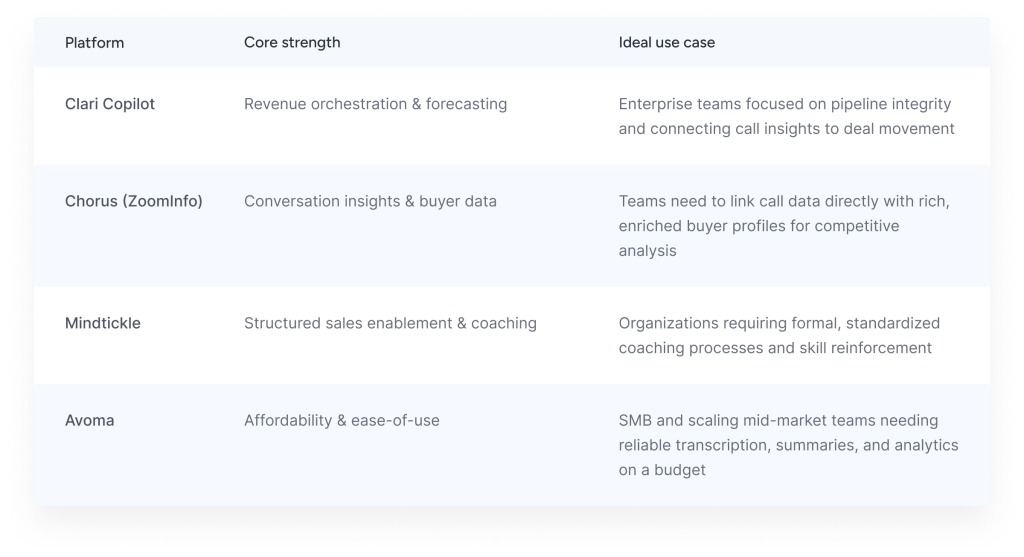
This table compares four post-call analysis platforms: Clari Copilot (revenue orchestration and forecasting for enterprise pipeline integrity), Chorus (ZoomInfo) (conversation insights and buyer data for competitive analysis), Mindtickle (structured sales enablement and coaching), and Avoma (affordability and ease-of-use for SMB transcription and analytics). Each platform targets specific organizational needs, from high-level revenue management to skill reinforcement and budget-conscious analysis
These platforms operate by recording, transcribing, and analyzing 100% of sales interactions—calls, emails, and CRM notes. This systemic approach is a massive upgrade over traditional methods, where managers typically reviewed only 20–30% of calls manually [18].
- Pipeline and deal inspection: Tools like Clari Copilot focus on connecting conversation insights directly to revenue outcomes. According to a Forrester TEI study, Clari’s Revenue Orchestration Platform delivered a 398% ROI and $96.2 million in net value over three years for its customers [11]. This demonstrates the financial power of linking detailed call performance to forecast accuracy and pipeline health.
- Enhanced buyer data: Chorus.ai, now part of ZoomInfo, leverages its access to enriched buyer data to go beyond simple transcription, combining AI analysis with comprehensive prospect information to deepen post-call insights and better understand buyer intent [12].
- Structured coaching and enablement: Mindtickle, for instance, focuses on the coaching workflow itself. Their customers report a high completion rate, with 95% of coaching forms completed on time [13]. This ensures that conversation intelligence insights translate into measurable, consistent, and structured skill improvement plans.
- Efficiency and win rates: The impact of these analytics is clear: teams leveraging conversation intelligence report a 15% higher win rate and 27% shorter call handling times compared to teams without such analytics [14]. For scaling teams, Avoma is often cited as a more affordable, easy-to-use solution for transcription, summaries, and analytics, rated 4.6/5 on G2 for its accessibility for SMBs [8].
Real-time coaching platforms: Instant guidance during live calls
A new, highly disruptive category of AI platforms is shifting the coaching focus from hindsight to foresight. These real-time coaching platforms specialize in delivering instant, in-the-moment feedback, prompts, and behavioral nudges directly to the rep during a live call. This approach is rapidly becoming the gold standard for high-volume sales motions, new hire ramp, and closing critical skill gaps immediately.
The power of contextual coaching
The core value proposition of these tools, which include innovators like Cluely, HeyNomi, Salesken.ai, Outscale.ai, Spiky.ai, and Maximus, is the ability to enable proactive coaching. Instead of waiting until the weekly 1:1, reps receive AI-driven guidance when they need it most: mid-conversation.
The data strongly validates this shift:
- Teams utilizing AI-driven real-time call coaching report a 17% improvement in close rates compared to those using post-call-only coaching [15].
- Live call coaching drives a substantial 30% increase in reps meeting quota, with attainment rising from 16% to 46% after implementation [16].
- Gartner data further confirms that live feedback during calls improves close rates by over 12% [17].
For managers, this translates into faster results and stronger team retention. Real-time AI coaching can reduce rep ramp time by 50%, potentially dropping onboarding duration from six months to three months [16]. Furthermore, reps who receive this instant support are 40% more likely to stay with their company for two or more years [16].
Featuring Outscale.ai: real-time sales coaching for high-growth SaaS
Outscale.ai (https://outscale.ai) is designed as a sales coaching platform that guides reps during live calls, helping them ask the right questions and handle objections flawlessly. It is explicitly positioned for high-growth SaaS RevOps and Sales Leaders who struggle with the volume of calls and inconsistent rep performance.
Key features include:
- Real-time guidance & objection handling: The platform acts as an AI coach during live calls, suggesting deep-dive questions, cross-sell/upsell opportunities, and providing objection handling strategies, all personalized to the individual rep.
- Instant knowledge support (RAG-powered): It provides immediate access to company information, product details, and competitor battle cards via a RAG-powered agentic bot. This knowledge support is quick, always up-to-date, and accessible in natural language during the call.
- Comprehensive call analysis & missed opportunities: The AI uses advanced, custom fine-tuned models to analyze 100% of sales conversations. It detects missed opportunities, performance patterns, and assesses quality without manual review, cutting coaching time by up to 80% [18].
- Seamless integration: It functions as a Chrome extension, working directly within popular communication tools like Google Meet and Zoom. This provides a zero-learning-curve experience and automates post-call workflows.
Outscale.ai focuses on delivering personalized, immediate behavioral correction and skill reinforcement, enabling reps to apply feedback instantly and close skill gaps far faster than traditional methods allow.
Choosing the right alternative for your team’s workflow
The decision between a post-call analysis leader and a real-time coaching innovator is not about which tool is universally “better,” but which methodology aligns best with your team’s specific sales motion, deal velocity, and existing enablement maturity.
The most effective sales organizations often implement a dual-strategy, combining both methods for a continuous feedback loop [19]:

This table outlines decision factors for choosing between real-time coaching platforms and post-call Conversation Intelligence (CI) platforms. Real-time platforms are prioritized for high-volume, short-cycle sales motions, new or high-turnover reps, and goals like instant behavioral change and rapid skill reinforcement for budget-sensitive teams. Post-call CI platforms are prioritized for complex, long-cycle enterprise sales, experienced teams, and goals requiring deep root-cause analysis, competitive intelligence, and structured curriculum enforcement by Revenue Operations teams needing unified orchestration and historical data
The value of balanced coaching
Real-time coaching delivers instant behavioral guidance during live calls, creating muscle memory and addressing in-the-moment failures [19]. If your core challenge is consistency—ensuring 20 BDRs ask the right discovery questions or handle the same three objections correctly—real-time prompts and alerts are indispensable. This proactive intervention prevents negative behavior from being reinforced across dozens of calls.
Post-call analysis conversely, provides historical insights to shape long-term training strategies and identify systemic problems [19]. This is where RevOps and sales leaders find strategic value: dissecting the why behind a lost deal six months ago or quantifying the long-term effectiveness of a new value proposition.
By carefully assessing your team’s most pressing pain point—whether it is the need for immediate, contextual guidance to save the current deal, or the need for deep, structured analysis to perfect the long-term sales playbook—you can select the alternative that delivers the highest ROI for your revenue goals. conversely, provides historical insights to shape long-term training strategies and identify systemic problems [19]. This is where RevOps and sales leaders find strategic value: dissecting the why behind a lost deal six months ago or quantifying the long-term effectiveness of a new value proposition.
Sources:
[1] https://www.highspot.com/blog/hit-sales-quota-with-ai-coaching/
[2] https://www.claap.io/blog/gong-pricing
[3] https://www.claap.io/blog/gong-alternatives
[4] https://www.meetjamie.ai/blog/gong-alternatives
[5] https://www.meetjamie.ai/blog/gong-ai
[6] https://www.mindtickle.com/blog/sales-coaching-software
[7] https://www.glean.com/blog/ai-in-revenue-operations
[8] https://www.momentum.io/blog/gong-io-alternatives-conversation-intelligence-revenue-orchestration
[9] https://insight7.io/how-to-build-a-sales-coaching-workflow-that-reduces-manual-call-review/
[10] https://www.pwc.com/us/en/tech-effect/ai-analytics/ai-predictions.html
[11] https://www.clari.com/press/clari-revenue-ai-delivered-96-million-in-value-to-enterprise-customers/
[12] https://www.momentum.io/blog/top-ai-driven-sales-coaching-platforms-2025-buyers-guide-for-gtm-teams
[13] https://www.mindtickle.com/sales-coaching-insights/
[14] https://www.assemblyai.com/blog/the-conversation-intelligence-value-machine
[15] https://www.articsledge.com/post/ai-powered-real-time-sales-coaching-for-reps
[16] https://www.kixie.com/sales-blog/sales-coaching-statistics-and-the-impact-of-live-coaching-on-quota-attainment/
[17] https://spiky.ai/en/blog/real-time-sales-coaching-benefits
[18] https://outscale.ai/
[19] https://blog.miarec.com/real-time-versus-post-call-voice-analytics
 Outscale.ai