
Table of contents
- Cost-effective Gong competitors: AI-driven coaching without the enterprise price tag
- Why teams are searching for cost-effective Gong alternatives
- The rise of category-focused AI sales coaching tools
- Conversation intelligence tools: Post-call insights for structured coaching
- Real-time coaching tools: In-the-moment feedback for faster improvement
- Finding the right balance between capability and cost
- Conclusion: The future is specialized and cost-conscious
Cost-effective Gong competitors: AI-driven coaching without the enterprise price tag
In the current high-pressure sales climate, sales and revenue operations leaders are facing a tough mandate: maximize rep performance, accelerate deal cycles, and do it all while radically reducing technology spend. The consensus is clear, AI-driven coaching is no longer a luxury, it is a necessity for predictable revenue growth. Yet, for many SDR Managers, Sales VPs, and RevOps leaders, the cost of implementing legacy conversation intelligence platforms, often referred to as the “Gong tax,” has become an unacceptable drain on the budget.
While market leaders like Gong established the category, the new generation of AI-native sales coaching tools are offering powerful surgical capabilities without the prohibitive cost structure, making performance automation accessible to the mid-market and even smaller enterprise teams. This breakdown explores the landscape of cost-effective Gong competitors, detailing how specialized AI tools are delivering strong coaching capabilities, high adoption, and faster ROI, finally allowing sales teams to balance performance, automation, and fiscal efficiency.
Why teams are searching for cost-effective Gong alternatives
The shift away from monolithic, enterprise-heavy pricing models is driven by a stark reality: sales organizations are seeking lighter, outcome-focused platforms that deliver demonstrably faster return on investment. The financial disparity between legacy platforms and modern AI-native solutions has created an undeniable pressure point for budget-conscious revenue teams.
The problem with legacy platform costs
The market-defining conversation intelligence platforms carry a high price tag that often outweighs the functional value they deliver to all team members. Legacy platform stacks can cost up to $500 per user annually, a figure that dwarfs the pricing of modern AI-native alternatives, which can start as low as $19 per user monthly [1]. This pricing gap is significant enough to fundamentally alter technology planning. For a mid-market SaaS company with a hundred sales representatives, this difference can translate into tens of thousands of dollars annually.
Furthermore, the initial investment required by enterprise platforms creates steep entry costs. These often include minimum platform fees that can start at $5,000, combined with average implementation costs of $7,500 [2]. These barriers exclude many high-growth teams that need the AI capability but cannot justify the steep setup expenditure and platform commitment. RevOps and Sales Ops leaders are rightfully looking to deploy solutions that offer flexible, usage-based, or volume-based pricing that scales alongside their business, not ahead of it.
Prioritizing ROI and adoption
The high-cost reality is compounded by concerns about feature bloat and adoption friction. When a mid-market SaaS company replaced a $67,500 legacy stack with a unified AI platform costing $22,050 annually, they cut their annual spend by a remarkable 67% [3]. This case study highlights the measurable savings achievable when teams move away from paying for unused features in an oversized platform.
Beyond the dollar signs, there is also a cultural and operational consideration. Many sales teams avoid complex, legacy tools because they perceive them as overly monitored or intrusive [1]. Sales managers and BDR managers prefer lightweight, intuitive platforms that focus narrowly on a specific, high-impact outcome, leading to faster adoption rates among their reps. The good news is that this focus on efficiency does not compromise performance. Statistics show that 83% of sales teams using AI report revenue growth, compared to 66% of non-AI users, underscoring that affordable AI tools can still deliver strong ROI without requiring an enterprise-level budget [4].
The rise of category-focused AI sales coaching tools
The demand for cost-efficiency has accelerated the specialization of the AI sales tech market. AI adoption across sales teams has surged, jumping from 24% in 2023 to 43% in 2024, demonstrating its rapid mainstream integration across revenue teams [5]. This rapid integration has led to the fragmentation of the revenue intelligence market.
The adoption is not limited to large enterprises, as 52% of SMBs now utilize some form of AI, reflecting the fast-paced adoption of specialized, affordable AI tools in the mid-market [6].
The AI-native orchestration shift
Experts recognize that the market is moving toward “AI-Native Orchestration,” where specialized autonomous agents are replacing manual dashboards [7]. Instead of one massive platform attempting to do everything, the market is splitting into highly specialized categories that address distinct stages and needs within the sales process. The two dominant categories are:
- Conversation intelligence platforms: Focused on retrospective, post-call analysis for structured coaching and pipeline visibility. Examples include Gong, Clari, Chorus, and Mindtickle.
- Real-time coaching tools: Focused on in-the-moment guidance and live feedback during calls for immediate skill correction and agility. Examples include Cluely, HeyNomi, Salesken.ai, Outscale.ai, and Spiky.ai.
Sales leaders now have the opportunity to choose the specific type of AI intervention that best aligns with their current coaching maturity and primary business objective, rather than buying an entire, expensive suite of features [8].
Conversation intelligence tools: Post-call insights for structured coaching
This category, where Gong and Clari reside, specializes in analyzing call recordings, transcripts, and interaction data after the call has ended. These tools are the backbone of data-driven coaching and are ideal for teams focused on deep deal analytics and long-term performance improvement.
Core functions and outcomes
Conversation intelligence platforms automatically process massive volumes of sales interactions to identify recurring patterns, track key moments, and surface actionable insights that improve rep performance over time. Modern platforms are highly sophisticated, automatically detecting critical discussion points such as pricing objections, competitor mentions, and next-step commitments, and connecting those moments directly to the ultimate deal outcome [9].
For coaching staff, this data enables prescriptive sales analytics, moving beyond simple descriptive metrics like talk-to-listen ratio to actionable, structured recommendations for the entire sales team [10]. The resulting impact on performance is significant: teams using conversation intelligence platforms report up to 15% higher win rates through structured, data-driven coaching initiatives [11].
The value of unified platforms
While the legacy players started as pure conversation intelligence tools, modern, cost-effective alternatives are increasingly unifying capabilities to address multiple needs at a lower cost. Platforms that combine conversation intelligence with pipeline management functionality can deliver measurable operational efficiencies. This combination has been shown to result in 25% faster deal velocity and 60% better CRM data accuracy through powerful automation [3].
For RevOps, this unification means less friction between data systems, better forecasting accuracy, and a more streamlined tech stack, reducing the administrative burden that often accompanies siloed applications.
Real-time coaching tools: In-the-moment feedback for faster improvement
Real-time coaching tools represent the newer, more agile category of sales AI. This technology delivers live, AI-powered cues and prompts directly to the sales representative during the conversation, helping them adjust behavior instantly and close skill gaps on the spot. This approach is perfect for teams seeking immediate impact, rapid rep ramp-up, and continuous, in-call agility.
Instant impact and accelerated onboarding
The primary benefit of real-time guidance is its immediate impact on performance. The difference between post-call analysis and in-the-moment feedback is the difference between a classroom lesson and a live performance coach. Live call coaching can nearly triple quota attainment, jumping from 16% with traditional, retrospective coaching to 46% when real-time feedback is utilized [12].
For SDR Managers and BDR Managers, the focus is often on speed to competency. Real-time AI coaching dramatically reduces the onboarding time for new representatives by half, cutting ramp-up periods from six months to just three [12]. By instantly guiding reps through critical moments, these tools build competence and confidence faster than traditional ride-alongs and manual coaching sessions.
Contextual guidance and budget alignment (Outscale.ai)
These tools often function as a “magical teleprompter,” guiding representatives live with prompts for advanced objection handling, demonstrating empathy, and utilizing persuasive phrasing [13]. This is particularly valuable in high-stakes or complex sales conversations where a single misstep can derail the deal.
One prominent example of a platform excelling in this budget-friendly, real-time segment is Outscale.ai. Outscale.ai focuses specifically on delivering contextual, in-the-moment guidance and closing skill gaps instantly. Its alignment with the cost-effective market segment is rooted in its focus on essential, high-impact features—providing the critical live feedback needed to boost call outcomes without bundling the expensive, large-scale data analysis and deal-room features common to enterprise platforms. For teams that already have basic CRM and forecasting tools but urgently need to elevate call quality, Outscale.ai offers an agile and budget-conscious path to immediate performance uplift. Generative AI-powered real-time tools, in general, can drive 3–15% higher revenue and 10–20% better sales ROI by significantly improving in-call decision-making [14].
Finding the right balance between capability and cost
Selecting the right cost-effective Gong competitor is not about finding the cheapest tool, but about finding the optimal intersection of capability and cost that drives the highest measurable ROI for your team. Sales leaders must adopt a simple decision framework to evaluate pricing, feature depth, and scalability against their current coaching maturity and budget constraints.
Key players in post-call analysis
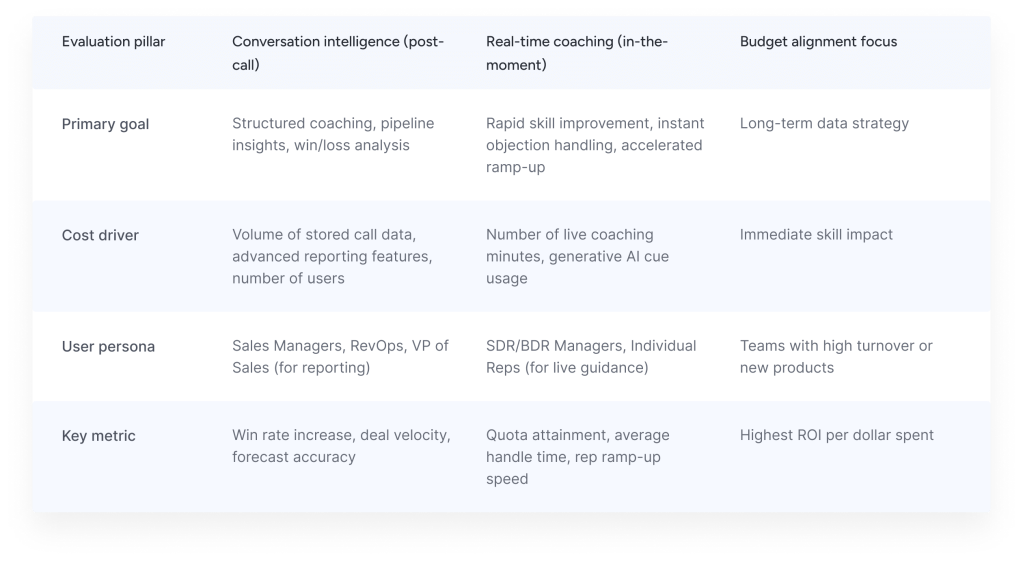
This table presents three pillars for evaluating sales tools: Conversation Intelligence (post-call), Real-time coaching (in-the-moment), and Budget alignment focus. CI’s primary goal is structured coaching and win/loss analysis for Sales Managers and RevOps, driven by stored data volume and focused on win rate and forecast accuracy. RTC aims for rapid skill improvement and accelerated ramp-up for frontline reps and managers, driven by live coaching minutes and measured by quota attainment and rep ramp-up speed. The third pillar focuses on long-term data strategy and immediate skill impact for high-turnover teams, prioritizing the highest ROI per dollar spent.
Aligning spend with measurable outcomes
Aligning spend with measurable outcomes
Modern AI vendors are increasingly moving away from feature-based pricing and are instead tying pricing models directly to projected ROI [15]. This shift helps RevOps and Sales Ops teams align their technology spend with measurable outcomes. Instead of asking “How much does this cost?”, the question becomes, “What is the cost per percentage point of the win rate increase?”
The return on investment in AI-enabled coaching is demonstrably high. Sales training and AI-enabled coaching programs can generate up to 353% ROI, underscoring the critical importance of selecting tools with tangible performance impact [16].
When AI is correctly integrated with an active coaching program, the results are transformative: sales teams can achieve 3.3x higher quota attainment, 56% faster deal cycles, and 118% higher profit margins per customer [17]. This means that the right cost-effective AI platform, even one focused purely on real-time guidance or streamlined post-call insights, is an investment in revenue rather than just a cost center.
Conclusion: The future is specialized and cost-conscious
For SDR Managers, Sales VPs, and RevOps leaders navigating the current economic pressures, the pursuit of a Gong competitor is really the pursuit of focused, measurable value. The era of the all-in-one, high-cost platform is giving way to a more specialized market defined by AI-Native Orchestration.
Whether your immediate need is the deep, structured analysis provided by specialized conversation intelligence tools or the high-impact, immediate skill correction delivered by real-time coaching platforms like Outscale.ai, the market now offers powerful options that align with a cost-conscious budget. By understanding the functional split between post-call insights and in-the-moment feedback, sales leaders can make an informed decision, selecting a platform that delivers surgical AI capability without the enterprise price tag, ensuring both performance maximization and fiscal responsibility.
Sources:
[1] https://www.oliv.ai/blog/gong-vs-clari
[2] https://www.claap.io/blog/gong-pricing
[3] https://www.oliv.ai/blog/gong-alternatives
[4] https://www.salesforce.com/news/stories/sales-ai-statistics-2024/
[5] https://offers.hubspot.com/ai-sales
[6] https://www.smallbusinessdigitalalliance.com/wp-content/uploads/2024/01/AI-and-US-SMBs-2024-Report.pdf
[7] https://www.oliv.ai/blog/best-revenue-intelligence-software-platforms
[8] https://graph8.com/why-your-next-sdr-will-be-trained-by-an-ai-coach/
[9] https://federicopresicci.com/blog/sales/win-loss-analysis/
[10] https://www.clari.com/sales-analytics/
[11] https://www.assemblyai.com/blog/conversation-intelligence-software
[12] https://www.kixie.com/sales-blog/sales-coaching-statistics-and-the-impact-of-live-coaching-on-quota-attainment/
[13] https://www.cluelyai.com/
[14] https://www.salesken.ai/blog/sales-success-with-generative-ai
[15] https://baincapitalventures.com/insight/5-emerging-trends-in-ai-pricing-what-sales-leaders-are-seeing-on-the-frontlines
[16] https://www.hyperbound.ai/blog/sales-training-market
[17] https://www.globenewswire.com/news-release/2024/11/19/2983613/0/en/Using-AI-in-Sales-Coaching-Achieves-3-3x-Growth-in-Quota-Attainment-According-to-New-Research.html
 Outscale.ai