
What is AI sales coaching?
In today’s high-velocity B2B SaaS environment, sales teams are under increasing pressure to perform at a high level, deliver personalized customer experiences, and scale operations efficiently, all simultaneously. Traditional coaching, which depends on periodic 1:1 meetings, subjective assessments, and delayed feedback, struggles to keep up with the speed and scale modern sales organizations demand. AI-powered sales coaching addresses this challenge by delivering real-time, data-driven, and highly personalized support to each sales rep. By integrating artificial intelligence, machine learning, and conversational intelligence into sales enablement strategies, AI coaching is transforming how SDR Managers, Sales Managers, and RevOps leaders empower their teams to exceed performance goals.
Definition of AI-powered sales coaching
AI-powered sales coaching refers to the use of intelligent technologies like machine learning (ML), natural language processing (NLP), and predictive analytics to guide, train, and improve the performance of sales professionals. Unlike conventional methods, which provide sporadic and delayed feedback, AI coaching offers continuous, tailored guidance based on real-time data collected from sales conversations, CRM activity, and behavioral patterns
Key features include:
- In-call coaching with contextual prompts, such as recommending a relevant case study or guiding the rep to ask discovery questions
- Automated performance insights, which score reps based on various KPIs like talk-listen ratio, filler word usage, or objection handling
- Adaptive feedback loops that evolve by learning from each rep’s improvement areas and wins
- Support in critical sales tasks like pitch refinement, handling objections, discovery questioning, and follow-up sequencing.
According to a report, companies adopting AI coaching reported 3.3x higher year-over-year quota attainment, a 30% improvement in employee engagement, and a 56% reduction in sales cycle length [1]. For instance, a wellness brand highlighted in a BTS study achieved a 7% increase in conversions and saved 26 hours per manager per month through AI-driven call analysis and feedback automation [2], illustrating the dual impact of performance uplift and operational efficiency.
How AI sales coaching differs from traditional coaching
Traditional coaching methods are heavily reliant on human observation, subjective interpretation, and manager availability. This means coaching can be inconsistent and limited in scope, especially as teams scale. AI-powered coaching, on the other hand, brings automation, data consistency, and real-time support into the coaching process
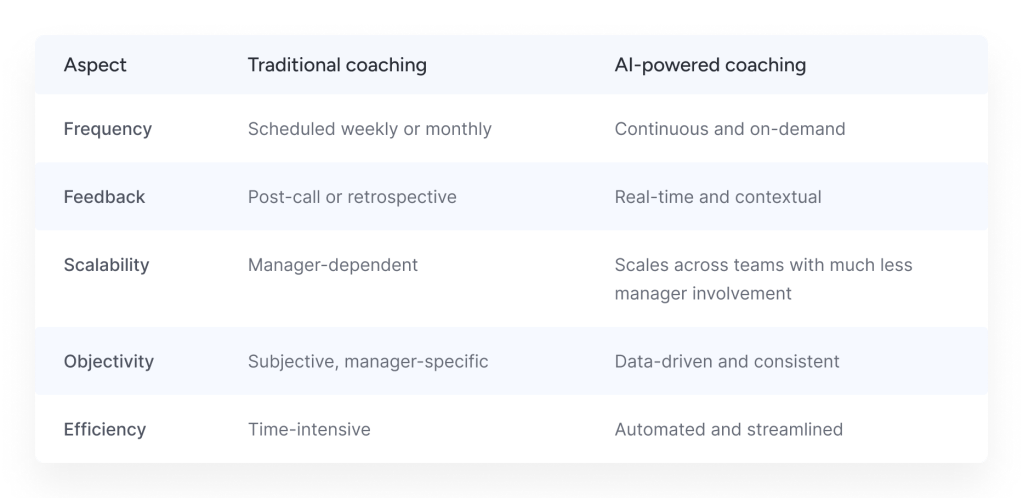
Supporting data: A Korn Ferry study found that AI-driven coaching can increase win rates by up to 15% and reduce rep attrition by 18% [3], both critical metrics for sustaining high-performing teams. Similarly, Highspot’s 2024 State of Sales Enablement report concluded that organizations integrating AI in their enablement stack are three times more likely to meet revenue targets [4]. These outcomes are possible because AI handles repetitive tasks; like call transcription, CRM updates, and basic performance scoring; freeing managers to focus on strategic enablement
Core components of AI sales coaching
Traditional coaching methods are heavily reliant on human observation, subjective interpretation, and manager availability. This means coaching can be inconsistent and limited in scope, especially as teams scale. AI-powered coaching, on the other hand, brings automation, data consistency, and real-time support into the coaching process
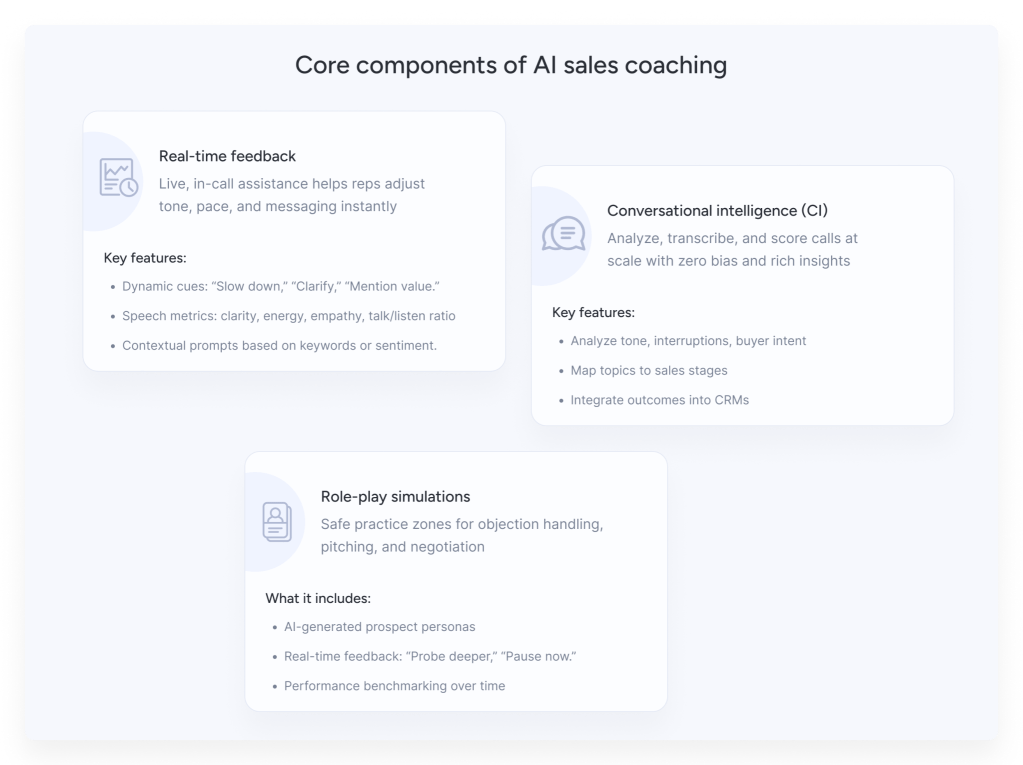
Real-time feedback:
One of the most transformative capabilities of AI coaching is its ability to provide live, in-call assistance. Real-time coaching allows reps to adjust their tone, pacing, and messaging during conversations with prospects.
- Dynamic coaching cues such as “slow down,” “ask a clarifying question,” or “bring up value proposition.”
- Monitoring speech metrics like clarity, energy levels, talk/listen ratio, and empathy markers.
- Contextual prompts are triggered by specific words or sentiment shifts in the conversation.
Example: Salesforce’s Agentforce, powered by Einstein AI, and Outscale.ai can listen to sales calls in real time, and provide in-the-moment coaching to guide the rep. It also summarizes key customer concerns and highlights potential upsell signals for follow-up [5]
Spiky.ai’s internal case study shows that delivering micro-feedback after each sales interaction improved overall rep output by 24% and increased productivity by 19%, thanks to automated reinforcement learning [6].
Conversational intelligence (CI)
Conversational intelligence enables AI tools to transcribe, analyze, and score sales calls at scale, removing human bias and adding contextual accuracy.
Core functions:
- Analyze speech patterns, sentiment trends, keyword frequency, and interruption counts.
- Map conversation topics to sales stages (e.g., discovery, negotiation).
- Identify buyer intent signals and coach on moments where reps miss critical cues.
- Integrate summarized outcomes directly into CRM systems for better tracking and alignment.
Benefits:
- Eliminates subjective judgment by applying uniform scoring metrics across all reps [8].
- Enables personalized coaching journeys based on rep-specific interaction data.
- Identify buyer intent signals and coach on moments where reps miss critical cues.
- Builds rep awareness by showing how their behavior influences customer response in measurable terms.
Role-play simulations
AI-driven simulations offer reps a safe space to practice scenarios like cold calls, pricing objections, or negotiation tactics, without the risk of losing real deals.
Functionality includes:
- AI agents simulate prospects using diverse buyer personas, industries, and deal stages.
- Feedback mechanisms offer real-time suggestions like “pause for response” or “probe for pain point.”
- Benchmarking tracks a rep’s performance over time and measures progression against goals.
Real-world impact: According to Immersive Learning News, companies that integrated AI simulations reported a 60% decrease in time-to-competency and a 275% boost in rep confidence compared to traditional methods [9]
AI-driven simulations offer reps a safe space to practice scenarios like cold calls, pricing objections, or negotiation tactics, without the risk of losing real deals
Example: Seismic’s Lessonly platform uses AI to analyze practice sessions and refine delivery, helping reps cut sales cycles by 15% and improve pitch accuracy before live calls [11]
Why AI sales coaching is crucial for modern sales teams
For Sales and RevOps leaders aiming to scale high-performing teams while maintaining quality, AI sales coaching provides several distinct advantages
Top benefits include:
- Improved quota attainment: Teams leveraging AI coaching consistently outperform, with up to 3.3x higher quota attainment reported [1].
- Faster ramp time: Role-play simulations and contextual feedback significantly accelerate onboarding and reduce time-to-quota.
- Shorter sales cycles: Real-time call guidance and precision coaching reduce the back-and-forth with prospects, leading to 15 – 30% shorter sales cycles [2, 11].
- Scalability: AI platforms can provide individualized coaching to every rep, regardless of team size or geographic location, ensuring consistency and coverage.
- Rep retention and morale: Continuous feedback and measurable growth help sales professionals feel supported and more confident, reducing attrition by nearly 18% [3].
Moreover, platforms such as Outscale.ai, Avoma, Sybill, Trellus, and Agentforce offer end-to-end enablement features—from conversation analytics to performance dashboards—making coaching not just reactive but proactive and strategic.
Final takeaway
AI-powered sales coaching is no longer experimental; it’s now essential. As B2B SaaS companies navigate the complexities of scale, competition, and evolving buyer expectations, AI coaching provides a critical edge. From real-time in-call assistance to personalized simulations and conversation analysis, it enables reps to grow continuously while allowing managers to lead with strategic insight. The organizations embracing AI today are not just improving sales outcomes; they’re building resilient, data-driven cultures of learning and performance.
Sources:
[1] https://www.globenewswire.com/news-release/2024/11/19/2983613/0/en/Using-AI-in-Sales-Coaching-Achieves-3-3x-Growth-in-Quota-Attainment-According-to-New-Research.html
[2] https://bts.com/study/ai-sales-coaching-boosts-conversions-wellness-company/
[3] https://www.kornferry.com/insights/articles/dynamic-coaching-sales-leaders-ai
[4] https://www.highspot.com/resource/state-of-sales-enablement-report-2024/
[5] https://kolvan.com/what-is-salesforce-agentforce/
[6] https://spiky.ai/en/blog/sales-rep-performance-automated-feedback
[7] https://www.sybill.ai/
[8] https://outscale.ai/ai-sales-coaching/
[9] https://www.immersivelearningnews.com/ai-virtual-reality-training-statistics/
[10] https://www.dimmo.ai/blog/what-is-trellus-ai
[11] https://seismic.com/lessonly/