
Table of contents
How to coach sales teams on personality types and learning styles: Secrets of psychographic coaching
Sales coaching is no longer about delivering the same training to everyone and hoping for the best. In today’s competitive B2B landscape, enablement leaders must personalize their approach. Tailoring coaching to personality traits and learning preferences, a method often called psychographic coaching, drives engagement, enhances performance, and helps teams hit quota more consistently.
This guide offers actionable strategies for sales managers, RevOps, and enablement teams to personalize coaching effectively.
Why personalization matters
Source: https://outscale.ai/
Generic training can leave reps disengaged. In fact, 81% of sales professionals say their coaching isn’t personalized to their needs [1]. Companies using structured, individualized coaching see a 28% higher win rate and up to 88% better productivity than those using standard methods [1].
Insight: Teams receiving at least two hours of personalized coaching per week average a 56% win rate, compared to 43% for those receiving less than 30 minutes [1].
Personalized coaching also supports better retention. Organizations with adaptive learning cultures report up to 50% higher employee retention [2]. And with 80% of reps saying they would feel more satisfied if coaching aligned with their individual style [3], the case for personalization is stronger than ever.
Coaching to different sales personas
Your sales team is made up of individuals with distinct psychographic traits. Understanding and adapting to these personalities ensures your coaching resonates.
Here are three primary rep personas and how to coach them:
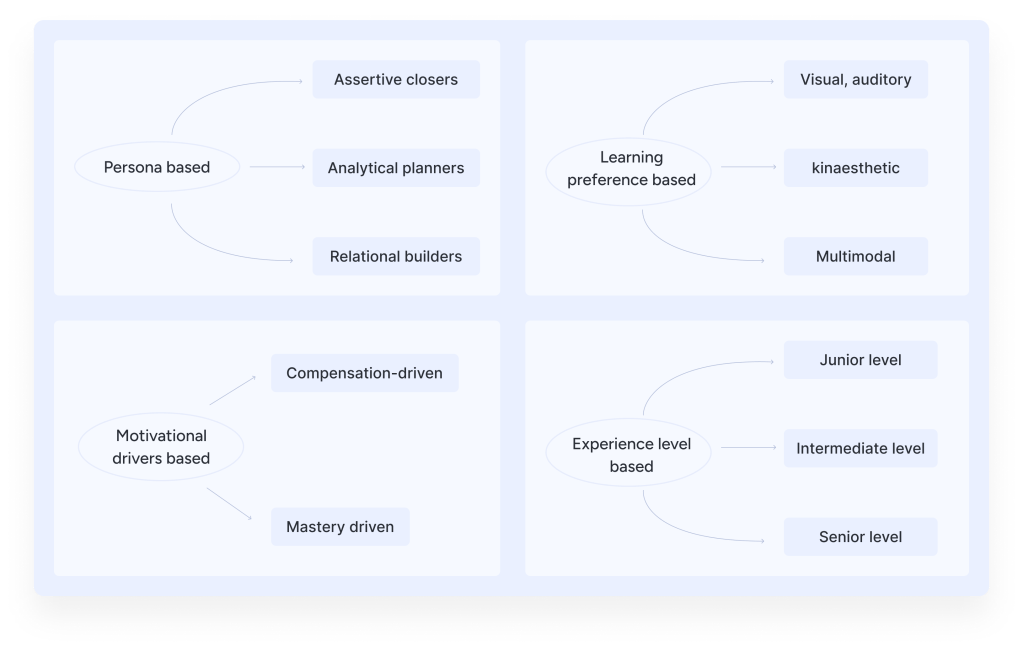
- Assertive closers are competitive and goal-oriented. They thrive under pressure and love recognition. Coaching should focus on clear performance targets, fast-paced feedback, and celebrating quick wins to fuel their motivation.
- Analytical planners value structure, data, and predictability. Coaching them effectively means breaking down performance metrics, reviewing historical data, and mapping out step-by-step strategies.
- Relational builders excel in emotionally intelligent selling and collaboration. Coaching should center on strengthening relationship-building skills, incorporating storytelling, and practicing empathetic communication.
Expert insight: “A competition-driven rep needs different coaching than someone who thrives on relationship-building.” – Stu Schlackman [4]
The DISC framework (Dominance, Influence, Steadiness, Conscientiousness) also helps tailor coaching styles [5]. Dominant reps want concise, action-oriented sessions. Steady types prefer a nurturing, long-term growth approach.
Understanding learning preferences
Personality aside, learning preferences influence how reps absorb coaching. The VAKM framework (Visual, Auditory, Kinaesthetic, Multimodal) helps identify the best formats [6]:
- Visual learners prefer charts, annotated decks, and visual playbooks. Use diagrams and color-coded workflows to explain key concepts.
- Auditory learners retain more from conversations. Try recorded coaching calls, verbal feedback, and team discussions.
- Kinaesthetic learners learn best by doing. Hands-on training, mock calls, and product walkthroughs work well for them.
- Multimodal learners make up 87% of people [6], benefiting from a mix of all the above.
Coaching takeaway: Blended coaching formats that combine visual, verbal, and experiential learning result in stronger engagement and long-term retention [7][8].
Coaching strategies by rep profile
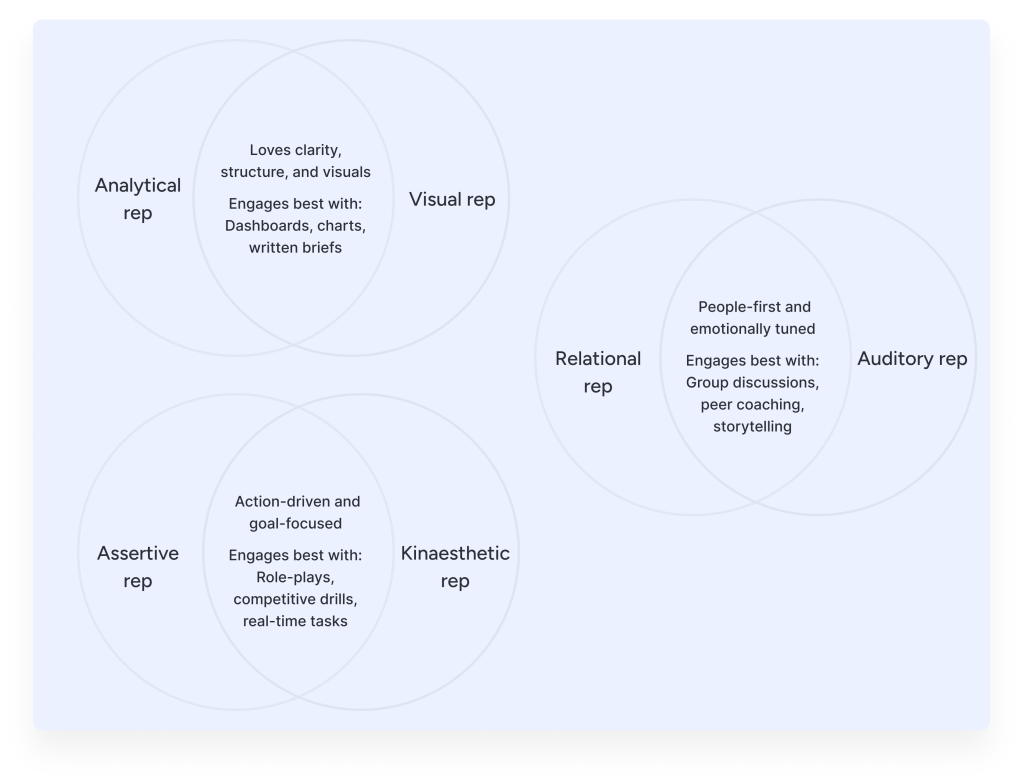
To deliver impactful coaching, combine personality traits with preferred learning styles. For example:
Source: https://outscale.ai/
- An analytical + visual rep will respond well to dashboards, detailed visual aids, and written briefs.
- An assertive + kinaesthetic rep prefers live role-plays and performance-based exercises
- A relational + auditory rep engages better in group discussions or peer coaching circles.
Temperament matters too. Introverts may prefer written feedback or asynchronous learning, while extroverts tend to enjoy live role-plays and interactive sessions [9].
Manager tip: During onboarding, ask reps how they learn and what motivates them. This builds trust and lets you customize your coaching from day one [10].
Motivators vary:
- Compensation-driven reps need coaching that clearly ties performance to financial incentives.
- Mastery-driven reps seek long-term growth. Include career development tracks, mentoring, and personal goals [8].
Experience level shapes coaching depth:
- Junior reps benefit from tactical skills like handling objections, mastering scripts, and learning product basics through repetition and guided practice.
- Mid-level reps need help refining their workflow, optimizing productivity, and elevating their discovery and qualification skills. Coaching at this stage should focus on deal progression tactics, improving call quality, and bridging the gap between execution and strategy.
- Senior reps want strategic input such as deal reviews, account growth plans, competitor positioning, and market insights [8].
Frameworks like OSKAR (Outcome, Scaling, Know-How, Affirm, Review) offer a flexible coaching structure [8].
Scaling personalization with technology
With limited time and large teams, sales managers can scale coaching with AI and enablement tech:
- 66% of sales teams use AI to analyze calls, detect trends, and suggest coaching opportunities [1].
- Companies using AI-led enablement see a 3.3x increase in quota attainment year over year [11].
Example: Tools like Seismic and Highspot deliver content tailored to role, performance, and deal stage [12].
Other tactics to personalize at scale include:
- Integrating coaching content with CRM data for timely relevance.
- Delivering adaptive learning via nudges, checklists, or micro-modules triggered by performance data.
- Mixing group and one-on-one coaching. 58% of high-performing teams use group coaching to tackle common challenges [1].
Practical stat: AI-powered coaching can reduce ramp time by 50% and cut deal cycles by up to 30% [13].
Final takeaway
Coaching based on personality traits and learning styles drives measurable performance improvements. It boosts rep engagement, shortens ramp times, and improves long-term retention.
When sales leaders combine psychographic insights with modern coaching tools, they create an environment where reps grow faster and perform better.
Sources:
Sources
[1] https://qwilr.com/blog/sales-coaching-statistics/
[2] https://www.allego.com/blog/how-personalized-learning-drives-sales-success/
[3] https://seismic.com/resources/ebooks/sales-coaching/
[4] https://stuschlackman.com/are-you-stressed-about-making-your-2024-goals/
[5] https://brooksgroup.com/sales-training-blog/4-customer-personality-types-your-sales-reps-must-be-able-recognize/
[6] https://www.snhu.edu/about-us/newsroom/education/types-of-learning-styles
[7] https://insight7.io/study-methodologies-choosing-the-right-one-for-2024/
[8] https://tldv.io/blog/sales-coaching/
[9] https://www.glencoco.com/how-to-adapt-sales-tactics-for-different-personality-types
[10] https://carew.com/blog/carew-learning-styles-in-sales/
[11] https://www.momentum.io/blog/top-ai-driven-sales-coaching-platforms-2025-buyers-guide-for-gtm-teams
[12] https://goconsensus.com/blog/best-sales-enablement-tools/
[13] https://eubrics.com/the-power-of-ai-in-sales-coaching-and-training-blog/
 Outscale.ai