
Table of contents
- Ultimate guide to AI sales coaching (2025)
- Foundations of sales coaching in the modern era
- The AI revolution in sales coaching
- Core coaching techniques and hybrid approaches
- Role-based coaching strategies
- Tools & technologies for AI sales coaching
- Implementing an effective coaching program for B2B SaaS sales teams
- Measuring sales coaching effectiveness
- Future of sales coaching: Trends, ethics, and innovation
- Case studies & success stories
- Sales coaching certifications & career development
- Final thoughts: Transforming sales coaching into a scalable growth engine
Ultimate guide to AI sales coaching (2025)
Sales coaching has become a cornerstone of success in B2B SaaS. It drives productivity, boosts revenue, and sharpens team performance. For SDR managers, sales managers, RevOps leaders, and VPs of Sales, effective coaching is the competitive edge that separates high-performing teams from the rest.
This guide covers everything you need to know: modern coaching methods, AI-driven enablement, role-specific strategies, performance measurement, and how to drive long-term growth.
We’ll start by defining what sales coaching really means, how it differs from training, and why behavior-focused coaching creates lasting impact. Then we’ll explore how AI is transforming coaching by making it scalable, personalized, and data-informed.
As hybrid teams and specialized roles become the norm, we’ll show you how to tailor coaching for SDRs, AEs, and managers by combining human insight with AI precision. You’ll also learn how to put AI tools to work through conversation intelligence, CRM-linked workflows, and frameworks that help you build a coaching culture that actually sticks.
Finally, we’ll look at what’s next: ethical AI adoption, coaching at scale, success stories from top-performing teams, and how to grow your own career through certifications and enablement roles.
Whether you’re starting from scratch or refining an existing program, this guide will help you coach smarter and scale faster.
Foundations of sales coaching in the modern era
Sales coaching in B2B SaaS is no longer a periodic performance review. It is a continuous, strategic practice that drives skill mastery, behavior change, and revenue growth. For SDR Managers, BDR Managers, Sales Leaders, RevOps, and Sales Enablement professionals, a strong coaching foundation sets the tone for scalable success.
1.1 What is sales coaching?
Sales coaching is a personalized, ongoing process where experienced leaders guide reps in developing their skills, mindset, and behaviors to perform effectively in real-world scenarios. It is rooted in continuous feedback, active observation, and behavior refinement.
In today’s B2B SaaS landscape, sales has shifted from simple transactions to complex, consultative selling. Reps must now be agile, emotionally intelligent, and capable of navigating long, multi-stakeholder journeys. Coaching addresses this need by:
- Reinforcing soft and technical skills
- Helping reps adapt to dynamic buyer behavior
- Driving confidence and accountability
“Sales coaching fosters continuous improvement by focusing on specific behaviors and real-world scenarios, contrasting with training’s one-time skill transfer.” – Morton Kyle
“Sales coaching is an ongoing, personalized process where a manager or experienced individual provides one-on-one guidance, feedback, and support to sales professionals.” – Novavente
1.2 Sales coaching vs sales training
Sales training and sales coaching play distinct but complementary roles in building high-performing sales teams. While training provides the foundation, coaching ensures those skills stick and evolve.
- Purpose: Training focuses on knowledge transfer, playbooks, methodology, and product information, typically delivered in a structured, time-bound format. Coaching focuses on applying and refining those skills through personalized guidance, rooted in real-world interactions
- Format: Training is often a one-time or periodic group event, such as onboarding or workshops. Coaching is a continuous, one-on-one process tailored to the individual rep’s challenges and goals
- Focus: Training prepares reps with general knowledge. Coaching ensures reps learn to navigate real scenarios, manage objections, adjust communication styles, and improve confidence through behavioral feedback
- Outcome: Training builds initial capability. Coaching transforms that into mastery, leading to consistent performance improvement
“Training is teaching somebody something new. Coaching is getting them to actually do what they know how to do.” – ExecVision
Research by Highspot shows that although managers dedicate 20% of their time to coaching, only 26% of reps receive weekly one-on-one coaching. This disconnect highlights a missed opportunity to reinforce skills and drive sustained performance improvements.
1.3 The ROI of effective sales coaching
Effective sales coaching directly correlates with performance metrics that matter most to revenue teams. When implemented strategically and consistently, the returns are substantial.
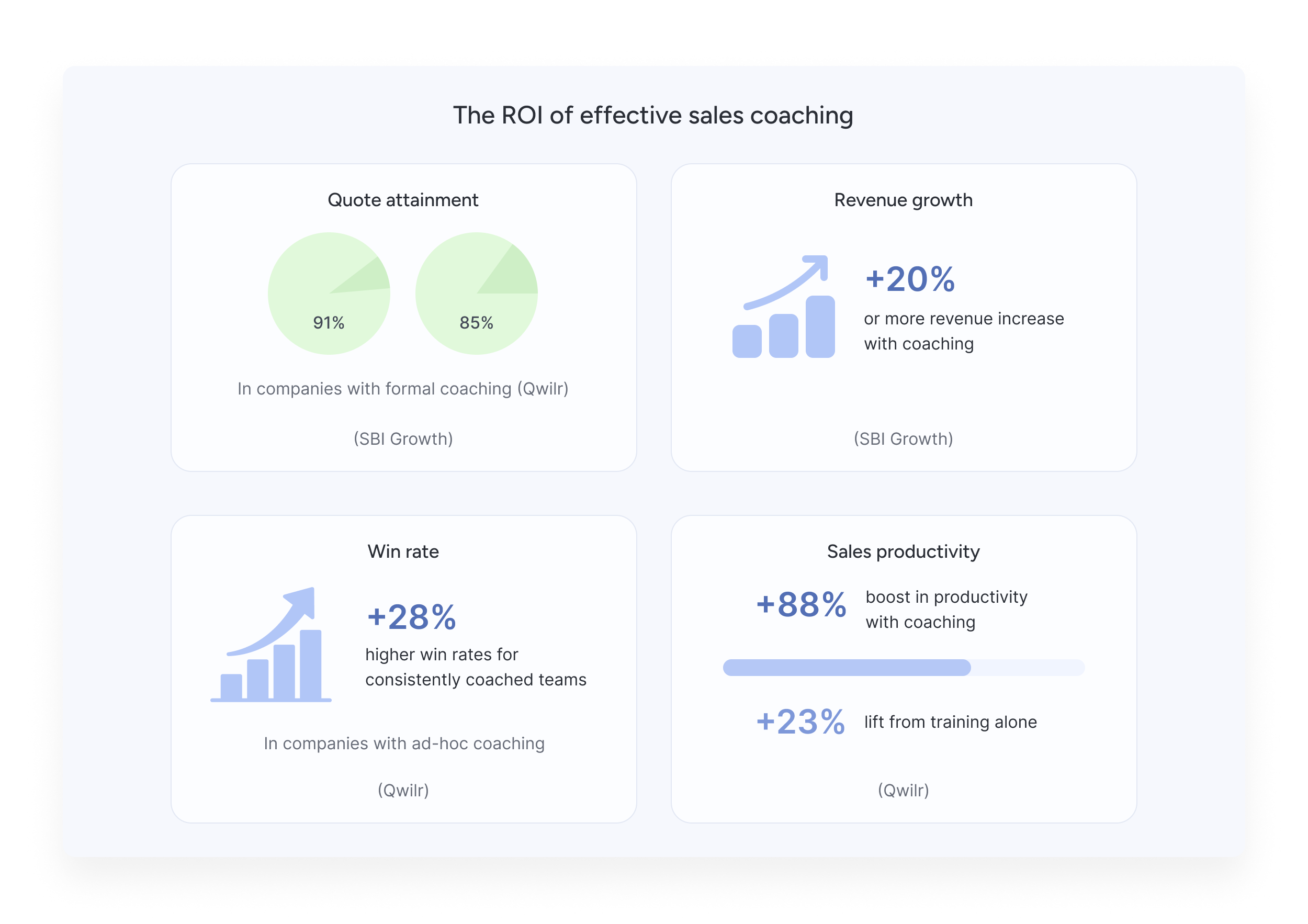
- Companies with structured coaching programs achieve 91% quota attainment, compared to 85% in less formal environments [1]
- Teams with regular coaching see 28% higher win rates, a clear indicator of improved deal execution and qualification [1]
- Coaching improves rep productivity by 88%, significantly more than the 23% lift from training alone [1]
- SBI Growth reports organizations investing in strategic coaching see a 20% or greater increase in revenue [2]
Beyond revenue growth, coaching delivers long-term benefits:
- Shorter sales cycles: Reps who receive coaching can navigate deals more efficiently, reducing time to close
- Better forecasting: Ongoing feedback helps managers more accurately assess pipeline health
- Lower rep turnover: A culture of development builds engagement, loyalty, and internal promotion paths
- Improved trust: Coaching creates a dialogue-rich environment where reps feel supported and heard
“Effective coaching shortens sales cycles, lowers sales force turnover, and boosts the skills and morale of sales reps.” – CustomerThink
1.4 Building a coaching culture
Building a coaching culture requires more than offering occasional feedback sessions. It means embedding coaching into the DNA of your organization and daily team operations.
Core components:
- Manager enablement:
- Train managers in active listening, developmental questioning, and delivering constructive feedback.
- Use coaching frameworks like GROW (Goal, Reality, Options, Will) and CLEAR (Contract, Listen, Explore, Action, Review) to ensure structure and clarity [3] [4]
- Create a predictable rhythm with weekly one-on-ones, pipeline reviews, and call coaching [5]
- SBI Growth reports organizations investing in strategic coaching see a 20% or greater increase in revenue [2]
- Peer coaching:
- Encourage reps to share wins, challenges, and tips through role-play and feedback sessions.
- Peer-led sessions reduce pressure on managers and promote cross-learning.
- Insight7 reports that peer collaboration enhances psychological safety and team trust [6]
- Embedded feedback loops:
- Implement conversation review practices to identify real-time coachable moments.
- Move away from theoretical advice and toward evidence-based, personalized feedback using performance data [5]
- Coaching frameworks and tools:
- GROW and CLEAR models guide structured coaching conversations.
- These frameworks foster rep ownership of their development while ensuring consistency across the organization [3] [4]
The business case for culture:
- Companies with coaching cultures report 51% higher revenue compared to peers [1]
- 74% of high-performing sales orgs say coaching is their top priority for front-line managers [1]
“Coaching is unlocking a person’s potential to maximize their own performance. It is helping them to learn rather than teaching them.” – Timothy Gallwey
The AI revolution in sales coaching
Sales coaching is undergoing a fundamental transformation. The traditional model, once rooted in human intuition and reactive feedback, is now being reshaped by artificial intelligence. Sales teams today need more than periodic check-ins and manual debriefs. They require personalized, consistent, and scalable coaching experiences that match the complexity of modern B2B selling. This is where AI steps in.
2.1 Traditional sales coaching: Challenges and gaps
Despite being foundational to rep development, traditional coaching often falls short due to time limitations, inconsistent approaches, and underutilized feedback loops
Sales coaching often struggles to make an impact due to five core challenges. First, most sales managers dedicate less than 5% of their time to coaching, limiting consistency and depth. Coaching practices are also fragmented, relying on ad-hoc notes and subjective feedback. Many reps report that coaching rarely focuses on real skill development, and sessions often feel like rushed check-ins with little actionable advice. On top of that, managers frequently lack formal training and deprioritize coaching when under pressure from deadlines or meetings.
2.2 What is AI sales coaching?
AI sales coaching leverages machine learning, natural language processing, and real-time analytics to optimize rep performance. It captures data from sales conversations, CRM updates, and behavior patterns to provide:
- Real-time, contextual coaching cues
- Post-call analysis tied to performance metrics
- Role-specific recommendations
Faster skill development
AI engines like those used by Nooks provide in-the-moment feedback, accelerating a rep’s ability to self-correct and learn dynamically [7]
Consistency without bias
AI enables objective analysis of every call and interaction, applying standardized scoring criteria to all reps equally. This consistency ensures everyone receives fair, actionable input.
Time efficiency for managers
By automating call reviews, transcription, and basic feedback loops, managers gain back time to focus on strategy and relationship-building.
Scalable personalization
AI platforms analyze rep behaviors and suggest learning paths customized to role, stage, or individual gaps. For instance, Gong and Avoma identify talk ratios, buyer intent signals, and objection handling trends.
Key technologies:
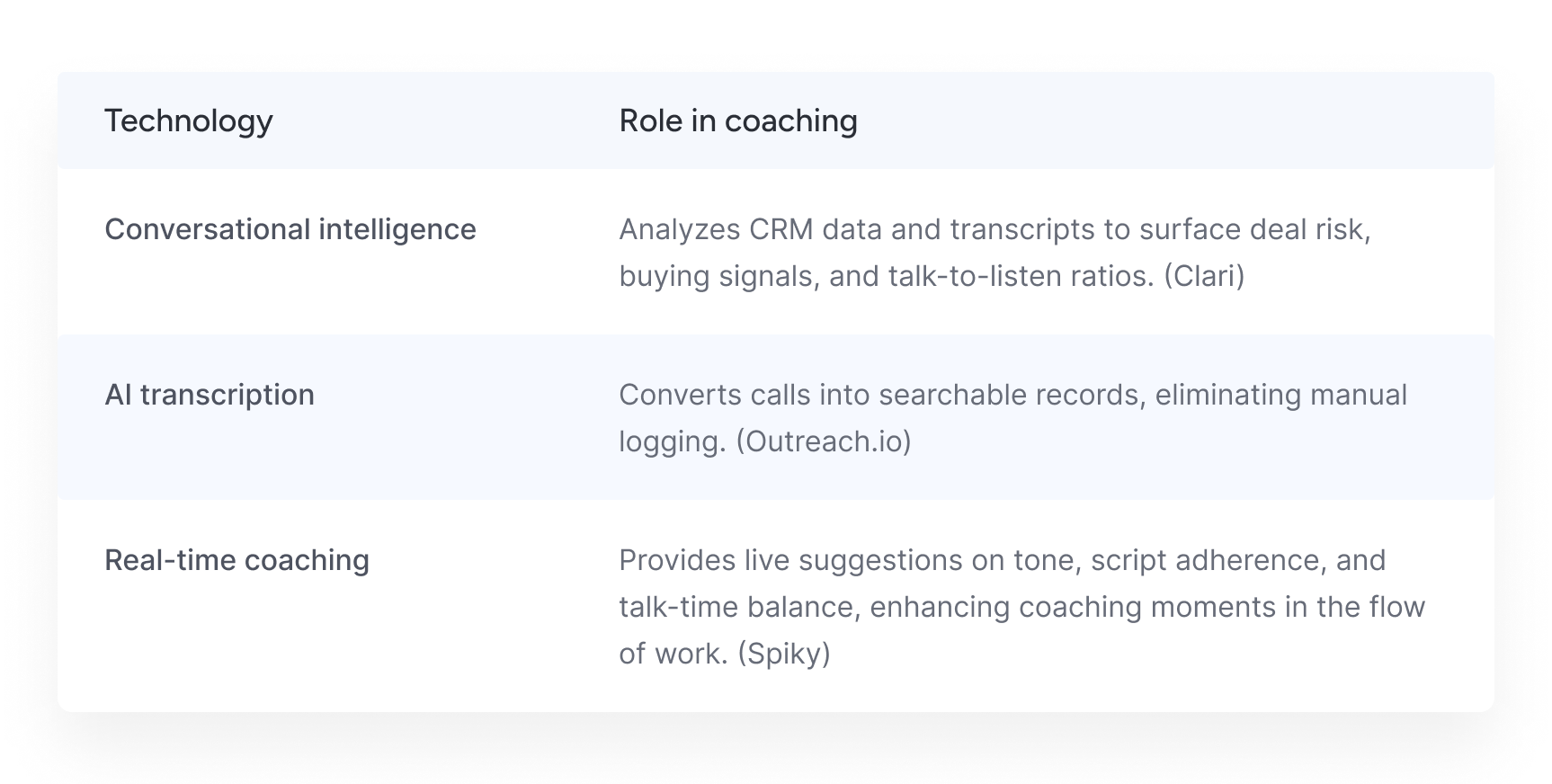
- Conversational intelligence: Surfaces trends from call transcripts, including competitor mentions and deal risks
- AI transcription engines: Automatically convert calls into structured, searchable notes
- Real-time feedback: Offer instant coaching nudges, such as flagging talk-time imbalance or script deviation
2.3 Traditional vs. AI coaching: A comparative view
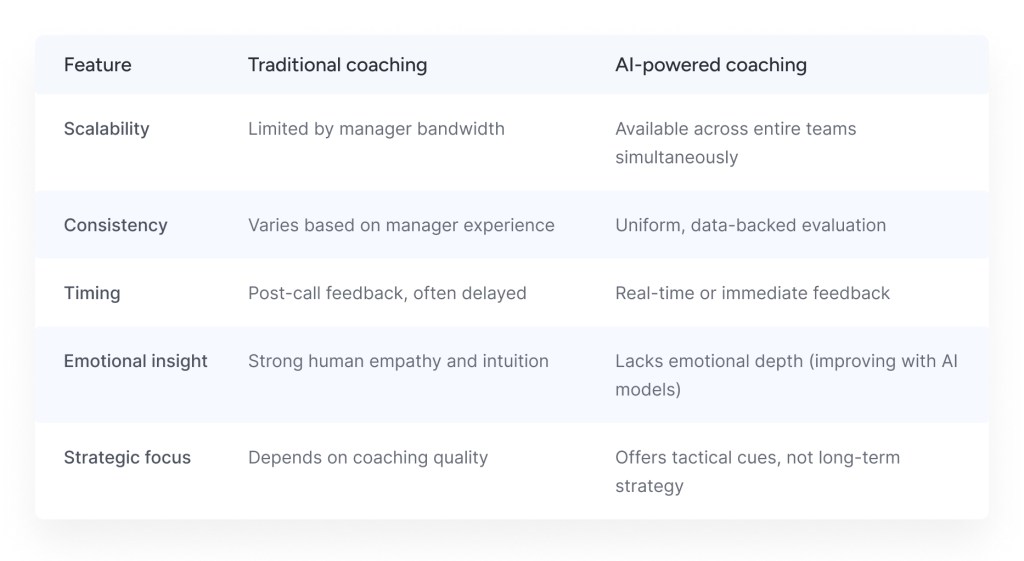
Traditional sales coaching relies heavily on a manager’s time, experience, and intuition, making it hard to scale, inconsistent across reps, and often delayed in feedback. In contrast, AI-powered coaching delivers scalable support across teams, with real-time, data-driven insights. While it still lacks the emotional depth of human empathy, AI tools offer consistent evaluations and immediate tactical feedback, though they currently focus more on short-term performance than long-term strategic development
According to The People Space, AI coaching works best when paired with human empathy. A hybrid model is ideal: AI manages repetitive analysis while managers bring context, mentorship, and emotional support [8]
Recommended strategy:
Let AI systems handle foundational coaching, call scoring, behavioral analytics, and performance trends, while managers focus on deal strategy, mindset development, and personalized growth.
2.4 Why AI sales coaching matters now
The urgency for AI coaching tools has intensified due to several converging trends:
Reps are overloaded
Let AI systems handle foundational coaching, call scoring, behavioral analytics, and performance trends, while managers focus on deal strategy, mindset development, and personalized growth.
Demand for personalization
Modern buyers expect tailored interactions. Similarly, reps need coaching that reflects their unique pipeline, industry, and prospect base. AI tools can analyze thousands of calls to create individualized playbooks.
Tangible performance uplifts
Companies using AI-based coaching tools have seen up to a 30 percent increase in quota attainment according to Retorio [9] Demodesk reports a 17 percent boost in rep productivity when real-time feedback engines are implemented [10]
Mainstream adoption is growing
Companies using AI-based coaching tools have seen up to a 30 percent increase in quota attainment according to Retorio [9] Demodesk reports a 17 percent boost in rep productivity when real-time feedback engines are implemented [10]
“AI isn’t replacing humans. It’s rescuing them from burnout,” notes SellingPower. By taking care of repetitive, tactical coaching, AI lets managers and reps invest more in relationship-building and strategy.
Core coaching techniques and hybrid approaches
For SDR Managers, BDR Managers, Sales Managers, RevOps professionals, and Sales Leaders, building high-performing teams hinges on a coaching strategy that is both time-tested and future-ready. Whether you’re running weekly 1:1s, experimenting with real-time feedback, or scaling group sessions across global teams, blending classic methods with AI-enhanced innovation is key.
This guide breaks down essential coaching techniques and how to operationalize a hybrid human-AI coaching model that builds rep confidence and accelerates performance at scale.
3.1 Classic coaching techniques that still work
Even in the AI age, foundational sales coaching techniques remain critical for driving performance. These human-led strategies build trust, uncover personal development goals, and address skill gaps that automation alone cannot resolve.
- 1:1 coaching sessions
- High impact on performance: Regular 1:1 coaching meetings lead to a 10–29% improvement in individual sales rep performance [11]. These sessions allow managers to align KPIs, guide reps on tactical execution, and shape career trajectories.
- Tailored development: According to Seismic, top-performing managers personalize 1:1s to each rep’s unique challenges, enabling more meaningful progress beyond surface-level metrics [12]
- Group coaching
- Promotes peer learning: Weekly sessions where reps share wins and troubleshoot roadblocks foster transparency and team collaboration [13]
- Drives team cohesion: Salesloft emphasizes that collaborative sessions allow reps to internalize strategies and build collective momentum [14]
- Insight7 reports that peer collaboration enhances psychological safety and team trust [6]
- Pipeline reviews
- Structured accountability: Managers can assess metrics like win rate, deal velocity, and forecast accuracy to ensure reps focus on the right deals [15]
- Predictive coaching: These reviews help shift the narrative from lagging results to leading behaviors.
- Objection handling training
- Boosts closing rates: Reps who are coached on objection handling are 20–30% more likely to close deals, according to [16]
- Builds trust: Convin notes that objection handling is more about anticipating concerns with empathy than combatting pushback [17]
3.2 AI-enhanced coaching techniques
Modern sales teams are turning to AI to complement traditional coaching. This unlocks real-time insights, shortens ramp times, and enables consistent, scalable feedback.
AI role-play simulations
- Accelerates ramp-up: Onboarding time is reduced by up to 30% and message consistency improves by 25% when reps engage in AI-powered simulations [18]
- Unlimited practice: Reps can simulate cold calls or handle objections on demand, receiving immediate feedback on tone and accuracy, without tying up manager time.
Real-time AI feedback
- Drives behavioral improvement: Teams using real-time feedback report up to a 20% increase in skills like open-ended questioning and active listening [19]
- Contextual coaching in action: Rather than post-call reviews, AI offers mid-conversation guidance that empowers reps to adapt on the fly.
Conversation scoring
- Enables data-driven coaching: Tools track adherence to scripts, discovery techniques, and objection resolution. This gives coaches actionable metrics rather than gut instinct [20]
- Scales coaching efforts: Mindtickle found that conversation scoring helped organizations double their coaching effectiveness across large teams [21]
3.3 Building a hybrid AI + human coaching model
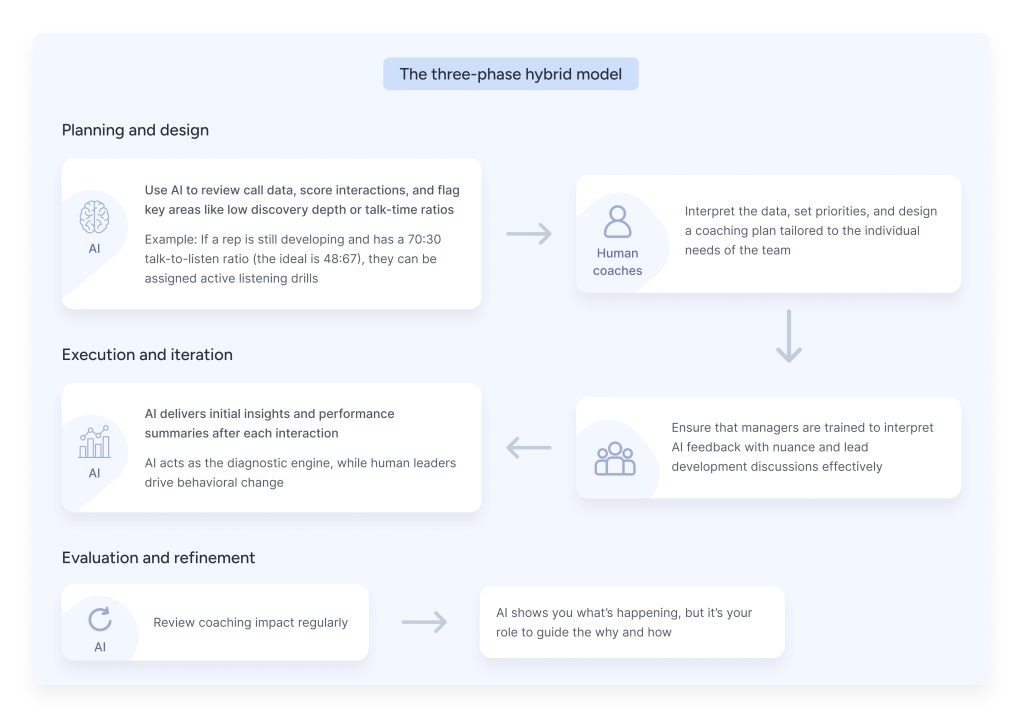
The hybrid coaching model combines AI insights with human judgment across three phases. In Planning & Design, AI pinpoints skill gaps from call and CRM data, while coaches set priorities and create action plans. during execution & iteration, AI delivers real-time performance scores, and managers lead 1:1s and provide mentoring. Finally, in Evaluation & Refinement, AI suggests content updates and trends, while coaches refine strategies and support peer development
The Human advantage: Salesforce emphasizes that while AI excels at surfacing insights, only human coaches can drive motivation and strategic growth through empathy and creativity [22]
3.4 Creating a coaching cadence that scales
Coaching should be a consistent rhythm, not a one-time event. A structured cadence ensures accountability, predictability, and results.
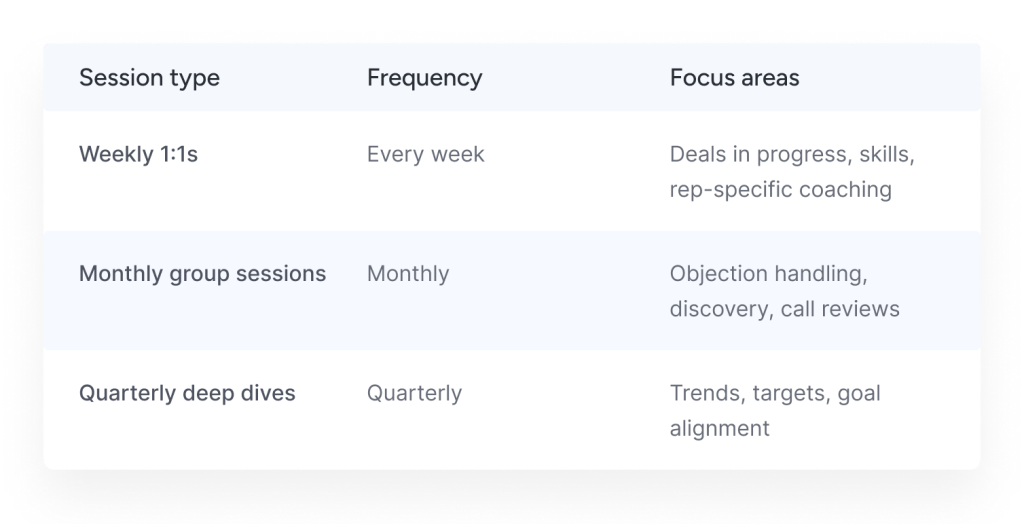
An effective coaching cadence includes a mix of weekly, monthly, and quarterly sessions. Weekly 1:1s focus on active deals, skill development, and personalized coaching. Monthly group sessions tackle shared challenges like objection handling and discovery through collaborative reviews. Quarterly deep dives take a strategic view, assessing performance trends, aligning goals, and setting future targets
Federico Presicci suggests this cadence creates sustainable momentum while respecting bandwidth.
Anchoring coaching to playbooks
- Align sessions with documented playbooks that include persona briefs, talk tracks, objection frameworks, and closing tactics [23]
- Companies like Showpad use these assets to streamline onboarding and reinforce consistent conversations [24]
Feedback models for scale
- SLED: Support, Listen, Explain, Develop, encourages two-way feedback.
- Tell-show-do-review: Ideal for behavioral repetition and reinforcement.
Scaling through enablement
- Use AI to flag coaching opportunities automatically.
- Train frontline managers in coaching fundamentals.
- Roll out train-the-coach and peer mentorship programs to expand reach without overwhelming bandwidth [25]
Role-based coaching strategies
To scale revenue, improve pipeline health, and drive consistent performance across the board, sales coaching must be tailored by role. A one-size-fits-all coaching model fails in today’s specialized, fast-paced B2B landscape. By aligning coaching methods to each sales persona, SDRs, AEs, managers, and remote reps, organizations can maximize rep effectiveness, speed up onboarding, and ensure strategic alignment
4.1 Coaching SDRs and BDRs for pipeline generation
SDRs and BDRs are your pipeline’s ignition switch. These roles demand energy, precision, and relentless outreach, but often come with inexperience. A coaching strategy that prioritizes confidence-building and structure can shorten ramp time and boost lead quality
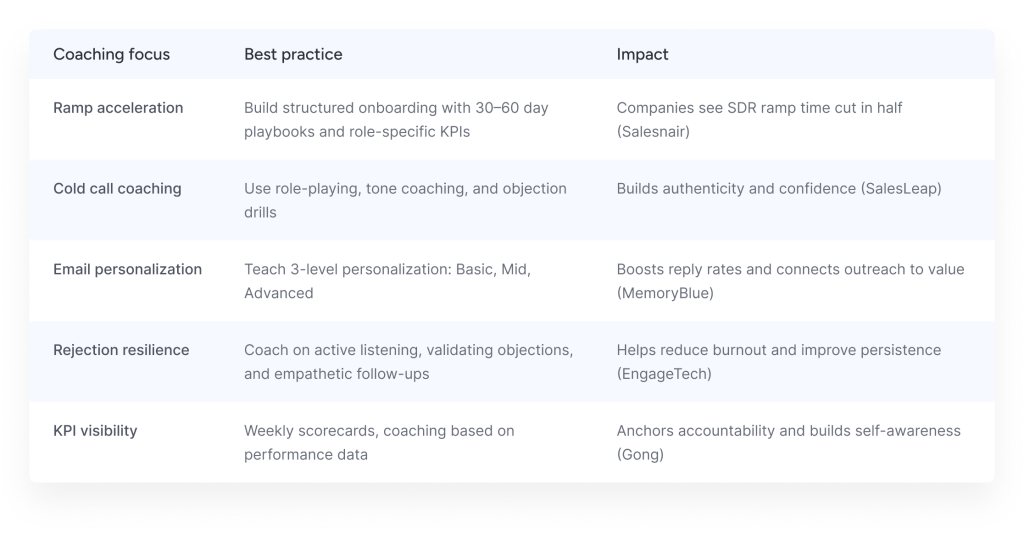
Effective sales coaching focuses on a few key areas. Structured onboarding with clear playbooks and role-specific KPIs helps new reps ramp up faster. Cold call coaching using role-plays and objection drills builds confidence and authenticity. Teaching reps how to personalize emails at different levels improves reply rates and message relevance. Coaching for rejection resilience through active listening and empathetic follow-ups helps reps stay motivated. And using weekly scorecards tied to performance data keeps reps accountable and more aware of their progress
Real-world impact:
Factor 8 implemented a “Coaching as a Service” model for a struggling SDR. Within two months, conversion rates spiked dramatically, showcasing the power of consistent feedback and micro-coaching [26]
4.2 Coaching AEs for deal progression and objection handling
As deal-owners, Account Executives (AEs) require a coaching approach that focuses on negotiation finesse, discovery depth, and objection management. Coaching here directly impacts revenue and sales velocity.
Key coaching priorities:
- 1:1 call reviews with SIP feedback: Host dedicated 1:1 sessions to review recent sales calls using the SIP (Specific behavior – Impact – Plan) model: identify a Specific behavior or action the AE took, explain its measurable Impact on the outcome of the call, and collaboratively develop a Plan for improvement. This structured method ensures feedback is practical, actionable, and reinforces a growth mindset.
- Objection handling frameworks: Equip AEs with structured frameworks that emphasize active listening to uncover true concerns, crafting responses that are value-driven, and supporting them with relevant social proof or case studies. Practice these frameworks through mock scenarios and call simulations.
- Predictive coaching insights: Integrate contextual coaching during live calls using conversation intelligence platforms. These tools provide real-time suggestions, highlight missed cues, and identify moments to dig deeper during discovery or overcome hesitations during negotiation, allowing reps to self-correct in the moment.
- Quarterly skill gap reviews: Conduct structured skill assessments every quarter using performance data, win/loss analysis, and manager feedback. Customize development plans to strengthen weak areas, especially those exposed in long or complex enterprise sales cycles, and align goals with upcoming pipeline opportunities
Results from coaching AEs:
- Win rates: Companies that invest in ongoing AE coaching see win rates improve by 5 to 15%. This is driven by increased objection handling efficiency, personalized pitch alignment, and clearer discovery paths [27].
- Sales cycle reduction: AE coaching focused on need-qualification and stakeholder mapping leads to a 10 to 20% reduction in sales cycle duration, accelerating pipeline velocity [28]
- Deal size growth: AEs with access to coaching frameworks secure larger deals. On average, deal size increases by 20 to 30% when reps co-create ROI narratives with the buyer [28]
- Quota attainment: 88% of AEs receiving regular coaching hit their quota targets, compared to only 71% in teams without structured feedback, as shown by a study conducted by [29]
- Forecast accuracy: Coached reps are 30% more likely to submit accurate forecasts due to enhanced pipeline visibility and performance introspection [29]
Feedback engagement: Teams using structured feedback models report 40% higher participation in self-review and debrief loops, which further reinforces skill adoption [28]
Coaching engagement itself improves as reps engage more deeply in feedback loops, review their calls, and participate in collaborative debriefs. Without structured coaching, reps often disregard feedback, leading to performance plateaus.
4.3 Coaching sales managers as coaches
Sales managers are the coaching conduit for the entire team. If they don’t know how to coach, even the best strategies fall flat. Coaching the coach is now a non-negotiable.
Development priorities:
- Leadership development: Equip managers with foundational performance and people-management skills, such as setting goals, running effective 1:1s, resolving conflicts, and aligning team efforts with strategic objectives. Well-trained managers foster a culture of trust and drive stronger engagement across their teams [30]
- Framework adoption: Introduce structured coaching frameworks like SLED (Skill, Level, Explain, Develop) and PAUSE (Prepare, Ask, Understand, Share, Execute). These models offer repeatable templates for consistent feedback and elevate the quality of coaching conversations.
- Accountability coaching: Leverage conversation intelligence, pipeline dashboards, and deal rooms (via tools like Gong, Dock, or Atrium) to anchor coaching in data. This ensures feedback is timely, tied to real outcomes, and helps reps take ownership of progress.
Revenue impact:
Organizations where managers are trained to coach see 8% higher annual revenue [29]
4.4 Coaching remote and hybrid teams
Remote sales teams introduce coaching complexity. With less visibility and face-to-face interaction, consistent enablement and feedback become harder, but more essential.
Remote coaching challenges:
- Communication delays: Without in-person interactions, clarifications are often postponed, leading to slow decision-making and confusion during deal execution.
- Inconsistent feedback: Reps may receive fragmented or delayed coaching that lacks context, which hampers their ability to improve in real time.
- Poor collaboration: Remote environments reduce spontaneous knowledge sharing, weakening team synergy and the ability to learn from peers.
- Isolation and burnout: The lack of face-to-face camaraderie and unclear boundaries between work and life increase mental fatigue and reduce motivation.
- Limited live training time: Busy schedules and time zone differences make it hard to organize synchronous coaching sessions, leading to missed opportunities for skill development
Best practices to solve these:
- Digital tools: Leverage CRMs, sales enablement platforms, and call analysis software to capture key moments, track coaching impact, and deliver asynchronous feedback at scale.
- Coaching rituals: Establish predictable coaching cadences, such as weekly 1:1s, virtual role-plays, and peer-to-peer feedback sessions, to maintain momentum and engagement.
- Personal connection: Incorporate informal touchpoints, recognition rituals (like shoutouts in team chats), and team huddles to build trust and morale.
“Remote coaching must go beyond screen-sharing. It requires personal connection, asynchronous formats, and coaching continuity,” says Klaviyo’s Enablement Team [31]
Tools & technologies for AI sales coaching
In today’s hyper-competitive B2B sales environment, coaching platforms powered by artificial intelligence are no longer just an edge, they’re essential. From real-time support during live calls to post-conversation analysis and CRM-integrated insights, the right platform transforms how revenue teams operate. Effective sales coaching tools empower managers and reps with clarity, speed, and precision, helping organizations close performance gaps and accelerate growth.
5.1 What makes a great sales coaching platform?
The best AI-driven coaching platforms do more than record calls or offer suggestions, they embed coaching into the flow of work, continuously refining skills and performance.
1. Real-time feedback and in-call guidance
Coaching in the moment transforms live calls into learning opportunities. With contextual cues, content prompts, and objection-handling guidance delivered during active calls, reps receive course correction exactly when it matters.
According to Jiminny, real-time feedback improves coaching adoption, retention, and rep confidence by allowing reps to apply lessons immediately [32]
2. CRM integration for seamless coaching
When coaching insights are tied directly to CRM data, they become more meaningful and relevant. Performance metrics, deal status, and buyer interaction history provide the foundation for personalized coaching.
Insight7 found that CRM-powered coaching creates a 360-degree view of rep performance, making each coaching session more actionable and contextual [33]
3. Scorecards that drive accountability
Customizable coaching scorecards help managers measure, monitor, and reinforce desired behaviors. By aligning rep actions to KPIs, teams foster a culture of consistency and accountability.
According to Revenue.io, high-performing teams are 2.8 times more likely to use scorecards to guide coaching and rep development [34]
4. Dashboards that visualize coaching impact
Dynamic dashboards bring clarity to coaching ROI. Whether it’s talk ratios, objection frequency, or win/loss rates, visualized performance metrics help leaders tailor coaching to the individual.
As highlighted by Improvado, visual performance tracking allows for faster, data-driven coaching decisions [35]
5. Speed and accessibility of coaching
Reps thrive on timely feedback. AI coaching platforms make feedback immediate and accessible, whether it’s through summary dashboards, mobile apps, or in-line annotations.
85% of salespeople report that quick coaching boosts their preparedness for buyer interactions [36]
5.2 Top AI sales coaching tools compared
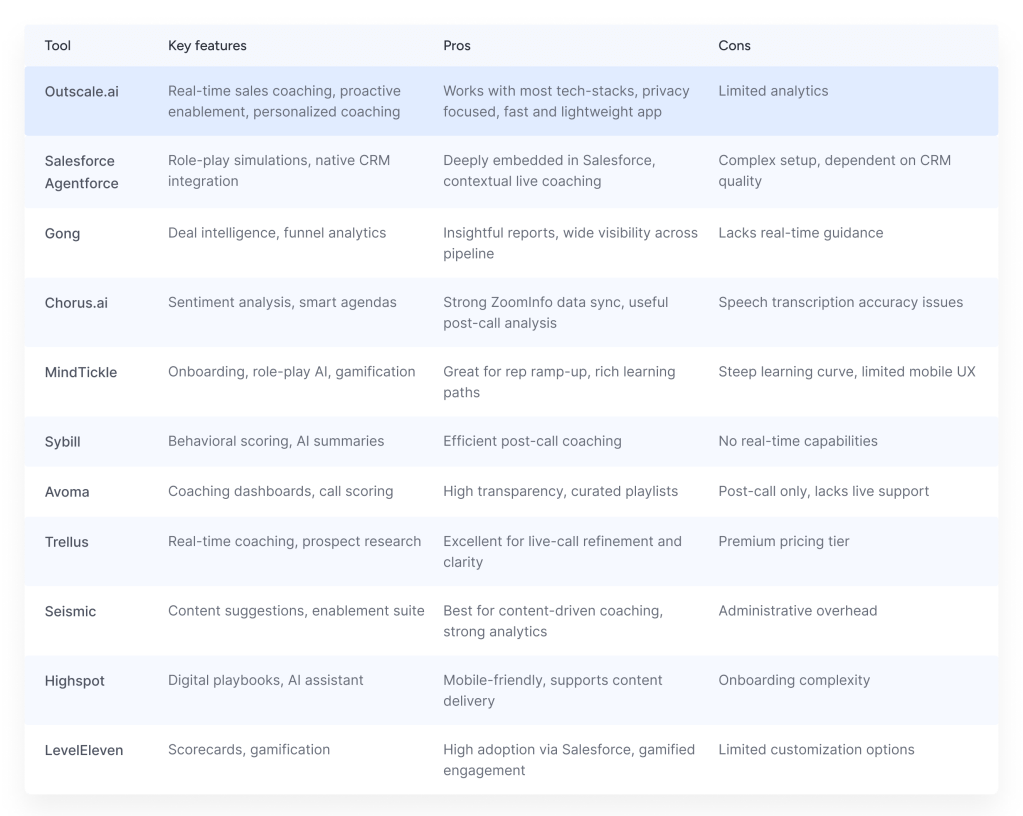
AI sales coaching tools offer a range of capabilities, from real-time guidance to post-call analytics and gamified engagement. Tools like Gong and Chorus.ai stand out for pipeline visibility and data sync but lack real-time coaching. MindTickle and LevelEleven focus on onboarding and motivation through gamification, while Seismic and Highspot shine in content enablement despite setup complexities. Outscale.ai adds to this landscape with real-time coaching, proactive enablement, and a lightweight, privacy-first design, though its analytics are still developing. Each tool serves distinct coaching needs depending on sales maturity, tech stack, and coaching strategy.
5.3 Conversation intelligence, speech analytics & Role-play AI
AI is rapidly redefining how sales conversations are understood and optimized. Tools that provide contextual coaching through conversation intelligence, speech analytics, and simulated role-play are enabling leaders to coach proactively, not reactively.
Conversation intelligence
Conversation intelligence tools analyze every sales interaction to uncover trends, identify risks, and highlight coaching moments. These tools deliver insights into rep behavior, buyer questions, and follow-up timing to help managers reinforce winning behaviors at scale.
According to MarketResearchFuture, the conversation intelligence market is projected to hit $80.12 billion by 2034, reflecting its strategic importance [37]
Speech analytics
Speech analytics enhances coaching by interpreting not just what’s said, but how it’s said. Through tone, sentiment, and pacing analysis, these tools help identify emotional cues that guide reps in real-time and inform coaching sessions.
Mihup reports that teams leveraging speech analytics see a 15% revenue boost within just 60 days and a substantial drop in churn [38]
Role-play AI
Role-play AI simulates high-stakes sales scenarios to train reps in objection handling, storytelling, and negotiation. These tools help build rep confidence and muscle memory through guided, interactive learning experiences.
Unboxed Technology found that role-play AI leads to a 275% increase in learner confidence and speeds up onboarding by 4× [39]
5.4 CRM & Sales enablement tool integrations
For AI coaching to deliver enterprise-wide impact, it must plug seamlessly into the tools your team already uses, especially CRMs and enablement platforms.
CRM integration
Tight CRM alignment grounds coaching in real-world sales interactions. Sales managers can track behavior against pipeline data, assess conversation effectiveness, and forecast more reliably.
Demodesk reports that teams using CRM-integrated AI tools enjoy 2× higher conversion rates, 30% more revenue per rep, and 25% time savings on manual tasks [40]
Sales enablement synergy
When AI coaching tools integrate with content delivery platforms like Seismic and Highspot, sales reps gain on-demand access to relevant training materials, scripts, and collaterals.
These integrations provide contextual learning, surfacing the right playbook, video, or talking point based on the rep’s active deal stage or persona.
Unified workflows
Streamlined ecosystems improve tool adoption and reduce friction. Rather than toggling across apps, reps stay within a single, intelligent environment.
Seismic notes that unified platforms increase coaching continuity by consolidating CRM, content, and performance management in one place [41]
Implementing an effective coaching program for B2B SaaS sales teams
Sales coaching is no longer a luxury, it’s a growth imperative. In a landscape where products evolve rapidly and buying decisions span multiple stakeholders, B2B SaaS companies must lean into coaching as a strategic lever.
According to Highspot, sales teams with structured coaching programs report a 28% higher win rate and an 88% increase in productivity [42]. That’s not a minor lift, it’s the difference between surviving and leading. But building an impactful coaching program is more than scheduling weekly 1:1s. It requires strategic design, operational execution, and cultural adoption
The following guide walks through a four-part journey: strategy, implementation, adoption, and overcoming challenges, with real-world insights and proven practices embedded throughout.
6.1 Designing a coaching strategy
Imagine coaching a team of salespeople the same way you’d coach a football team: every position has unique responsibilities, strengths, and weaknesses. A quarterback doesn’t train like a linebacker, and your SDRs shouldn’t be coached like your Account Managers.
That’s where a tailored coaching strategy comes in. It accounts for where your team is today, what they sell, and to whom.
Key elements of an effective coaching strategy
1. Tailored by sales maturity
Coaching evolves alongside your organization’s maturity level. In the Reactive coaching phase, coaching is sporadic and informal, usually triggered by performance issues rather than planned learning. There’s no structure or consistent follow-up, making development outcomes unpredictable.
At the Proactive coaching level, coaching becomes more structured and intentional. Regular sessions focus on specific selling stages, supported by data and observation. Managers now play an active role in developing their reps through feedback and planning.
The Predictive coaching phase leverages advanced analytics and AI to provide real-time, personalized coaching cues. Here, coaching is deeply embedded in workflows and continuously optimized, creating a feedback loop that aligns with long-term business goals.
As companies move up this maturity curve, coaching shifts from intuition-based to data-driven.
2. Designed for complexity
One-size-fits-all doesn’t work in coaching. Sales motions vary, from transactional SaaS to enterprise-level selling, and so should your coaching formats. Simple products may require light-touch coaching focused on speed and volume. Enterprise sales, in contrast, demand deep scenario-based simulations, strategic account planning, and layered feedback loops.
3. Persona-centric coaching
Different roles need different coaching content. SDRs need help refining outbound messaging and objection handling. AEs benefit more from support in competitive positioning and late-stage deal navigation. AMs thrive with coaching around upsell paths and renewal tactics. Role-specific training ensures coaching is actionable and directly applicable to reps’ daily challenges.
4. Relationship-driven models
Despite the rise of digital tools, coaching is still most impactful when grounded in trusted relationships. According to Spencer Wixom from Challenger, the personal connection between mentor and rep is the true growth engine. Tools can scale delivery, but only trust fosters vulnerability and real improvement.
6.2 Step-by-step implementation plan
Even a well-designed coaching strategy falls flat without execution. The best programs are phased, validated, and scaled with feedback loops built in.
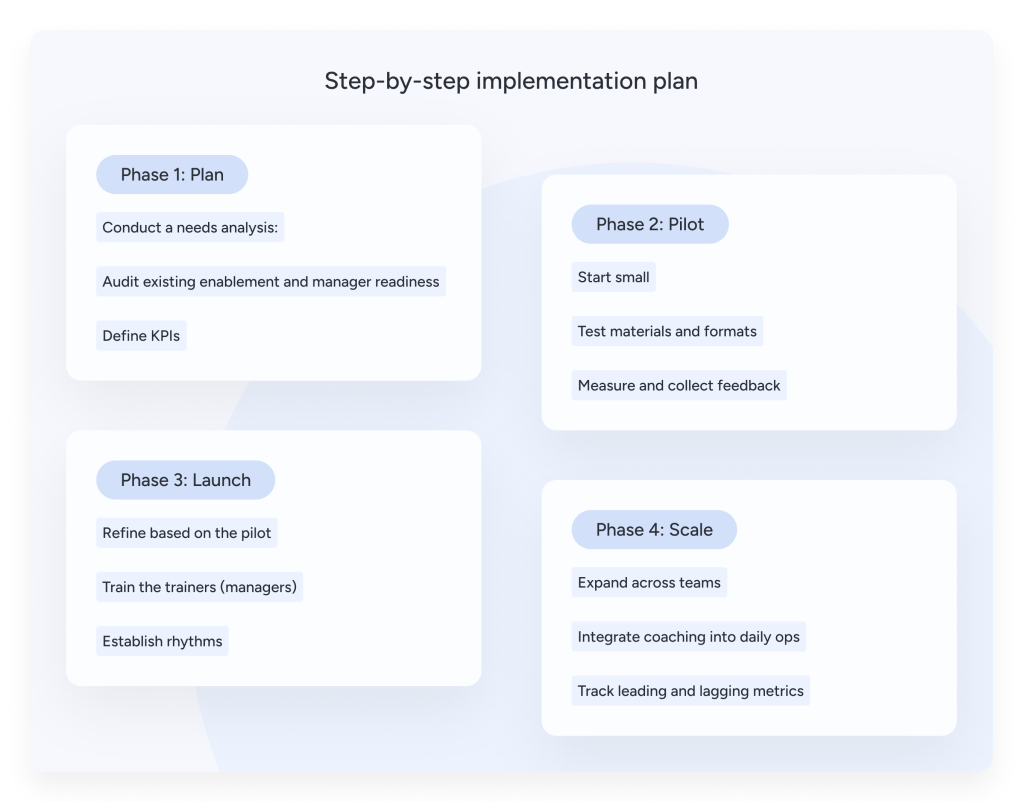
Phase 1: Plan
- Conduct a needs analysis: Look at performance data (win rates, average sales cycle, conversion rates), CRM hygiene, rep sentiment, and manager feedback to identify gaps
- Audit existing enablement and manager readiness: Is your content current? Are managers trained to coach, or are they just top performers who got promoted?
- Define KPIs: Use a blend of activity (training completion, call coaching frequency) and impact metrics (time-to-ramp, quota attainment, promotion velocity)
Phase 2: Pilot
- Start small: Like Square, which piloted with two reps, begin with a team willing to experiment. Choose a mix of top, average, and underperforming reps
- Test materials and formats: Try multiple coaching structures: live call reviews, deal war rooms, peer coaching, asynchronous feedback
- Measure and collect feedback: Use short pulse surveys, rep interviews, and KPI movement to determine what resonates
Phase 3: Launch
- Refine based on the pilot: Make tactical adjustments to the cadence, coaching forms, or session focus areas
- Train the trainers (managers): Give managers toolkits, call scorecards, scenario decks, and a coaching calendar
- Establish rhythms: Weekly 1:1s should focus on deal execution. Monthly sessions should hone core skills. Quarterly reviews can dive into role transitions or longer-term goals
Phase 4: Scale
- Expand across teams: Roll out to SDRs, AEs, AMs, and RevOps. Tailor content based on role and seniority
- Integrate coaching into daily ops: Tie coaching outcomes to OKRs and performance reviews. Sync content with product releases and marketing campaigns
- Track leading and lagging metrics: Leading indicators include completed coaching sessions, CRM hygiene, and content certifications. Lagging indicators include quota attainment, win rates, and churn reduction
6.3 Adoption, buy-in & behavior change
A coaching strategy means nothing if managers resist or reps disengage. The shift must be cultural.
Secure leadership alignment
When the CRO champions coaching, it signals that it’s a strategic priority. Highspot found: “When coaching is seen as a priority by CROs, it becomes a priority across the sales org.” [42]
Empower frontline sales managers
Frontline managers are not just messengers, they are the engine of coaching execution. Rain Group reminds us: “Sellers follow what their managers enforce.” Equip managers with:
- Play-based coaching guides
- Success criteria for different rep personas
- Metrics for visibility into rep progression
Establish a coaching rhythm
Structure breeds habit. Implement a coaching rhythm model:
- Weekly 1:1s: Focus on pipeline quality, active deal progression, call debriefs
- Monthly skill clinics: Interactive sessions on negotiation, discovery, or demo delivery
- Quarterly peer coaching: Cross-team role-plays, case study breakdowns, best practice sharing
Drive rep-level buy-In
Reps adopt what benefits them. Show clear ROI:
- Connect coaching with promotion paths and quota impact
- Highlight rep success stories in team meetings
- Offer recognition for improvement, not just outcomes
According to LinkedIn, reps receiving weekly coaching are 29% more likely to become top performers, yet only 53% of orgs use structured tools to support this [43]
6.4 Overcoming common challenges
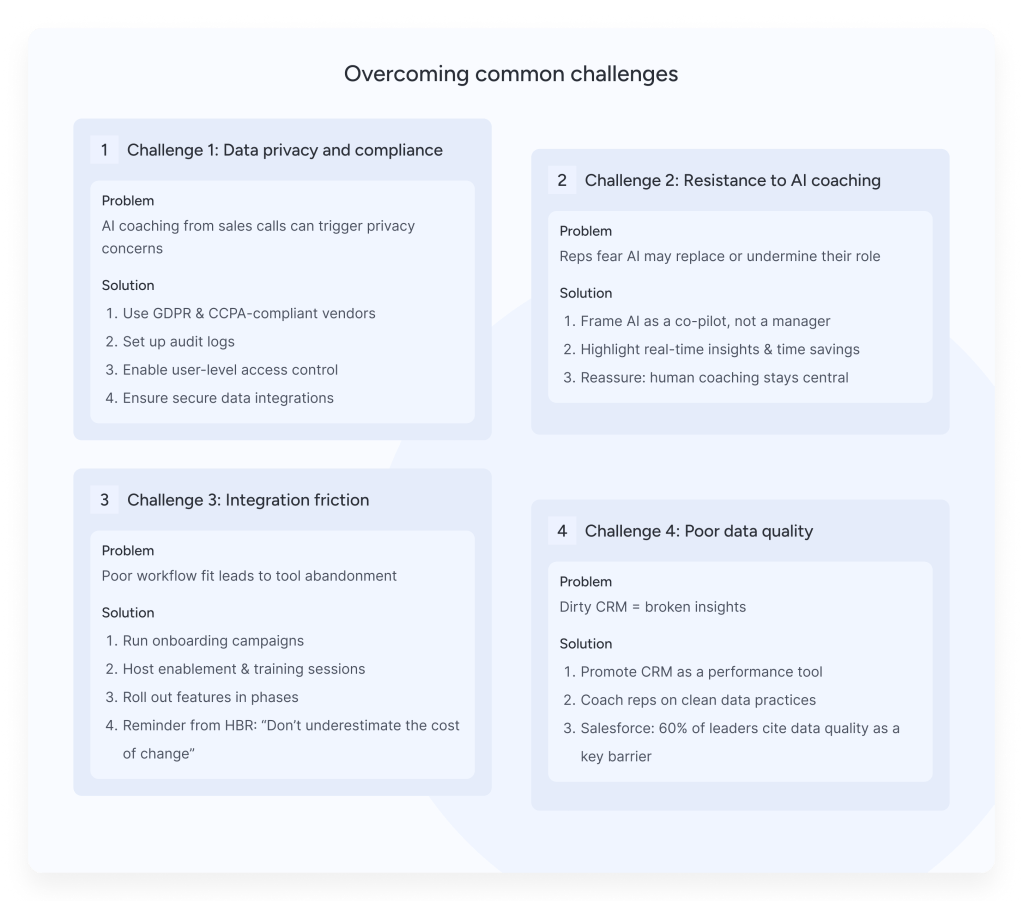
Coaching at scale, especially in modern AI-assisted environments, doesn’t come without friction. Here are the most common hurdles:
Challenge 1: Data privacy and compliance
Problem: Using contextual coaching powered by sales call data raises privacy concerns
Solution: Work with GDPR- and CCPA-compliant vendors. Ensure audit logs, user-level access control, and secure integrations
Challenge 2: Resistance to AI coaching
Problem: Reps may fear that AI coaching tools undermine their autonomy or job security
Solution: Present AI as a co-pilot that supports reps with real-time insights, pattern recognition, and time savings, while reinforcing that human coaching remains central
Challenge 3: Integration friction
Problem: New tools are abandoned if they don’t fit the existing workflow
Solution: Conduct onboarding campaigns, enablement sessions, and phased rollouts.
As HBR notes, “AI tools require major effort in integration, training, and maintenance — don’t underestimate the cost of change” [44]
Challenge 4: Poor data quality
Problem: AI and analytics models can’t deliver insights if CRM hygiene is weak
Solution: Reinforce a clean data culture. Train reps to treat the CRM as a performance tool, not a tracking system.
According to Salesforce, 60% of leaders cite data quality as a barrier [45]
Measuring sales coaching effectiveness
Sales coaching is no longer a “nice-to-have” in modern B2B SaaS organizations. It’s a performance accelerator. But to move beyond good intentions and intuition, sales leaders need to understand how to measure coaching effectiveness in tangible, revenue-driving terms. This section breaks down the core elements of evaluating coaching impact, from KPIs to dashboards to calculating ROI and closing the loop with ongoing optimization.
7.1 Coaching metrics that matter
The effectiveness of sales coaching hinges on tracking the right KPIs. These aren’t just about how many calls reps make, but about measuring real progress, performance growth, and skill acquisition. There are two primary categories of coaching metrics: outcome-based KPIs and activity-based KPIs.
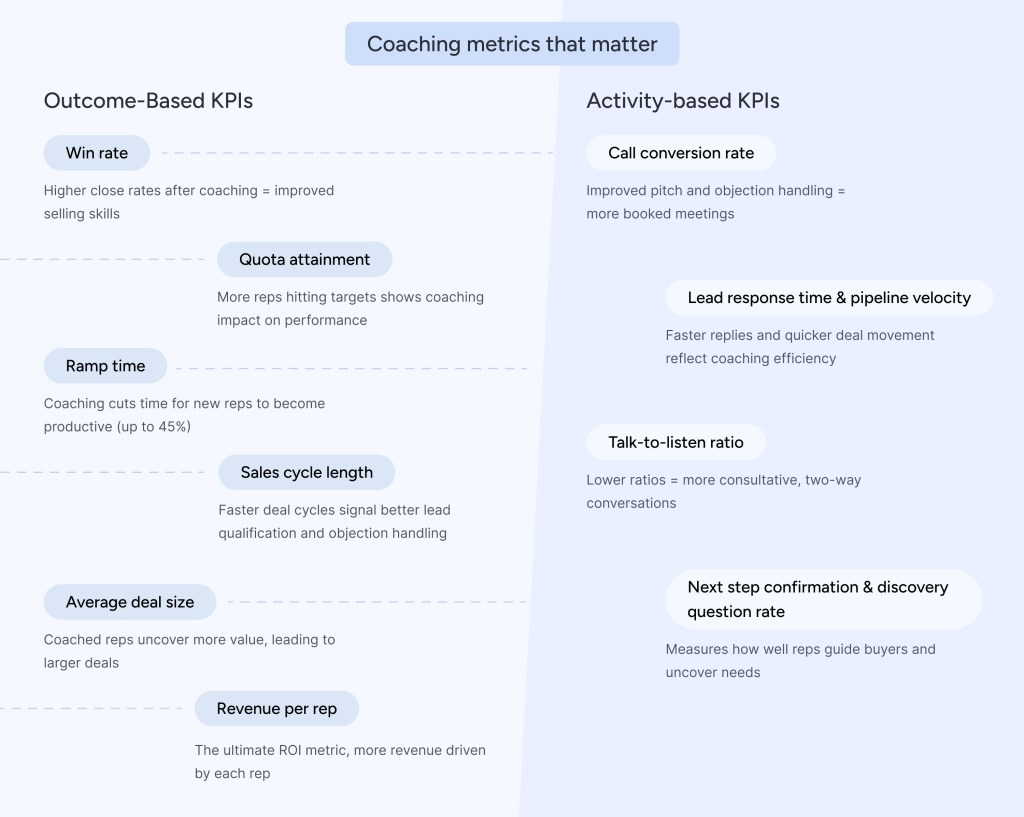
Outcome-based KPIs
- Win rate: This metric evaluates the success of coaching programs in helping reps close deals. A rising win rate after targeted coaching sessions on discovery or objection handling is a strong indicator of coaching effectiveness.
- Quota attainment: Post-coaching, tracking how many reps consistently meet or exceed their sales quotas shows the direct link between coaching and goal achievement.
- Ramp time: An efficient coaching program can significantly shorten the time it takes for new reps to become productive. According to ASLAN Training, structured coaching can reduce ramp time by up to 45% [46]
- Sales cycle length: Shorter sales cycles suggest that reps are qualifying leads more effectively, handling objections with confidence, and progressing deals faster, signs of successful coaching.
- Average deal size: With improved discovery and consultative selling skills, coached reps may be better at uncovering value and upselling, leading to higher deal values.
- Revenue per rep: This is a cumulative measure that reflects the true ROI of coaching. Increased revenue per rep is a key sign that your coaching program is driving long-term results
Activity-based KPIs
- Call conversion rate: Coaching focused on improving objection handling or pitch delivery often leads to more successful calls and meetings booked.
- Lead response time and pipeline velocity: These metrics reveal how efficiently reps are managing their pipeline post-coaching. Shorter response times and faster pipeline movement indicate increased rep agility and improved prioritization.
- Talk-to-listen ratio: This behavioral metric shows whether reps are engaging prospects in meaningful, two-way conversations. Lower ratios indicate a more consultative approach, an essential coaching goal.
- Next step confirmation rate and discovery question rate: These signal how well reps are guiding prospects through the buying journey and uncovering needs. Effective coaching should raise both of these figures.
Sales coaching boosts productivity by 88%, compared to standalone training at just 23% [46]
7.2 Building a coaching dashboard
A well-structured coaching dashboard transforms raw sales data into insights that drive performance improvement. It’s more than a collection of charts, it’s a strategic tool for visualizing skill gaps, tracking progress, and managing coaching impact.
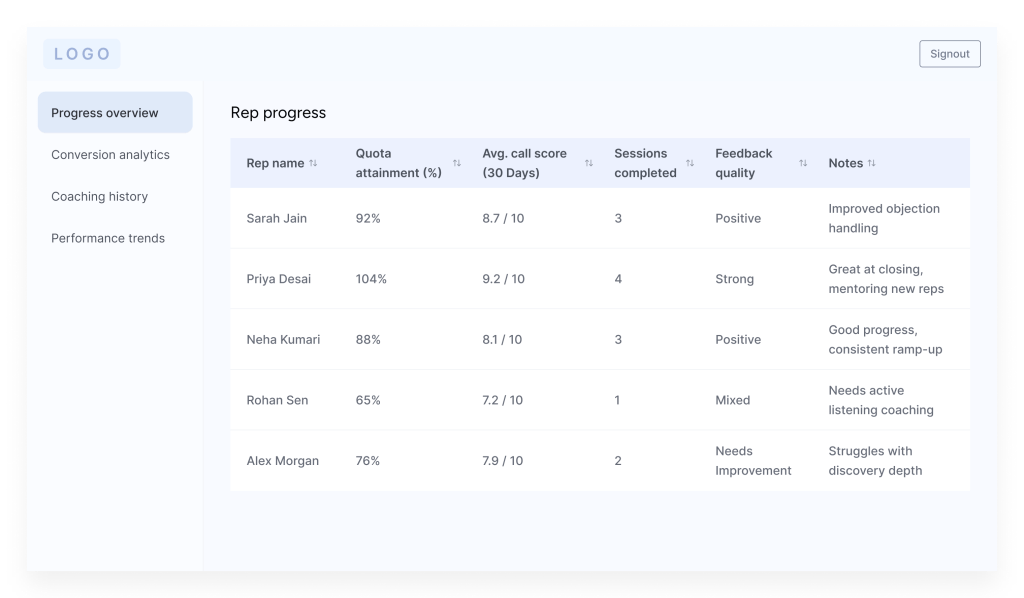
Key components of a sales coaching dashboard
- Rep progress tracking: Track trends in quota attainment, call scoring improvements, and manager feedback to understand individual development over time.
- Conversation analytics: Use conversation intelligence platforms to monitor sentiment, talk-to-listen ratios, and how reps handle common objections. This reveals the quality of conversations and coaching impact.
- Coaching session history: Record when coaching sessions took place and tie them to subsequent performance changes. This helps identify which coaching tactics are most effective.
- Team-wide performance trends: Identify systemic challenges, like frequent discovery issues or pipeline drop-offs at a particular stage. This allows you to scale successful coaching strategies across teams.
Despite 93% of sales leaders using dashboards, only 21% of CRM dashboards track the right metrics for predictable growth [47]
Best practices
- Focus on meaningful, performance-related indicators rather than vanity metrics.
- Use color-coded visuals and trend lines for instant comprehension.
- Embed call recordings, feedback notes, and scores to add context to quantitative data.
“Dashboards help turn 1:1s into performance-driving sessions by surfacing actionable feedback.” – Spinify
7.3 Calculating ROI of coaching programs
Sales leaders are increasingly asked to justify coaching budgets. The answer lies in demonstrating clear ROI through tangible business impact. Research by Allego shows coaching can generate a 353% return on every dollar invested [60]
ROI formula:
ROI (%) = [(Net Profit from Coaching – Coaching Cost) ÷ Coaching Cost] × 100
“Dashboards help turn 1:1s into performance-driving sessions by surfacing actionable feedback.” – Spinify
Steps to calculate ROI
1. Establish a baseline
Document performance metrics like win rate, average deal size, and ramp time before the coaching initiative begins.
2. Calculate costs:
Include all expenses, such as coaching hours, technology platforms, internal training time, and opportunity costs
3. Track post-coaching metrics:
Monitor performance over 30-, 60-, and 90-day intervals. Look for consistent upward trends.
4. Quantify the gains:
- Revenue impact: How much more revenue is generated post-coaching?
- Churn reduction: Has rep turnover dropped? A mid-sized tech firm reduced first-year attrition by 15% after incorporating coaching into onboarding [48]
7.4 Feedback loops and continuous optimization
Effective sales coaching doesn’t end after a dashboard review. The best programs include continuous feedback loops that fuel adaptation and growth.
How to close the coaching loop
- Review performance data regularly: Compare current KPI trends with previous coaching cycles to identify what’s working.
- Refine coaching content: Double down on formats that correlate with improved metrics, like objection handling modules that raise win rates.
- Collect rep feedback: Run surveys to find out which formats resonate best, peer roleplays, video reviews, or one-on-one sessions.
- Calibrate managers: Align coaches on how they evaluate reps to ensure fairness and consistency in feedback.
“Coaching is unlocking a person’s potential and helping them learn rather than teaching them.” – Timothy Gallwey [62]
94% of reps say coaching improved their performance, and 82% believe it is critical to their success [49].
Tools that support optimization
- Conversation intelligence platforms: Offer deep insights into real-time skills like objection handling and conversation flow.
- Call scoring automation: Automatically flag coaching opportunities and common performance issues.
- GROW coaching framework: Helps structure 1:1s by guiding reps through Goals, Reality, Options, and the Way Forward
Future of sales coaching: Trends, ethics, and innovation
Sales coaching is entering a transformative phase. Fueled by AI advancements and supported by stronger ethical frameworks, the future of sales development isn’t just about human intuition or digital automation, it’s about creating synergy between both. This section explores the latest innovations in AI-powered coaching, the emerging ethical boundaries, and the rise of human–AI partnerships that redefine what scalable, high-performance sales teams look like.
8.1 Emerging technologies: AI agents, chatbots, voice AI
AI agents automate high-frequency, repetitive tasks such as lead qualification, opportunity scoring, and pipeline forecasting. According to a Solda.ai study, AI agents can operate with 30 percent more cost efficiency than traditional sales call centers. In fintech use cases, these agents have also demonstrated 1.5× higher upsell conversion rates, showing their effectiveness in handling nuanced customer journeys [50]
Chatbots once relegated to FAQs, now initiate 26 percent of all sales transactions, supporting deeper lead engagement and even negotiating renewals. A Seismic report indicates organizations leveraging chatbots saw a 67 percent increase in overall sales conversions [51]
Voice AI is making significant strides in detecting customer emotions, tone shifts, and friction points during live calls. With VC funding surging from $315 million in 2022 to $2.1 billion in 2024, the sector is on a steep upward trajectory. Companies like ACI Corp have reported an increase in qualified leads from 45.5 percent to 64.1 percent after integrating voice AI into CRM workflows [52]
These innovations support:
- Personalized call script enhancements based on real-time analysis
- Sentiment tracking and tone calibration to improve rep empathy
- Real-time coaching nudges during live rep interactions to guide performance
By enabling real-time feedback and data-driven insights, these technologies are reshaping how reps learn and execute, turning every call into a coaching opportunity.
8.2 Generative AI for sales training and enablement content
Generative AI is no longer experimental. It is central to how modern organizations scale training and knowledge across teams without losing personalization.
AI avatars and adaptive videos: What previously took hours now takes minutes. AI avatars can compress complex two-hour onboarding sessions into 30-minute personalized video content. This significantly boosts learning retention and early-stage rep confidence [53]
Email, proposal, and call summary generation: Generative AI is automating the manual documentation process by instantly creating personalized emails, call recaps, and proposals, allowing reps to focus more on selling rather than writing [54]
AI-powered role-plays: Sales organizations are using dynamic Gen AI role-play simulations that adapt to each rep’s strengths and learning gaps, creating a tailored learning environment.
Research suggests that companies combining Gen AI and structured coaching saw 3.3× higher quota attainment and a 95 percent surge in rep productivity [55]
Implementation best practices:
- Mix AI-generated enablement modules with live coaching for human reinforcement
- Define outcome-based KPIs like average response time and call quality scores
- Continuously iterate content based on performance data and coaching feedback
This synergy helps managers scale upskilling programs while ensuring reps remain equipped with relevant, up-to-date resources
8.3 AI ethics and limitations in sales coaching
With great power comes great responsibility. As AI becomes deeply embedded in coaching and enablement, ethical oversight becomes non-negotiable.
Despite its benefits, only 25 percent of Americans trust conversational AI, and 60 percent of professionals prefer that AI be guided by human oversight [56]
Key ethical risks include:
- Data privacy violations: GDPR mandates strict privacy compliance, with violations leading to fines up to €20 million or 4 percent of global revenue [57]
- Bias in recommendations: AI, trained on historic sales data, can reinforce biases unless regularly audited and recalibrated.
- Lack of transparency: Opaque algorithms can make it difficult to justify coaching feedback.
Actionable safeguards:
- Run regular bias audits to detect and correct discriminatory behavior
- Involve stakeholders in AI decision-making processes
- Seek explicit rep consent before deploying coaching bots or feedback systems
- Implement clear audit trails for all AI-generated feedback
According to Salesforce, embedding continuous monitoring and human approval loops is critical to preserving ethical AI deployment in coaching [58]
Without these steps, AI-driven coaching could damage trust, hinder performance, and introduce compliance risks.
8.4 The human–AI synergy in sales development
The real breakthrough is not AI in isolation, but in its partnership with human expertise. When leveraged together, they can create a scalable and deeply effective coaching environment.
Organizations that embedded AI into structured coaching processes experienced a 56 percent reduction in sales cycle length and 3.3× increase in quota attainment [55]
Benefits of human–AI collaboration:
- AI flags performance gaps, but human managers provide emotional intelligence and strategic mentoring
- Systems track rep development while managers reinforce behaviors and values
- Teams using this model offer retraining for 32 percent more reps and define clear career paths for 25 percent more team members [55]
Yet, empathy, rapport building, and emotional support remain human strengths that no algorithm can replicate. According to the Coaching Federation, successful mentorship still hinges on authenticity and human connection [59]
A practical framework for integration:
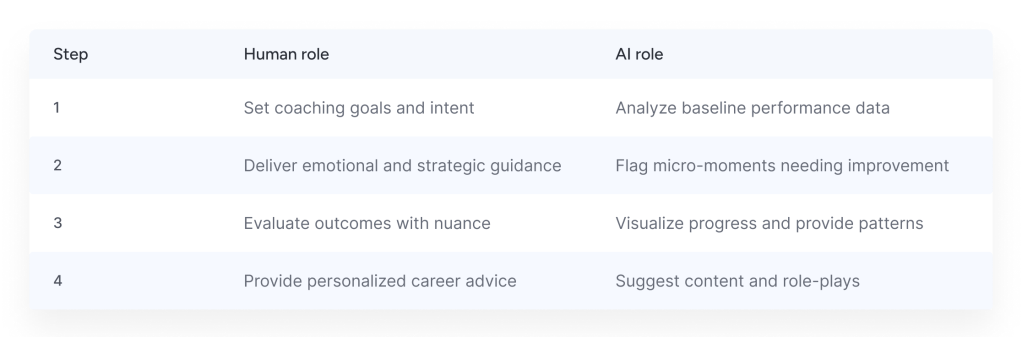
In a hybrid coaching model, humans and AI play complementary roles across the coaching journey. Humans lead by setting intent, offering emotional guidance, and evaluating outcomes with context. AI supports by analyzing performance data, spotting areas of improvement, and visualizing progress. While humans personalize growth paths and career advice, AI suggests relevant content and role-plays to reinforce development
This integrated model ensures coaching remains emotionally resonant while becoming more scalable and data-driven.
8.5 Why this matters for your organization
Revenue impact: AI-enabled companies experience 29 percent higher revenue growth and a 30 percent rise in rep engagement and productivity [60]
Case example: A SaaS organization reduced deal cycles by 22 percent and increased rep productivity by 30 percent after integrating AI-driven coaching insights into their sales workflows [19]
Future-proofing talent: With 53 percent of reps not feeling equipped to use AI safely and 47 percent fearing job displacement, building an AI-ready, ethics-driven culture is key to long-term success [56]
8.6 Takeaways for SDR, BDR, RevOps, and sales leaders
As AI continues to reshape the sales landscape, leaders across all roles must take intentional steps to embed it into workflows in a way that empowers their teams rather than displacing them.
- Integrate AI agents and real-time coaching frameworks: Embed AI within your CRM and call workflows to automate repetitive tasks, flag coaching moments, and deliver real-time prompts. This allows reps to learn and improve in the flow of work, which is shown to increase call conversion rates by up to 26 percent [51]
- Use generative AI for scalable, personalized enablement: Leverage generative AI to create adaptive onboarding programs, role-specific training modules, and sales playbooks. Organizations doing this have seen a 95 percent boost in rep productivity and 3.3× higher quota attainment [55]
- Implement ethical safeguards: Ensure transparency and data protection through practices like bias audits, informed consent, and continuous monitoring. GDPR violations can result in penalties of up to €20 million, making ethical deployment not just responsible, but essential [57]
- Balance automation with human mentorship: AI can guide reps with insights, but trust and engagement still rely on human connection. Human-led mentoring supports the emotional side of coaching, something technology cannot replicate. According to the Coaching Federation, authentic mentorship remains a critical success factor [59]
- Track key performance indicators: Monitor and optimize based on KPIs such as sales cycle length, rep engagement, win rates, and forecast accuracy. Sales teams using AI-informed coaching saw deal cycles reduce by 22 percent and overall productivity increase by 30 percent [19]
Ultimately, AI is not here to take over the coaching role. It is here to partner with managers, offering timely guidance at scale while allowing leaders to focus on strategic development and human-centric leadership
Case studies & success stories
AI coaching has rapidly evolved from a theoretical advantage into a real-world performance multiplier for B2B sales teams. From SDRs to enterprise account executives, AI-enhanced coaching tools are not only improving skills development but also delivering measurable ROI across revenue metrics, ramp time, and rep productivity. This section explores how high-performing organizations are implementing AI coaching, the results they’re seeing, and what sales leaders can learn from these real-world applications.
9.1 AI coaching in action: Real company examples
Sales leaders are no longer asking if AI coaching works, they’re asking how fast they can scale it. Across industries and sales functions, AI coaching platforms have transformed the way sales teams are trained, measured, and optimized. Below are key use cases that show AI coaching in action:
- Zoom and second nature: Zoom implemented Second Nature’s AI-driven coaching platform to simulate real buyer conversations. SDRs were able to practice pitch delivery in real time, resulting in 100% voluntary rep engagement and significantly increased practice frequency [61]
- OpenLending and Quantified.ai: Fintech company OpenLending deployed Quantified’s AI role-play simulator to assist reps in managing tough conversations. Within just four months, the company recorded a 13.97% uplift in opportunity progression, evidence of how targeted skills training can drive real pipeline results [62]
- Check point software: Check Point Software introduced AI-powered pitch training to thousands of reps worldwide. The rollout helped enhance pitch consistency and engagement, freeing managers to focus on high-impact mentoring while AI handled foundational skill reinforcement [61]
- tbi bank and AI agent Victoria: tbi bank utilized its AI agent “Victoria” to manage 10,000 leads per day. The AI solution contributed $1 million in volume and managed 24 simultaneous sales lines, delivering near-human accuracy and high efficiency [63]
- Highspot with Alight and Aetna: Highspot helped enterprise teams such as Alight and Aetna transform their sales content delivery workflows. Alight experienced a 9% shorter sales cycle and 11% increase in deal size. Aetna improved content governance by 62% and content findability by 83% [64]
These examples show that AI coaching is not a one-size-fits-all solution. Instead, it adapts seamlessly to different team sizes, sales models, and industries.
9.2 Measurable results: Before vs. after AI coaching
AI coaching delivers real, quantifiable performance gains. Below are clear before-and-after comparisons from B2B SaaS organizations:
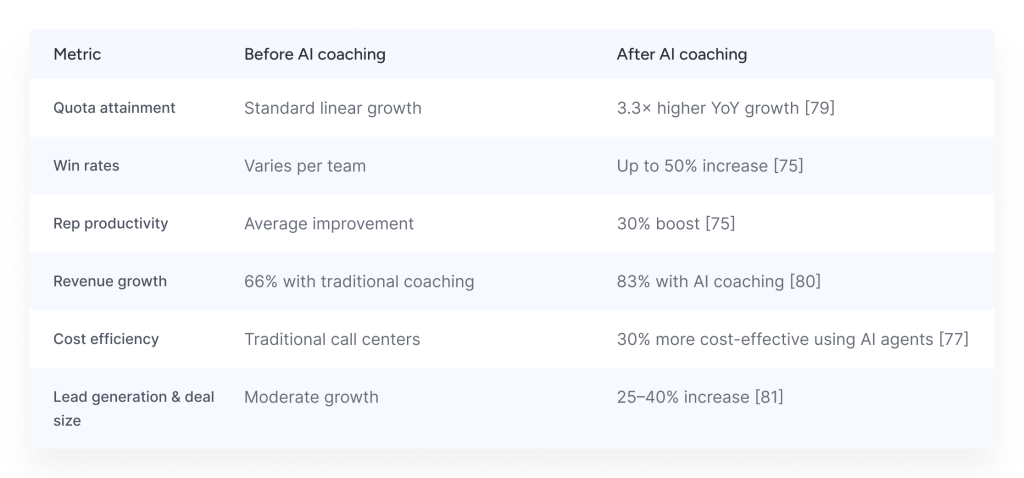
AI coaching has shown measurable improvements across key sales metrics. Quota attainment jumped to 3.3× higher year-over-year growth compared to the standard linear trend. Win rates, previously varying across teams, increased by up to 50%. Rep productivity saw a 30% boost post-AI implementation, while revenue growth improved from 66% under traditional coaching to 83% with AI. Cost efficiency also improved, with AI agents proving 30% more cost-effective than traditional call centers. Lastly, lead generation and deal size experienced a 25–40% increase, outperforming the previous moderate growth.
These metrics validate the performance impact of AI coaching on quota achievement, productivity, and bottom-line revenue.
9.3 Lessons learned from top-performing teams
The most successful AI coaching rollouts go beyond just adopting technology. They represent strategic, cultural, and operational shifts. Here’s what leaders have learned:
- AI is a force multiplier, not a replacement: One sales leader managing a 1,000-SDR team shared, “Human-only coaching doesn’t scale linearly. I needed a force multiplier.” AI expands a manager’s coaching reach while maintaining quality across the team [61]
- Competitive advantage lies in AI utilization: Ryan Vaillancourt, VP of Sales at Revenue.io, said: “You won’t lose your job to AI, but to someone using AI better.” Winning teams integrate AI deeply into coaching operations [65]
- Real-time feedback bridges the gaps: Managers can review only 1% of calls. Real-time, unbiased insights from AI fill this gap and empower reps with timely coaching [66]
- Structured rollout matters: High-impact rollouts follow a four-step framework, identify data gaps, involve sellers early, break silos, and train both reps and managers comprehensively [67]
- Coaching evolves from art to science: AI transforms coaching from gut-feel driven to data-driven. It ensures consistent, actionable, and scalable guidance across global teams [64]
9.4 Industry-specific applications: SaaS, B2B, inside sales
AI coaching platforms have the flexibility to support various sales models, tailored to their workflows and priorities:
SaaS sales teams
- A SaaS company used Second Nature’s AI to simulate product demos. Reps refined objection handling before engaging prospects, improving confidence and demo outcomes [61]
- One B2B SaaS team working with Spiky.ai saw deal cycles shorten by 22% and a 30% improvement in rep productivity, showing AI’s direct impact on velocity [68]
- Teams using this model offer retraining for 32 percent more reps and define clear career paths for 25 percent more team members [55]
B2B enterprise sales
- Enterprise sales teams used Gong AI to simulate objection handling and complex negotiations using real calls. This helped reps gain real-world scenario experience and improve under pressure [61]
Inside sales organizations
- Tools like Nooks deliver real-time coaching during live calls. By guiding reps on language and tone, they improve call outcomes instantly [69]
- Chorus.ai helps tech startups analyze post-call behavior and generate manager-ready coaching packets, saving time and improving feedback quality [61]
Sales coaching certifications & career development
Sales coaching is no longer a “nice to have” for modern B2B SaaS companies, it is a proven driver of performance, revenue, and retention. As competition grows and buyer expectations evolve, the need for structured, impactful coaching becomes non-negotiable. According to Demodesk, companies with effective coaching programs see 28% higher win rates, and GrowthMole reports 17% higher revenue growth among organizations investing in structured coaching [70]
10.1 Building internal coaching capabilities
While external certifications offer structure, long-term scalability comes from a strong internal coaching culture. Sales enablement leaders and managers must empower team leads with frameworks and feedback tools that drive behavioral change and measurable results.
Core elements of internal coaching programs:
- Structured coaching frameworks: Use models like GROW (Goal, Reality, Options, Will) to standardize coaching conversations and set clear outcomes.
- Sales methodology integration: Tie coaching sessions to real-world scenarios by embedding systems like MEDDIC, Challenger Sale, or SPIN Selling [71]
- Tech-enabled coaching: Platforms offering real-time feedback, role-plays, and performance analytics overcome time constraints and drive coaching consistency.
- Continuous feedback loops: Microlearning, regular manager check-ins, and peer reviews reinforce new habits. Allego reports teams with ongoing coaching ramp 4.9× faster and have 3.5× more prepared reps [72]
10.2 Career pathways in sales coaching and enablement
Sales coaching and enablement have evolved from operational support functions to strategic leadership roles. These positions offer measurable impact on team performance, go-to-market alignment, and organizational growth.
Typical career path progression:
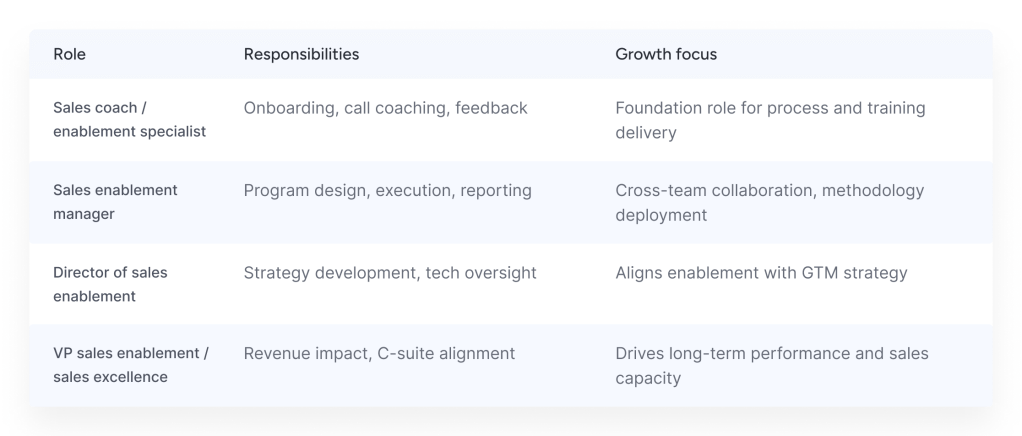
Sales enablement careers typically start with Sales Coaches or Enablement Specialists, who focus on onboarding, coaching, and laying the foundation for training. As Enablement Managers, professionals drive program execution and cross-team collaboration. Progressing to Director of Sales Enablement, the focus shifts to strategy and aligning initiatives with go-to-market goals. At the top, VPs of Sales Enablement lead revenue-impact initiatives and align enablement with long-term business performance.
Userpilot notes growing influence and compensation for these roles, with many leaders reporting directly to the CRO or COO [73]
10.3 Continuous learning & leadership upskilling
Top sales leaders prioritize ongoing growth. With rapid market shifts and rising buyer sophistication, upskilling is the key to staying relevant and effective.
Methods to stay ahead:
- Online courses & certifications: Coursera, HubSpot Academy, and eCornell provide flexible education for working professionals
- Mentorship & peer learning: Weekly learning circles and mentorship create accountability and drive shared learning.
- Workshops & coaching labs: Scenario-based sessions for objection handling, role-play, and forecasting skills.
- Industry conferences: Events like SaaStr, SaaStock, and Forrester’s B2B Summit offer deep dives into strategic selling, enablement, and leadership [74]
- Internal leadership tracks: Companies increasingly offer structured leadership development via shadowing, coaching certifications, and feedback-rich environments.
RAIN Group emphasizes that “effective sales coaching is a critical differentiator for top-performing sales organizations.” Supporting this, Spinify found that coaching lifts quota attainment by 25–35%, and Forecastio reports a 20–30% reduction in sales cycle length [75] [76]
Final thoughts: Transforming sales coaching into a scalable growth engine
Sales coaching is no longer a support function. It is a strategic advantage for modern B2B SaaS organizations. From SDR managers and RevOps teams to Sales VPs, leaders now recognize that sustainable revenue growth stems from coaching that is structured, data-driven, and embedded into the daily rhythm of sales execution.
The foundation lies in clear coaching principles and behavior-based development. Once established, AI-driven enablement unlocks scale and precision. Tools like real-time feedback, call analysis, and contextual guidance ensure coaching doesn’t stop after onboarding, it evolves with every deal, rep, and pipeline stage.
By blending traditional coaching techniques with AI-powered insights, teams can boost performance without sacrificing personalization. Role-based strategies, tailored frameworks, and measurable KPIs ensure that coaching meets the needs of every persona, whether it’s ramping a new SDR or elevating a front-line manager.
Future-ready organizations also view coaching as a career path. Certifications, mentorship, and continuous learning tracks don’t just upskill teams, they shape tomorrow’s leaders.
To lead in today’s fast-paced sales environment, it’s no longer enough to train. You must coach with intent, measure with rigor, and scale with technology.
The playbook is here. The time is now.
Sources:
[1] Qwilr sales enablement report 2023: https://qwilr.com/blog/sales-enablement-report/
[2] SBI growth study: https://sbigrowth.com/insights/sales-coaching/
[3] Stronger Sales Teams: https://strongersalesteams.com/coaching-methodologies/grow-model/
[4] Revegy: https://www.revegy.com/blog/clear-coaching-model/
[5] Selling Sherpa: https://sellingsherpa.com/2023/10/12/how-to-coach-sales-teams/
[6] Insight7: https://insight7.io/blog/peer-coaching-in-sales-teams/
[7] Nooks: https://www.nooks.in/resources/ai-powered-sales
[8] The People Space: https://www.thepeoplespace.com/ideas/articles/human-touch-ai-coaching
[9] Retorio: https://retorio.com/blog/ai-coaching-sales-performance
[10] Demodesk: https://demodesk.com/blog/ai-in-sales-coaching
[11] TLDV: https://www.tldv.io/blog/how-to-coach-sales-reps/
[12] Seismic: https://seismic.com/blog/sales-coaching-techniques/
[13] Brookgroup: https://brooksgroup.com/sales-training-blog/sales-coaching-group-sessions/
[14] Salesloft: https://salesloft.com/resources/blog/sales-coaching/
[15] Mural: https://www.mural.co/blog/pipeline-reviews
[16] Hygen: https://www.heygen.com/blog/sales-objection-handling-tips
[17] Convin: https://convin.ai/blog/how-to-handle-sales-objections
[18] Highspot: https://www.highspot.com/blog/ai-in-sales-enablement/
[19] Spiky: https://www.spiky.ai/blog/ai-in-sales-coaching
[20] Salesloft: https://salesloft.com/resources/blog/ai-sales-conversations
[21] Mindtickle: https://www.mindtickle.com/blog/ai-for-sales-coaching/
[22] Salesforce: https://www.salesforce.com/blog/ai-and-human-coaching/
[23] Pipedrive: https://www.pipedrive.com/en/blog/sales-playbooks
[24] Showpad: https://www.showpad.com/blog/sales-onboarding-playbooks/
[25] Training Industry: https://trainingindustry.com/articles/sales/the-future-of-sales-coaching/
[26] Factor 8: https://factor8.com/success-stories/sdr-coaching-impact/
[27] Supademo: https://supademo.com/blog/building-feedback-loops-for-sales/
[28] Trellus: https://www.trellus.ai/sales-coaching-benefits/
[29] Qwilr: https://qwilr.com/blog/sales-training-vs-coaching/
[30] RAIN Group: https://www.rainsalestraining.com/blog/sales-manager-coaching-guide
[31] Klaviyo: https://www.klaviyo.com/blog/remote-sales-coaching-best-practices
[32] Jiminny: https://jiminny.com/blog/real-time-feedback-impact
[33] Insight7: https://insight7.io/blog/sales-coaching-crm
[34] Revenue.io: https://www.revenue.io/blog/sales-coaching-scorecards
[35] Improvado: https://www.improvado.io/blog/sales-coaching-metrics
[36] Seismic: https://seismic.com/resources/blog/timely-sales-coaching
[37] Market Research Future: https://www.marketresearchfuture.com/reports/conversation-intelligence-market-14135
[38] Mihup: https://mihup.com/blog/speech-analytics-impact
[39] Unboxed Technology: https://unboxedtechnology.com/resources/ai-sales-roleplay-benefits
[40] Demodesk: https://demodesk.com/blog/crm-ai-integration-benefits
[41] Seismic: https://seismic.com/resources/blog/unified-sales-platforms
[42] Highspot: https://www.highspot.com/blog/sales-coaching-productivity-and-performance/
[43] LinkedIn state of sales report: https://business.linkedin.com/sales-solutions/state-of-sales
[44] HBR on AI integration: https://hbr.org/2023/02/why-ai-tools-fail
[45] Salesforce: https://www.salesforce.com/blog/data-quality-sales-leaders/
[46] Qwilr: https://qwilr.com/blog/impact-of-coaching-vs-training/
[47] Forecastable: https://www.forecastable.com/blog/sales-dashboard-metrics/
[48] Denver Business Coach: https://www.denverbusinesscoach.com/importance-of-sales-coaching/
[49] Federico Presicci: https://www.linkedin.com/pulse/sales-coaching-impact-performance-presicci/
[50] Solda.ai: https://solda.ai/resources/ai-in-sales
[51] Seismic: https://seismic.com/company/newsroom/chatbots-sales-increase/
[52] Medium – IPG Media Lab: https://ipglab.com/voice-ai-funding-case-study/
[53] Salesforce: https://salesforce.com/blog/ai-onboarding/
[54] Spekit: https://www.spekit.com/blog/ai-sales-training-tools/
[55] GlobeNewswire: https://www.globenewswire.com/news-release/sales-ai-impact/
[56] Kanerika: https://kanerika.com/blog/trust-in-ai-and-ethics/
[57] Overloop: https://overloop.com/blog/gdpr-for-sales/
[58] Salestechstar: https://salestechstar.com/ai-in-sales-coaching/
[59] Coaching Federation: https://coachingfederation.org/blog/human-touch-in-ai-coaching
[60] Forbes: https://www.forbes.com/sites/forbestechcouncil/2024/ai-in-sales-impact/
[61] Graph8: https://graph8.ai/sales-ai-coaching
[62] Quantified.ai - https://www.quantified.ai/resources
[63] Solda.ai: https://www.solda.ai/blog/tbi-bank-uses-ai-agent-to-drive-1m-volume
[64] Highspot: https://www.highspot.com/resources/aetna-alight-sales-enablement-case-study/
[65] Avoma: https://www.avoma.com/blog/ai-coaching-benefits
[66] BTS: https://www.bts.com/insights/sales-coaching-ai
[67] SellMeThisPen.ai: https://sellmethispen.ai/resources/ai-sales-coaching-playbook
[68] Spiky.ai: https://spiky.ai/blog/sales-coaching-case-study
[69] Nooks: https://www.nooks.in/blog/real-time-sales-coaching
[70] Growthmole: https://growthmole.com/sales-coaching-stats/
[71] Gartner: https://www.gartner.com/en/sales/insights/sales-methodologies
[72] Allego: https://www.allego.com/resources/sales-coaching-roi/
[73] User Pilot: https://userpilot.com/blog/sales-enablement-career-paths/
[74] Digital Defynd: https://digitaldefynd.com/best-sales-conferences/
[75] Spinnify: https://www.spinnify.com/blog/how-sales-coaching-drives-quota-attainment
[76] Forecastio: https://forecastio.com/blog/sales-cycle-metrics-and-reduction-insights/ Outscale.ai